Every smartphone user knows the frustration: you plug in your device with the original fast charger, the cable you have always used, and yet the battery fills at a crawl. The immediate instinct is to blame the charger, the cable, or even the phone battery itself. But in many cases, the culprit is not a hardware failure at all. It is a quiet software feature designed to protect the very component you are worried about. Adaptive Charging, a battery management system now common on Android devices, deliberately slows down charging to extend the long-term health of your lithium-ion battery. The feature is both helpful and widely misunderstood, and understanding how it works can save you from unnecessary frustration.
The Hidden Software Behind Slow Charging
Modern Android smartphones ship with intelligent battery management systems that operate behind the scenes. One of the most impactful of these is Adaptive Charging, a feature that studies your daily routines and adjusts charging behavior accordingly. If the system detects that you typically plug in your phone before bed and unplug it in the morning, it will intentionally pause charging at around 80 percent for several hours. The final 20 percent is delivered shortly before your alarm is set to go off. This strategy is not a bug or a sign of a failing component. It is a deliberate intervention aimed at reducing battery stress. Lithium-ion batteries degrade fastest when they are held at 100 percent charge for extended periods, especially under heat. By limiting the time the battery spends at full capacity, Adaptive Charging slows the chemical aging process inside the cells. For users who are unaware of this feature, the sudden slowdown feels like a technical problem. In reality, the phone is functioning exactly as its engineers intended.
It is a glimpse into a future where devices manage their own health as proactively as they manage connectivity and performance.
How Adaptive Charging Reshapes the Charging Curve
The mechanism behind Adaptive Charging is surprisingly straightforward. Instead of allowing the phone to charge at full speed continuously, the software learns your habits over time. It identifies patterns such as when you usually plug in and when you typically disconnect. Once it has built a reliable model of your behavior, it adjusts the charging curve to minimize the time the battery remains at or near 100 percent. For example, if you plug in at 11 p.m. and wake up at 7 a.m., the phone may charge rapidly to 80 percent, then pause or slow dramatically for several hours. Only in the early morning hours does it resume charging to complete the remaining 20 percent. This approach directly addresses one of the primary causes of battery degradation: prolonged exposure to high voltage and high temperature. By reducing the dwell time at full charge, Adaptive Charging can meaningfully extend the usable lifespan of the battery. The trade-off is that users who check their phone midway through the night will see a stalled charging indicator and may assume something is wrong.
The Science of Battery Preservation: Heat and Chemical Aging
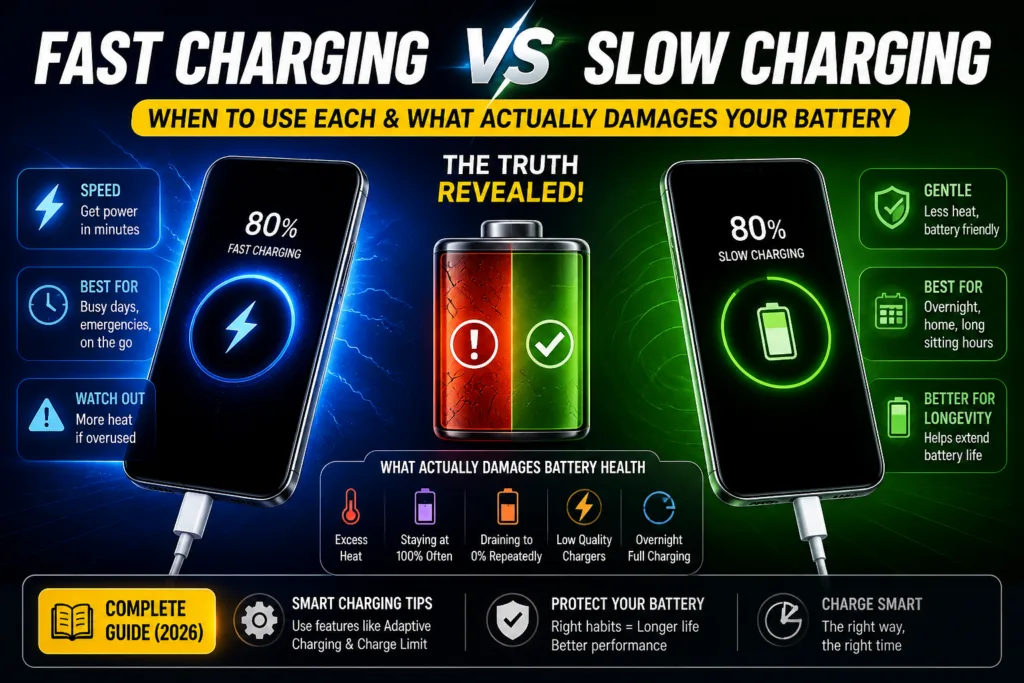
To understand why Adaptive Charging exists, it helps to look at the chemistry inside a lithium-ion battery. Every charging cycle causes a small amount of irreversible wear. Two factors accelerate this wear significantly: heat and high state of charge. When a battery charges rapidly, it generates heat. When it stays at 100 percent for hours, the internal voltage remains elevated, which promotes side reactions that consume lithium ions and degrade the electrolyte. Over time, these processes reduce the battery total capacity. Modern fast charging technologies can replenish a battery from near empty to full in under an hour, but they also produce more heat than slower charging methods. Adaptive Charging mitigates this by limiting power delivery during long, uninterrupted charging sessions. The phone essentially chooses to charge more slowly when it knows you have plenty of time, keeping internal temperatures lower and reducing chemical stress. This is not a trivial optimization. Battery chemistry remains one of the weakest links in consumer electronics, and manufacturers are increasingly relying on software to compensate for the physical limitations of current cell technology.
Fast Charging Versus Battery Health: The Fundamental Trade-Off
The rise of ultraaa-fast charging has created a fundamental tension in smartphone design. Devices now support charging speeds exceeding 100 watts, which can fill a battery in minutes rather than hours. But speed comes at a cost. Higher power levels generate more heat, and heat is one of the biggest enemies of battery longevity. Without intelligent controls, repeated fast charging could degrade a battery noticeably within the first year of use. Adaptive Charging is one of the tools manufacturers use to navigate this trade-off. It allows the phone to charge quickly when you need it most such as during a daytime top-up before heading out but slows down during overnight or extended sessions when speed is less critical. This context-aware approach balances immediate convenience with long-term durability. Users who frequently need rapid charging throughout the day may find the feature frustrating, but disabling it comes with a real consequence: the battery will likely wear out faster over months and years of use.

Regaining Control: How to Disable Adaptive Charging
For users who prioritize charging speed above all else, disabling Adaptive Charging is straightforward. On most Android devices, the setting is located under Settings, then Battery, and then Adaptive Charging. Some manufacturers place it under Settings, Battery Health, and Charging Optimization. Toggling the feature off typically restores full charging speed immediately, especially during daytime sessions. This can be a practical choice for people who need a quick boost before leaving the house or who do not follow a regular charging routine. However, it is important to understand the trade-off. With Adaptive Charging disabled, the phone will charge at full speed whenever it is plugged in, and it will hold the battery at 100 percent for as long as the cable remains connected. Over time, this pattern accelerates capacity loss. Users who disable the feature for convenience should be aware that they are trading long-term battery health for immediate speed. For many, that is a reasonable choice. But it should be an informed one.
Why Manufacturers Choose Battery Health Over Speed
Smartphone companies have a strong incentive to prioritize battery health. Consumers now expect their devices to last four to six years of daily use, a dramatic shift from the upgrade cycle of a decade ago. At the same time, users demand fast charging and all-day battery life. These expectations are in direct conflict, and manufacturers are using software to bridge the gap. By enabling Adaptive Charging by default, companies reduce the risk of premature battery degradation that could lead to early replacement or customer dissatisfaction. The strategy also reflects a broader industry trend toward sustainability. Longer-lasting batteries mean fewer devices end up in landfills, and manufacturers face growing pressure to reduce electronic waste. Some Android brands are already testing more advanced systems, including Priority Charging technology that dynamically adjusts charging speed based on user schedules, ambient temperature, and battery condition. These systems represent the next generation of battery management, where the phone not only learns your habits but also adapts in real time to environmental factors.
The Growing Consumer Demand for Battery Longevity
Battery performance has quietly become one of the most important factors in smartphone satisfaction. Consumers are no longer willing to accept devices that lose significant capacity after a year or two. This shift in expectations has forced manufacturers to invest heavily in battery health features. Adaptive Charging is part of a larger movement where software increasingly controls hardware behavior to preserve the user experience over time. The trend also mirrors changing charging habits. Overnight charging has become extremely common, with many users plugging in their phones before sleep and leaving them connected for hours after reaching full capacity. Without management systems, this habit would accelerate battery wear considerably. Adaptive Charging directly addresses this scenario by ensuring the battery spends minimal time at 100 percent. Yet the feature also highlights a persistent conflict: users want their phones to last for years, but they also want them to charge instantly. Balancing these competing priorities will continue to shape smartphone development for the foreseeable future.
The Transparency Gap: When Good Features Create Confusion
One of the most significant problems with Adaptive Charging is not the technology itself but the lack of communication around it. Many smartphone owners have no idea the feature exists. When charging speeds suddenly drop, users naturally assume the charger is broken, the cable is faulty, or the battery is failing. This creates a gap between what the phone is doing and what the user understands. Manufacturers enable battery optimization features silently during initial setup or through system updates, often without clearly explaining the side effects. As a result, users waste time troubleshooting hardware that is functioning perfectly. The psychological impact is also notable. Consumers associate fast charging with premium quality, and any slowdown feels like a downgrade. Even when the phone is protecting the battery, the experience feels inconsistent and frustrating. Closing this transparency gap will become increasingly important as smartphones become more autonomous. Users deserve to know why their device is behaving a certain way, especially when that behavior affects daily usability.
The Road Ahead: Smarter, More Adaptive Charging Systems
The future of smartphone charging is likely to be even more intelligent and context-aware. Instead of a simple on-off toggle for Adaptive Charging, future systems may adjust charging behavior dynamically based on a wide range of inputs, including work schedules, travel plans, gaming sessions, ambient temperature, and even the season of the year. These systems could operate as fully predictive AI-managed ecosystems that require little to no manual intervention. At the same time, battery health transparency is expected to improve. Users will likely demand clearer explanations about why their phones charge slowly under certain conditions, and manufacturers will need to provide those explanations in a way that is easy to understand. The rise of on-device AI processing, which increases both heat generation and power consumption, will make intelligent charging systems even more essential. Adaptive Charging is not a passing feature. It is a glimpse into a future where devices manage their own health as proactively as they manage connectivity and performance. Understanding it today helps users make better choices about how they treat the most critical component in their pocket.
- What is Adaptive Charging?Adaptive Charging is a battery management system that slows fast charging to protect battery health.
- How does Adaptive Charging work?It learns your daily routines and pauses charging at 80% until shortly before you wake up.
- Why does Adaptive Charging slow charging?To reduce battery stress by limiting time at full charge, which slows chemical aging.