Artificial intelligence has moved from boardroom strategy and Capitol Hill hearing rooms to the center of ordinary political campaigns. A review of more than 1,200 websites maintained by active congressional and gubernatorial candidates finds that AI now appears in nearly 40 percent of all House, Senate, and governor’s races in the 2026 midterm cycle. This is not a fringe concern or a tech-industry talking point; it is a bread-and-butter issue shaped by data center construction, electricity bills, and the fear of job displacement.
AI Now Appears in Nearly 40 Percent of Major Races
The scale of the shift is hard to overstate. In a political environment where campaign websites are usually built around tax policy, health care, and crime, AI has muscled its way into the upper tier of issues that candidates believe will move voters. The analysis covered more than 1,200 websites from active candidates running for the House, the Senate, and governor. The result shows that AI is no longer a niche policy topic confined to Silicon Valley districts or technology committees.
This is the first election cycle in which AI has registered as a mainstream campaign issue. In previous midterms, technology debates were often about platform speech, encryption, privacy, or antitrust enforcement. Those matters were real, but they rarely entered local races unless a major company was headquartered nearby. The 2026 race is different because AI now has a physical footprint in nearly every part of the country. Data centers are being built in rural counties, industrial parks, and suburban exurbs. Their demands on the local power grid, water supply, and land use have made an abstract national story into a tangible local grievance.
The political effect is visible across the country. Candidates are not simply adding a standard paragraph about innovation to their websites. They are delivering specific promises about siting decisions, utility rate protections, and moratoriums on new construction. The depth of the conversation suggests that voters are bringing these concerns to town halls and doorsteps, not waiting for candidates to raise them first.
Data Centers Turn AI Into a Local Issue
The single largest driver of AI politics is the data center. These massive facilities underpin everything from cloud computing to model training and inference, but their public profile has been shaped by the consequences they impose on host communities. In race after race, the dominant concerns are concrete and local: higher electricity costs, intense water consumption, and the loss or commitment of large parcels of land.

Electricity rates are the most volatile issue. Data centers consume enormous amounts of power, often in communities where the grid was not designed for industrial-scale loads. Utility companies may respond by raising rates for all customers, building new transmission lines, or extending long-term agreements that shift costs. For residents already dealing with inflation, the sight of a new data center can quickly become a symbol of rising bills rather than economic opportunity.
Water use is similarly grounded. Data center cooling systems can draw millions of gallons of water per day, putting pressure on municipal supplies in drought-prone regions. In areas where agriculture and residential use are already contested, the arrival of a data center can reignite old conflicts over who gets priority access to a finite resource. That is precisely the kind of issue that local reporters cover, local activist groups organize around, and local candidates cannot ignore.
Land use is the third pillar of the data center debate. Large facilities require hundreds of acres, often with incentives attached. Counties and towns have to weigh tax revenue against the loss of open space, the strain on roads and emergency services, and the character of their communities. Candidates are discovering that taking a position on a particular project can define a campaign. A single proposed facility can produce a wave of advocacy, opposition, and litigation that lasts for months.
How did data centers become political flashpoints?
Data centers became political flashpoints because they bring the consequences of AI into specific cities and counties. Instead of debating artificial intelligence as a vague concept, voters see construction cranes, hear about utility rate increases, read about water usage, and argue over zoning decisions. Those tangible effects generate intense local engagement, which in turn pushes candidates to take clear positions.
Democrats and Republicans Are Campaigning on Different AI Fears
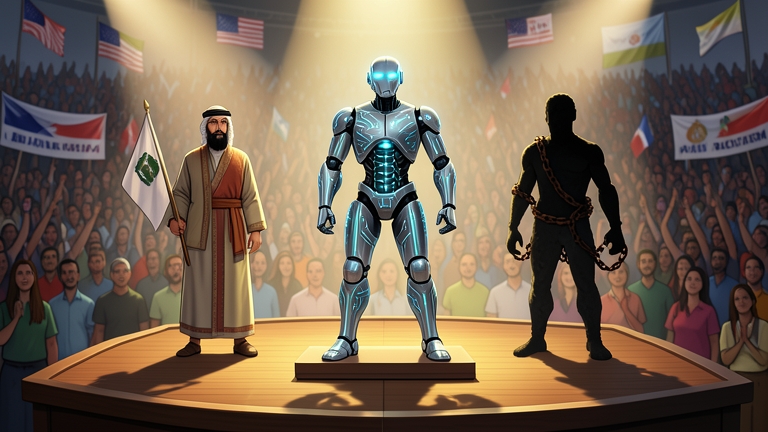
The partisan split over AI is not about whether AI matters, but about which dangers should dominate public policy. The analysis found that Democratic candidates reference AI roughly twice as often as their Republican counterparts. Their message centers on risk, regulation, and the protection of children. This pattern aligns with a broader Democratic emphasis on consumer protection, algorithmic accountability, and safety standards.
Democratic candidates are more likely to discuss harms such as deepfakes, online exploitation, biased decision-making, and the need for federal oversight. The concern about child safety is particularly potent because it connects AI to a universal worry that cuts across demographic lines. Platforms that deploy generative tools, chatbots, and synthetic media are being judged by whether they can keep minors safe from harmful content and predatory behavior. Candidates who can speak credibly about these issues have found an issue that feels urgent and present.
Republican candidates take a different path. Their AI messaging leans heavily on national security and strategic competition with China. The framing is less about what AI might do to individuals and more about what AI might mean for American power. In this telling, AI is a geopolitical contest, and the United States cannot afford to fall behind. That argument is sharpened by export controls, semiconductor policy, and fears about Chinese advances in model development and military application.
This divergence matters for the legislative agenda after Election Day. A Congress in which both parties agree that AI is important but disagree on why it matters is likely to produce fragmented policy. The points of common ground, such as investment in research and infrastructure, may advance. The harder questions, around civil liberties, content moderation, and liability, are likely to stall.
AI Has Superseded Older Cultural Flashpoints
Perhaps the most striking finding is how quickly AI has risen past issues that have dominated American elections for decades. The analysis shows AI ranking ahead of long-established campaign topics including Israel policy, manufacturing, and racism. That does not mean these older issues have disappeared. It means that, at least in the current cycle, more candidates see AI as a strategically valuable subject for their campaign websites and stump speeches.
The rise of AI as a campaign issue also reflects a broader change in how technology policy is consumed by the public. Voters no longer need a technical background to have an opinion about AI. They have experienced generative tools, seen the rise of deepfakes, read about automation, and watched companies pour billions into data center construction. AI has become a civic issue with visible consequences, not a specialist debate.

The shift also has an electoral logic. Many of the districts and states hosting data centers are facing decisions that were once made quietly by economic development boards and utility commissions. Now those decisions are public, contested, and closely tied to a familiar national story about AI. For candidates in those areas, ignoring AI would be an obvious omission. Engaging with it offers a way to speak to pocketbook concerns, national security, and the future all at once.
What Is the Biggest AI Issue in the 2026 Elections?
The biggest AI issue in the 2026 elections is the local impact of data center construction. Candidates are hearing from constituents about electricity cost increases, water usage, and land use pressure caused by the rapid build-out of AI infrastructure. These local consequences have turned a national technology debate into a campaign issue with direct consequences for homeowners, taxpayers, and communities.
That stands in contrast to previous years, when technology policy was more likely to be framed around abstractions like privacy and platform bias. The data center debate has made AI tangible. A resident may not understand model training, but they can read their utility bill. A county commissioner may not follow frontier AI research, but they can see the plans for a new facility. That grounding in physical reality is what has pushed AI into nearly 40 percent of major races.
Most Voters Are Skeptical, And Candidates Are Listening
The political weight of AI is reinforced by public opinion. Separate polls show that a majority of Americans are skeptical about AI and worried about its effects on jobs. This skepticism is not limited to a particular party or demographic. It is broad enough that candidates from both parties see an incentive to address AI, even if they offer different diagnoses and remedies.
Job loss is the deepest source of public anxiety. Many Americans have seen automation shrink employment in manufacturing, retail, and administrative work. They now see generative AI producing text, images, code, and customer-service responses with startling proficiency. The fear is not confined to manual labor; it reaches white-collar professions like journalism, law, finance, and design. Candidates who can offer a plausible story about protection, retraining, or economic transition will have an advantage.
At the same time, skepticism of AI is not the same as rejection. Voters may be worried about job loss, but many still use AI tools themselves or work for companies that rely on them. The task for candidates is to separate the useful applications of AI from its most threatening consequences. That is a difficult line to hold, which is why the issue is likely to produce strong positions on both sides.
The Policy Fallout Is Already Taking Shape
The fact that AI has become a campaign issue suggests that the next legislative session will be different. Lawmakers who campaigned on data center concerns will come into office with a mandate to address siting, utility costs, and environmental reviews. That could lead to state-level efforts to regulate construction, require more community consultation, or change how data centers pay for their own infrastructure. Some states have already moved in that direction, and the 2026 cycle will likely accelerate the trend.
There is also a national dimension. If local concerns dominate the conversation, Congress may face pressure to create uniform standards for data center development, grid reliability, and water use. The alternative is a patchwork of state and local rules that complicates planning for companies and creates sharp differences in the cost of computing. A federal framework could provide certainty, but it would also raise questions about states’ rights and local control.
The debate over AI and competition with China is likely to remain a major theme as well. That concern feeds directly into policy areas such as export controls, semiconductor subsidies, and federal research funding. Republicans have made this a central part of their message, and the next Congress may find that national security arguments attract broader support than consumer-protection arguments when budget decisions are made.
The deeper question is whether the United States will treat AI as something to be accelerated or constrained. A campaign season focused on data center costs and job displacement could tilt the balance toward constraint. A campaign season driven by fear of falling behind China could tilt it toward acceleration. The actual outcome will depend on how the two parties translate their messaging into legislation once they are in office.

AI Politics Is Here to Stay, and Its Shape Is Still Forming
The entrance of AI into the mainstream campaign conversation is not a temporary phenomenon caused by a single news cycle. It is the result of years of investment, construction, and public exposure that have made AI a part of everyday economic life. The question now is not whether candidates will talk about artificial intelligence, but whether their policies will match the scale of the challenges voters are raising. The issue will not disappear after the midterms. It will follow winning and losing candidates back to Washington, where the promises made on the campaign trail will collide with the complexity of governing amid a global race for technological dominance.
The most immediate change is that AI is no longer something politicians can delegate to experts. Every candidate for national or state office must now have a position on data centers, electricity rates, water use, job displacement, and the competition with China. The campaigns that figured this out early, whether Democrats focused on safety or Republicans focused on national security, have found new ways to connect with voters. The ones that ignored the issue have done so at their own risk, because AI has become a measure of whether a candidate understands the world voters are actually living in. That is why it now ranks ahead of older flashpoints, and why its place on the political agenda is likely to be more permanent than the current cycle suggests.