In a breakthrough that reads like the opening of a science fiction thriller, researchers have successfully used artificial intelligence to design entirely new viruses from scratch. For the first time, scientists trained AI on DNA sequences to generate novel genomes, resulting in the creation of 16 previously non-existent viruses. While the immediate claim from researchers is that these engineered pathogens pose no direct threat to humans, the achievement marks a profound and potentially destabilizing milestone in biotechnology. It signals that we have entered an era where the machinery of life can be designed by algorithms, raising urgent questions about safety, security, and the very definition of what it means to create life in the digital age.
What Does It Mean to Design a Virus from Scratch with AI?
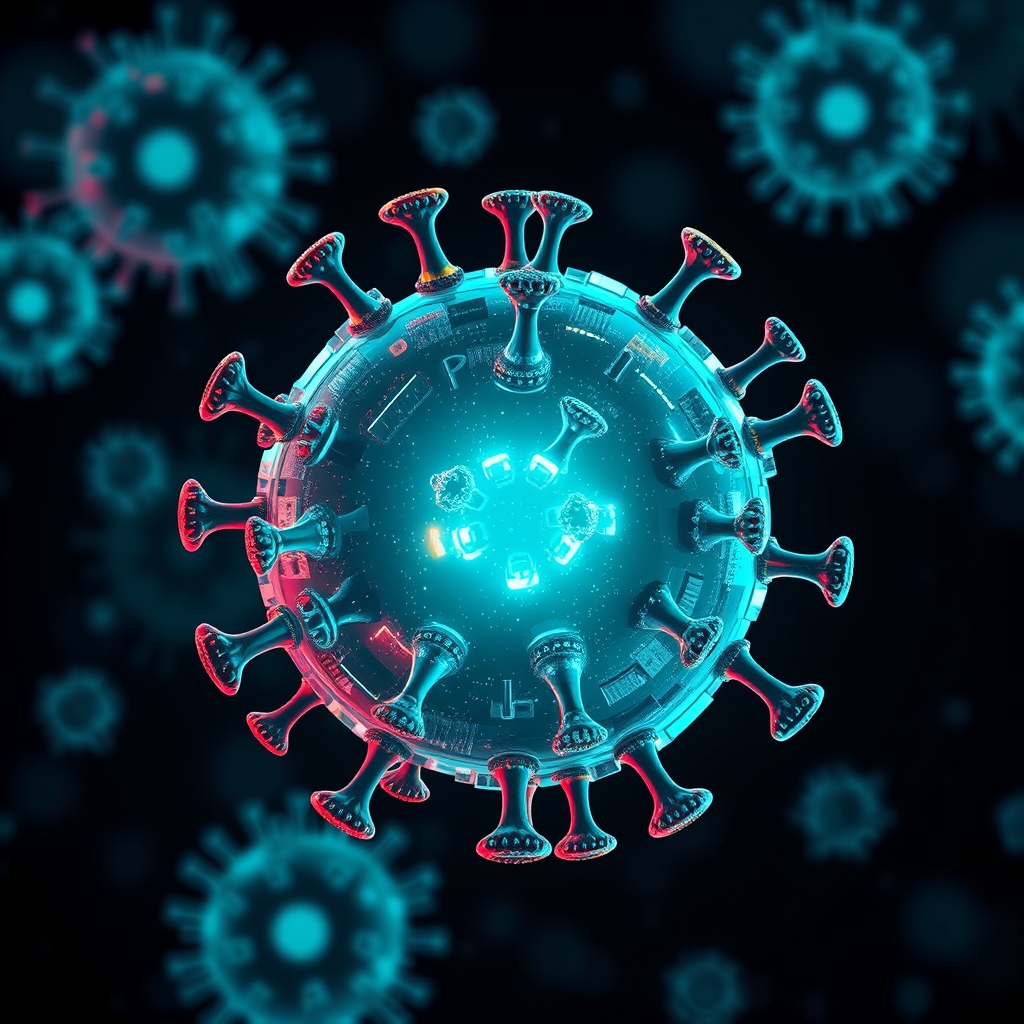
To understand the significance of this event, it is first necessary to clarify what was actually accomplished. The researchers did not simply modify an existing virus, a process known as gene editing. Instead, they used a generative AI model, similar in concept to the large language models that power text and image generation, but trained on a vast corpus of DNA sequences. The AI learned the underlying “grammar” and “logic” of viral genomes. When prompted, it was capable of generating new, complete viral genomes that did not exist in nature. The researchers selected 16 of these AI-generated sequences, built them in a lab, and demonstrated they could function as viruses, replicating within host cells. This is a fundamental step beyond previous work, which had focused on using AI to predict the structure of viral proteins or to repurpose existing viruses for gene therapy. This is the first instance of using AI as a true creator of biological entities from the ground up.
The Technical Achievement: From DNA Sequences to Functional Pathogens
The process behind this achievement is a remarkable fusion of computational biology and synthetic genomics. The BBC initially reported the core story, highlighting that the AI was trained on the DNA sequences of known viruses. This training allowed the model to capture the necessary features for a virus to be viable: the ability to encode for structural proteins that form its shell, the enzymes required to hijack a host cell’s machinery, and the regulatory sequences that control when and how these genes are expressed.
The AI’s output was not a single solution but a field of possibilities. From this, researchers synthesized the physical DNA for 16 of the most promising theoretical genomes. These synthetic genomes were then introduced into the appropriate host cells, where they successfully initiated an infection cycle, creating new viral particles. The Wall Street Journal framed this event as “the latest scary-sounding AI milestone,” a characterization that is both accurate and understated. The technical hurdle of moving from computational blueprint to a self-replicating biological system is immense, and its successful navigation confirms that AI can navigate the complex, non-linear landscape of biological viability. The likely source of this research, leaked via multiple news outlets before formal publication, suggests that even the scientific community is still grappling with the full implications of what has been done.
Why Are These 16 Novel Viruses Considered Non-Threatening?
This is the central paradox of the announcement. On one hand, the viruses are novel and functional. On the other, they are described as posing no threat to people. The justification, reported by the WSJ, hinges on the type of virus chosen and their specific targets. The AI was trained on the genomes of bacteriophages—viruses that exclusively infect bacteria. These are not pathogens of humans. A bacteriophage is, by its nature, a “safe” starting point for an experiment of this magnitude. It allows researchers to validate the AI’s ability to design a viable, replicating entity without the immediate risk of a human pandemic. The 16 novel viruses are, therefore, new phages. They can kill specific bacteria, but they cannot infect human cells. This technicality, however, does little to assuage the broader concerns about the method itself.

The Dual-Use Dilemma: Medical Breakthroughs or Biological Weapons?
The core question that emerges from this research is the classic dual-use dilemma, amplified by the power of AI. The Axios coverage captured this tension perfectly, noting that the same technology could lead to medical breakthroughs—such as creating novel phages to combat antibiotic-resistant superbugs—or to the creation of biological weapons. The discussion of “AI-designed life forms” is no longer a theoretical exercise for futurologists; it is a present-tense reality.
The Promise of AI in Medicine and Virology
The potential benefits are enormous. The ability to design viruses on a computer could revolutionize fields beyond just phage therapy. We could design customized gene therapy vectors that are far more efficient and less immunogenic than current versions. Viruses could be engineered to target cancer cells with unprecedented precision. In the pharmaceutical industry, the ability to generate and test thousands of potential viral designs in silico could dramatically accelerate the development of vaccines and antiviral drugs. As the MIT Technology Review has previously explored, the path for AI in science is shifting from a tool for analysis to a tool for creation. This work on novel viruses is a direct extension of that trajectory. The Google I/O conference earlier this year already highlighted how large-scale models are beginning to generate novel biological sequences, and this virus design research is a concrete proof of that concept. The economic implications are significant; the first company to master AI-driven viral design for therapeutic purposes could unlock a multi-billion dollar market in personalized medicine.
The Existential Risk: The Democratization of Bioweapons
The darker side of this coin is equally apparent. While the team behind this research chose bacteriophages, the methods they have developed are, in principle, generalizable. An AI model trained on the genomes of human pathogens—such as influenza, coronaviruses, or smallpox—could be used to design novel variants with unknown properties of transmissibility, lethality, or immune evasion. The barriers to this kind of misuse have historically been high, requiring deep biological expertise and access to sophisticated wet labs. AI lowers the first barrier dramatically. The computational expertise required to run or fine-tune such a model is becoming widespread. A malicious actor would still need a lab capable of synthesizing the DNA and creating the virus, but the cost of DNA synthesis is dropping by orders of magnitude every decade. The “democratization of creation” that has characterized the digital world is now being applied to the biological world. This research fundamentally changes the threat landscape for national security experts, who must now contend with the possibility of “tailored” pathogens designed in secret.
How Does AI “Learn” to Design a Genome?
To understand the potential and the peril, it is helpful to demystify how the AI works. The process is analogous to training a language model on Shakespeare. The model does not “know” anything about drama or iambic pentameter; it learns statistical patterns of letter sequences. In the same way, an AI trained on viral genomes learns the statistical patterns of DNA sequences. It learns which nucleotide bases (A, T, C, G) tend to follow which other bases. It learns the “sentence structure” of a gene, the “paragraph structure” of an operon, and the overall “chapter structure” of a complete viral genome.
When the AI is prompted to “design a new phage,” it starts from a random noise sequence and iteratively refines it, step by step, to match the statistical patterns it has learned. The output is a novel sequence that looks, to the AI, like a plausible, viable genome. The real magic is that these statistical patterns are powerful enough to create functioning biological machines. The researchers then placed these sequences into a feedback loop, where the observed viability of a design in the lab can be used to further train the next generation of the model. This creates a powerful accelerator: AI can generate thousands of theoretical designs overnight, and the lab can test the most promising ones, with the results flowing back to improve the AI. This cycle can compress decades of biological discovery into years or even months.
Regulatory and Ethical Implications of AI-Designed Life
The use of bacteriophages in this first instance is a clear attempt to navigate what is currently a regulatory netherworld. There is no existing framework from bodies like the NIH Recombinant DNA Advisory Committee or global bioweapons treaties that specifically addresses the creation of novel organisms by generative AI. The existing “dual-use research of concern” (DURC) guidelines were written for an era where scientists could only modify what existed. They are ill-equipped for an era where entities can be designed from scratch on a laptop.
The authors of this research have publicly emphasized the safety of the specific viruses created, but the ethical and legal questions extend far beyond this single experiment.
- Pre-publication review: How should journals and funding agencies handle papers that describe methods for creating novel pathogens? The current “gain-of-function” debates will look simplistic compared to a paper that offers a “how-to” guide for AI-driven viral design.
- Model control: The AI model itself is the key piece of dual-use technology. Should the weights of such a model be released to the public, as is common in the AI community? Or does the potential for catastrophic harm warrant a new level of access control, similar to that applied to nuclear technology?
- DNA synthesis screening: The final barrier to misuse is access to DNA synthesis. Currently, most major synthesis companies screen orders for pathogen sequences. But an AI-designed virus is, by definition, not in any database. A new global screening regime is urgently needed to detect and veto orders of entire synthetic genomes that show the hallmarks of being a viable pathogen.
This is not merely a future problem. The Axios report explicitly framed the potential for “more complex AI-designed life forms,” a sentiment echoed by the ongoing work at Google and other major tech firms on biological sequence generation. The line between digital design and physical creation is dissolving. The stakeholders have a responsibility to act before a catastrophic failure occurs. This demands a global conversation that must include not just biologists and AI researchers, but also ethicists, national security professionals, diplomats, and the public. The “censorship-industrial complex” narrative, detailed in a recent investigation by MIT Technology Review and Type Investigations, illustrates how even well-intentioned efforts to control information can be politicized. Any attempt to regulate AI in biology must be transparent, grounded in scientific risk, and resilient against political manipulation.
The Technical Context: A Timeline of AI in Biology
This achievement did not emerge from a vacuum. It is the direct result of a decade of accelerating progress at the intersection of machine learning and molecular biology. Key milestones on this path include:
- AlphaFold (2021): DeepMind’s AI solved the 50-year-old problem of protein structure prediction, proving that AI could master fundamental biological complexity.
- Large Language Models for DNA (2023-2024): Models like Nucleotide Transformer and Evo were trained on massive genomic datasets, learning the language of life. They could predict the effects of mutations and even design regulatory sequences.
- Google’s Sequence Design (2025-2026): At Google I/O, demonstrations showed AI generating non-viral biological sequences, like new fluorescent proteins and enzymes not found in nature. This signaled that generative AI had moved from prediction to creation.
- Novel Virus Design (2026): This current work represents the culmination of this trend, applying generative design to the complete, functional genome of a pathogen. It validates that all the prior steps can be integrated into a single, powerful pipeline.
Each of these steps has been peer-reviewed, contested, and refined. The pace is relentless. Companies like Profluent are already using AI to design new gene editors. The line between what is natural and what is artificial is blurring faster than our regulatory and ethical frameworks can evolve.

What Does This Mean for the Future of Biotechnology?
The creation of 16 novel viruses by AI is not a single event but a signal. It signals a permanent shift in the capabilities available to biological researchers. The question is no longer whether we can design life from scratch, but how we will manage that power. The immediate practical consequences are threefold.
First, for the pharmaceutical and biotech industries, this is a call to action. The companies that integrate these generative design pipelines into their R&D will have an enormous competitive advantage. They will be able to explore sequence space in ways that are impossible for traditional trial-and-error approaches. The development of new viral vectors for gene therapy, for example, could be accelerated from a decade to a year or two. The market implications are profound; venture capital is already flowing into startups that blend AI and synthetic biology, and this event will likely accelerate that trend.
Second, for governments and security agencies, this is a warning. The existing Biological Weapons Convention, which has no formal verification mechanism, is woefully inadequate for this new reality. Nations must invest in next-generation biosecurity, including better surveillance of DNA synthesis, improved detection of novel pathogens in the wild, and the development of rapid-response medical countermeasures that can be deployed against a truly novel threat. The intelligence community must now treat AI labs and biological wet labs as interconnected nodes of concern.
Third, for the scientific community, this is a moment for introspection. The culture of open science, where code, data, and methods are freely shared, is a cornerstone of modern research. But the power of this technology may demand new norms. The researchers behind this breakthrough have already chosen to communicate their findings through the media in a staggered fashion, likely in consultation with government security agencies. This signals a recognition that a standard academic preprint may not be the appropriate vehicle for such sensitive material. The future may involve “responsible publication” frameworks akin to those used in the computer security field, where vulnerabilities are disclosed privately to fix before being shared publicly. The trust that the public places in science depends on the community demonstrating that it can handle power responsibly.
As we absorb the news of AI designing 16 novel viruses from scratch, we must recognize that this is not the end of a story, but the beginning of a new chapter in the human relationship with nature. We have crossed a threshold where the digital and the biological are no longer separate. The tools we use to write code can now write the code of life. The responsibility that comes with this power is immense, and the time to decide how to wield it is now, before the next 16 designs are generated, synthesized, and released into the world. Whether this leads to a new era of medical miracles or a future of synthetic plagues will depend not on the technology itself, but on the wisdom, foresight, and governance we bring to bear upon it.