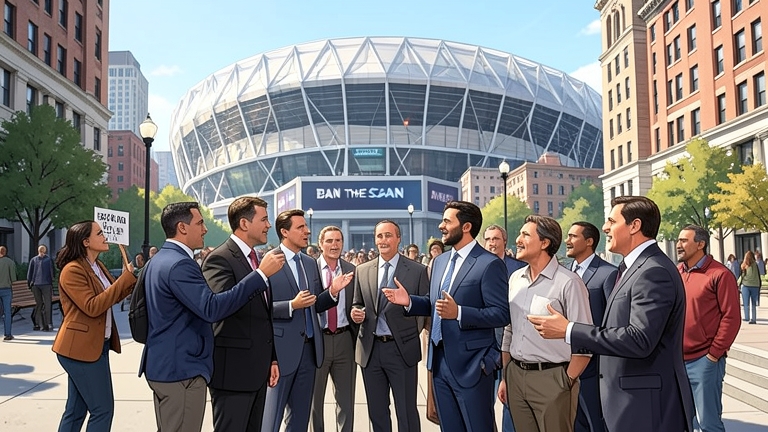
On a crisp Friday afternoon outside Madison Square Garden, a coalition of privacy advocates, musicians, and city lawmakers gathered not for a concert, but for a legislative standoff. Their target is not a touring act or a playoff game, but the sophisticated facial-recognition surveillance system that has quietly become as much a fixture of the venue as the iconic marquee. The rally was a public push for new legislation, formally proposed by City Council member Shahana Hanif, that would effectively force MSG and other large public venues in New York City to turn off the cameras that scan, catalog, and classify every face that enters their doors.
The “Ban the Scan” Bill: A Direct Challenge to MSG’s Surveillance Machine
The proposed legislation, introduced in January by Hanif, is straightforward in its ambition: it would prohibit public venues from using biometric recognition technology, specifically targeting the kind of facial-recognition systems that Madison Square Garden has deployed for years. At the rally, Hanif led a crowd in a chant of “ban the scan,” framing the issue as a fundamental fight against the unchecked abuse of biotechnology. “MSG and its CEO, James Dolan, have been flagrantly abusing biotechnology,” Hanif said, encapsulating the core grievance of the coalition.
The bill has already garnered significant political momentum. With 27 endorsements from City Council members—more than half the body—the proposal is no longer a fringe idea. According to Hanif, discussions are already underway with Speaker Julie Menin about advancing the legislation through the formal city government process. This level of support suggests that the council sees a clear and present danger in the way MSG has weaponized facial recognition, and that the public’s tolerance for being tracked at a basketball game or a concert is wearing thin.
The Watch List Problem: How MSG Tracks Its Critics and Fans
The urgency behind the “Ban the Scan” bill is rooted in a well-documented record of MSG’s surveillance practices. The venue is not merely using facial recognition for security in the traditional sense; it has built a vast database of faces linked to behavioral profiles and risk scores. As has been previously reported, fans who are publicly critical of Dolan or the New York Knicks can find themselves placed on watch lists. Once on that list, their faces are filed in MSG’s extensive database, and their every move inside the venue is subject to scrutiny.
One documented case illustrates the chilling granularity of this system. At a Knicks game, MSG security tracked a specific fan’s movements down to the minute. The dossier compiled on that individual included a detailed log of where they sat, who they spoke with, when they ate, and the precise paths they walked. This is not vague, large-scale data collection; it is targeted, personal tracking of individuals, often for reasons that have nothing to do with public safety.

The reach of this system extends far beyond the typical fan. Hundreds of lawyers who have been involved in litigation against Dolan or any Dolan-owned properties have been banned from MSG, Radio City Music Hall, and the Beacon Theatre. The most egregious example involved a mother who was blocked from taking her young daughter to a show at Radio City Music Hall simply because her law firm had once represented a party in a case against Dolan. This incident highlighted a fundamental truth: the surveillance system is not just about keeping out known troublemakers; it is about enforcing a private blacklist based on personal and professional conflicts.
Celebrity Dossiers and Risk Scores: The Scope of Biometric Data Collection
The scale of MSG’s data collection is even more staggering when considering its VIP and celebrity database. In July, it was reported that MSG maintains a database assigning risk scores to approximately 400 celebrities and high-profile individuals. These dossiers do not only track location and behavior; some entries include deeply personal attributes such as race and sexual orientation. This revelation moved the conversation from privacy to surveillance state-level concerns