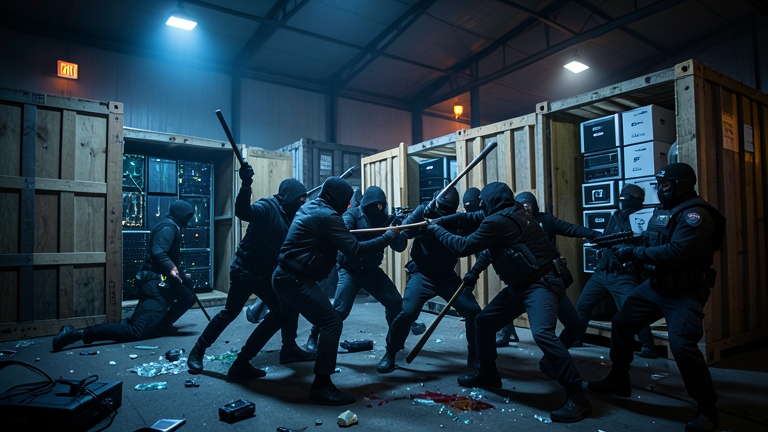
During the 25 years Gerardo Pachuca has spent investigating thieves who steal cargo from semitrucks, he says he has never seen behavior this brazen. The consultant and former Los Angeles sheriff’s detective claims that two times in recent months, robbers stole pricey hardware destined for AI data centers using a confrontational new tactic that has left the freight industry on edge. The incidents involved two different shipments of high-value technology traveling from Silicon Valley to Southern California, according to Pachuca, who says he learned about the thefts from law enforcement authorities. Each truck was tailed by private security professionals driving unmarked escort vehicles, which were supposed to ensure the goods made it to their destinations safely. But hours into one journey, another driver rear-ended the escort in a hit-and-run, forcing it to stop. In the other case, the escort stopped after another car nudged it into a tailspin, a ploy commonly known as a PIT maneuver, and then fled.
Everyone familiar with the accidents believes the escorts were deliberately immobilized, according to Pachuca. Once the semitrucks lost their escorts, the drivers proceeded without halting but not to their planned destinations. They were never heard from again, Pachuca says, and millions of dollars in data center gear remains unaccounted for. WIRED attempted to independently confirm Pachuca’s accounts with five state and local law enforcement agencies but could not because he shared limited information to avoid jeopardizing what he describes as ongoing investigations. Two other people in the cargo industry provided corroborating information.
A New Level of Violence in Freight Crime
J.J. Coughlin, chairman of the Southwest Transportation Security Council, a nonprofit intelligence-sharing group, says one of the affected escort companies notified him as soon as its vehicle was attacked while it was guarding high-value technology. Danny Ramon, director of intelligence and response at the freight-monitoring software developer Overhaul, says he learned about the rear-ending incident from law enforcement sources days after it happened. He describes the situation as a coordinated assault affecting a shipment of AI hardware.
Pachuca, Coughlin, and Ramon all say that no one was hurt in the attacks. They assume the truck drivers were in on the scheme, an increasingly common issue. The perpetrators have yet to be caught. They are all concerned that the isolated cases could turn into an alarming trend, a violent spin on freight crime now enabled by cyber-based scams and hacks, and targeting the very equipment powering the bleeding edge of the internet.
It is the worst I have seen, Pachuca says of cargo theft nationwide. The methods they are using, the value they are getting, the frequency these crimes are occurring.

How Cargo Theft Escalated From Property Crime to Coordinated Assault
The shift from opportunistic theft to orchestrated attacks marks a troubling evolution in freight crime. For decades, cargo theft was largely a crime of logistics: thieves would intercept shipments through fraudulent paperwork, identity theft, or simply by stealing parked trucks. Physical confrontation with security personnel was rare. The two recent incidents involving AI hardware shipments represent a departure from that norm. In both cases, the attackers did not merely exploit a vulnerability in the supply chain; they created one by neutralizing the primary security measure protecting the cargo.
Escort companies are a final line of defense and are increasingly in demand. Michael Duffy, CEO of Solutions Group International, says his escort business used to be busy primarily ahead of the holiday shopping season, but it has now picked up year-round, with companies moving liquid cooling parts, servers, and computer chips emerging as his biggest clients. Now that the values have shot through the roof, we are getting called all the time, Duffy says. He estimates his company has protected 13,000 shipments over the past four years, without a single loss.
High-value cargo and their escort vehicles have been targeted in Mexico and other countries for years. The suspected attacks in the US are now prompting escort operators to find ways to beef up their security, and some are encouraging personnel to call 911 at the first sign of suspicion. We have been trying to come up with a game plan, says Rachel Fruchtenicht of Shadow Freight Security.
Why AI Hardware Has Become a Prime Target for Cargo Thieves
The booming AI data center industry has created a new target for would-be thieves. Total spending on their construction in just the first half of this year surpassed the total for all of 2025. This explosive growth has generated enormous demand for specialized hardware, including high-performance GPUs, networking equipment, liquid cooling systems, and enterprise-grade servers. These components are small, dense in value, and often transported in containers that offer little visible indication of their contents.
While the overall number of thefts reported last quarter fell 26 percent year over year, the value of the goods taken more than doubled as criminals are increasingly targeting expensive cargo, according to new data released this month by Verisk CargoNet, an analytics and risk assessment firm. Some of the most commonly stolen goods include metals, especially copper, and enterprise-grade computer and networking equipment. These shipments are typically transported according to standard procedures, creating a significant mismatch between their financial value and their ordinary transportation and security profile, Verisk CargoNet said in an announcement accompanying the new data.
The Economics of AI Hardware Theft
Understanding why thieves are willing to escalate to violent tactics requires examining the economics. A single pallet of NVIDIA H100 or H200 GPUs can be worth more than a luxury car. A full truckload of data center equipment can easily exceed several million dollars in value. With the black market for enterprise computing components remaining robust, the risk-reward calculation has shifted dramatically. Traditional cargo theft yielded goods that required extensive fencing operations and often sold at steep discounts. AI hardware, by contrast, can be sold through gray-market channels to organizations desperate for computing capacity, smaller data centers unable to secure allocation from manufacturers, or overseas buyers willing to pay near-retail prices.
The violence seen in the recent attacks also reflects the sophistication of the criminal networks involved. Orchestrating a PIT maneuver or a staged rear-end collision requires planning, coordination, and personnel willing to commit felony assault. These are not opportunistic thieves. They are organized groups with the resources to conduct surveillance, stage accidents, and execute a seamless handoff of stolen goods. The involvement of truck drivers in the scheme adds another layer of complexity, suggesting that the criminals are infiltrating the supply chain itself.
What Is a PIT Maneuver and How Is It Being Used in Cargo Theft?
A PIT maneuver, short for Precision Immobilization Technique, is a tactical driving tactic used by law enforcement to force a fleeing vehicle to turn sideways and stop. In the context of cargo theft, criminals have adopted the same technique to disable escort vehicles. The attacker lightly contacts the rear quarter panel of the target vehicle, causing it to spin out of control. When executed at highway speeds, the maneuver is extremely dangerous and leaves the escort vehicle unable to continue pursuing or protecting the truck. The use of this tactic in a cargo theft context signals that criminals are willing to risk serious injury or death to get their hands on AI hardware.
The Escort Industry Under Pressure
Private escort companies have become an essential component of high-value cargo security. They provide a visible deterrent and a mobile response capability that static security measures cannot match. But the recent attacks have exposed vulnerabilities in the escort model. A single escort vehicle can be neutralized by a coordinated attack, leaving the truck unprotected. Escort drivers are typically unarmed and trained to avoid confrontation, making them vulnerable to aggressive tactics.
Rachel Fruchtenicht of Shadow Freight Security says the industry is now rethinking its standard operating procedures. Encouraging personnel to call 911 at the first sign of suspicion is a stopgap measure, not a long-term solution. Escort companies are exploring options such as deploying multiple vehicles, equipping escorts with defensive technologies, and integrating real-time monitoring systems that can alert law enforcement automatically. The challenge is that these enhancements come at a cost, and customers are already paying a premium for escort services. The question facing the industry is whether the current security model can keep pace with the evolving threat.

Who Is Behind the AI Hardware Heists
Law enforcement has not identified the perpetrators of the two recent attacks, and the limited information available makes it difficult to determine whether they are the work of a single group or multiple independent criminal networks. However, the tactics employed suggest a level of sophistication that points to organized crime rather than solitary thieves. The ability to identify high-value shipments, track their movements, and coordinate a multi-vehicle attack requires resources and intelligence-gathering capabilities that are beyond the reach of typical cargo thieves.
Gerardo Pachuca’s reluctance to share detailed information about the cases highlights the sensitivity of the investigations. Law enforcement agencies are likely concerned about compromising intelligence sources, tipping off suspects, or revealing vulnerabilities that could be exploited by other criminals. The industry is left to speculate about the scope of the threat, based on fragmentary information and anecdotal reports.
The Role of Inside Information in Cargo Theft
The assumption that the truck drivers were complicit in the thefts points to a persistent problem in the freight industry: insider threat. Cargo theft has always relied on inside information, whether from employees at shipping facilities, brokers, or drivers themselves. In the AI hardware context, the potential rewards are so large that the temptation to participate in a theft can be overwhelming. Drivers who are paid a fraction of the value of the goods they are transporting may be vulnerable to coercion or bribery.
Verisk CargoNet’s data shows that thefts involving inside information are among the most costly. When a driver is involved, the theft is often discovered only after the scheduled delivery time has passed, giving the criminals a significant head start. The use of GPS tracking and electronic logging devices has made it more difficult for drivers to deviate from planned routes without detection, but sophisticated criminals have found ways to disable or spoof these systems.
How Companies Can Protect AI Hardware in Transit
The growing threat of violent cargo theft is forcing companies to reevaluate their transportation security strategies. For organizations shipping AI data center equipment, the stakes are particularly high. A single lost shipment can delay a data center build-out, disrupt revenue projections, and damage customer relationships. The following measures are emerging as best practices for protecting high-value technology in transit:
- Multiple escort vehicles operating in a staggered formation to reduce the risk of simultaneous neutralization
- Real-time monitoring with geofencing and immediate alert escalation
- Driver vetting and background checks that go beyond standard requirements
- Randomized routes and schedules to prevent pattern analysis by criminals
- Covert tracking devices embedded in the cargo itself, not just in the truck
- Pre-arranged law enforcement coordination along the planned route
These measures add cost and complexity, but for shipments worth millions of dollars, they are increasingly seen as necessary. The alternative, as the recent attacks demonstrate, is the loss of both the cargo and the revenue it represents.
The Broader Implications for the AI Supply Chain
The targeting of AI hardware in transit has implications that extend beyond the freight industry. The AI data center build-out is one of the most significant infrastructure investments of the decade. Companies are spending billions of dollars on computing capacity, and any disruption to the supply chain can have cascading effects. If cargo theft becomes a significant constraint on the movement of AI hardware, it could slow the pace of data center construction, increase costs, and exacerbate the already tight supply of high-performance computing components.
Insurance premiums for high-value technology shipments are likely to rise in response to the increased risk. Some insurers may require enhanced security measures as a condition of coverage, adding another layer of cost and complexity. The industry may also see the emergence of specialized logistics providers that focus exclusively on high-value technology freight, offering end-to-end security solutions that integrate physical protection with cyber defenses.
A Problem That Is Likely to Get Worse Before It Gets Better
The cargo theft crisis is not a temporary anomaly. The conditions that have made AI hardware such an attractive target are structural: the value of the goods is high, the demand for computing capacity is growing, and the security measures currently in place are insufficient to deter determined criminals. As AI data centers continue to proliferate, the volume of high-value shipments will only increase, providing more opportunities for theft.
Law enforcement agencies face significant challenges in responding to these crimes. Jurisdictional issues, limited resources, and the difficulty of investigating cross-state cargo thefts mean that many cases go unsolved. The federal government has designated cargo theft as a priority for some task forces, but the scale of the problem continues to outpace the response. The industry is left to protect itself, relying on private security and intelligence-sharing networks to fill the gap.

The two attacks on escort vehicles in recent months may be the opening salvo in a new era of freight crime. If the criminals are not caught and the security measures are not improved, the violence is likely to escalate. The AI hardware inside those trucks is not just valuable; it is the physical infrastructure of the future economy. Protecting it in transit is becoming one of the most urgent security challenges of the digital age. The response from the industry, law enforcement, and policymakers will determine whether the attacks remain isolated incidents or become a defining feature of the AI supply chain.