The intersection of digital payments and cybersecurity has become one of the most critical battlegrounds in the modern financial landscape. As transaction volumes surge and regulatory scrutiny intensifies, payment platforms are no longer merely technology companies; they are custodians of financial trust. This is the context in which SabPaisa, an RBI-authorised digital payments company, announced its strategic selection of AccuKnox, a leading Zero Trust Security platform, to protect its payments infrastructure. The partnership, announced on August 2nd, 2026, signals a deeper trend: financial institutions are moving beyond traditional perimeter defenses to adopt AI-driven, identity-centric security models that can keep pace with both evolving threats and complex regulatory mandates.
AccuKnox, headquartered in California, will deploy its AI-powered cloud security platform across SabPaisa’s operations, providing a unified suite of tools designed to detect, respond to, and mitigate threats in real time. For SabPaisa, a company that handles large volumes of digital transactions across India—serving enterprises, educational institutions, and government organizations—this move is not just an upgrade; it is a foundational requirement for scaling securely.
Why SabPaisa Chose AccuKnox: Navigating RBI’s Stringent Regulatory Landscape
The Reserve Bank of India (RBI) does not offer leniency when it comes to the security posture of the entities it regulates. As an RBI-authorised payment company, SabPaisa operates under a microscope where compliance failures can result in steep penalties, loss of operating licenses, and irreparable damage to customer confidence. The company’s strategic goal was clear: harden its security platform to ensure robust protection while remaining in full alignment with RBI’s stringent regulations.
The evaluation process was rigorous. SabPaisa’s technical and security teams examined a range of solutions, measuring them against a complex set of criteria that included threat detection accuracy, real-time response capabilities, compliance reporting, and scalability. After a comprehensive assessment, SabPaisa determined that AccuKnox offered the most comprehensive and unified approach to its security and compliance needs.
The decision underscores a broader industry shift. Traditional security architectures—often fragmented across disparate tools for vulnerability scanning, identity management, and threat monitoring—are proving inadequate for modern cloud-native environments. RBI’s regulatory expectations have evolved to require a holistic view of security posture, one that integrates visibility across infrastructure, applications, data, and AI systems. AccuKnox’s modular yet tightly integrated platform directly addresses this requirement.

Deconstructing AccuKnox’s Zero Trust Architecture: More Than a Buzzword
Zero Trust is a security model that operates on a simple premise: never trust, always verify. In a Zero Trust architecture, no user, device, or application is trusted by default, regardless of whether they are inside or outside the network perimeter. This approach is particularly critical in the payments industry, where the compromise of even a single credential or a misconfigured container can expose sensitive financial data.
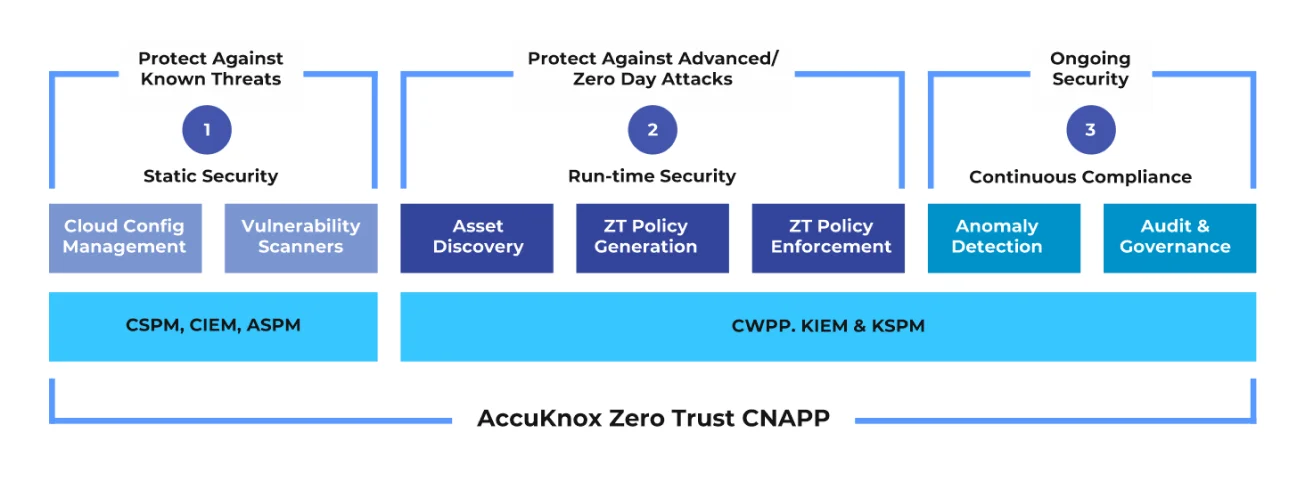
AccuKnox’s platform is not a single tool but a comprehensive ecosystem designed to cover every facet of cloud security. The platform’s architecture is built on seven distinct modules, each addressing a specific security domain while sharing a common data fabric for unified analysis:
- CNAPP (Cloud Native Application Protection Platform) – This integrates CSPM (Cloud Security Posture Management), CWPP (Cloud Workload Protection Platform), CIEM (Cloud Infrastructure Entitlement Management), CDR (Cloud Detection and Response), KSPM (Kubernetes Security Posture Management), KIEM (Kubernetes Infrastructure Entitlement Management), and GRC (Governance, Risk, and Compliance).
- AI Security – A forward-looking suite covering AI-SPM (AI Security Posture Management), AI-DR (AI Detection and Response), AI-Red Teaming, Agentic AI security, AI Identity, AI Data Security, and AI GRC.
- AI SOC – A Security Operations Center augmented with artificial intelligence to detect and respond to threats faster than human-led teams alone.
- Agentic AI SOC – An advanced evolution where autonomous AI agents execute response actions to contain threats.
- Data Security (DSPM) – Data Security Posture Management to discover, classify, and protect sensitive data across cloud environments.
- Application Security (ASPM) – Application Security Posture Management incorporating SAST (Static Application Security Testing), DAST (Dynamic Application Security Testing), SCA (Software Composition Analysis), and SBOM (Software Bill of Materials).
- Foundational Capabilities – Including SIEM (Security Information and Event Management) and secrets management.
These modules are characterized as “tightly integrated but loosely coupled,” meaning that SabPaisa—and any other client—has the flexibility to deploy specific modules based on immediate needs while maintaining the ability to expand coverage without ripping and replacing existing infrastructure. This architecture allows for incremental security maturity, which is essential for organizations managing legacy systems alongside modern cloud workloads.
How AccuKnox’s CNAPP and AI Security Modules Protect Payment Platforms
To understand the practical value AccuKnox brings to SabPaisa, one must examine how these modules function in a real-world payments context. SabPaisa processes transactions that traverse multiple environments: on-premises systems, public cloud infrastructure, containerized microservices, and third-party APIs with payment gateways, UPI, cards, and net banking.
The CNAPP module provides the foundational layer. Cloud Security Posture Management continuously scans SabPaisa’s cloud accounts for misconfigurations—such as publicly accessible storage buckets or overly permissive firewall rules—that could serve as entry points for attackers. Kubernetes Security Posture Management extends this to the container orchestration layer, ensuring that workload definitions and network policies adhere to security best practices.
Cloud Workload Protection takes this further by monitoring runtime behavior. Even if a static scan misses a vulnerability, CWPP can detect anomalous activity—such as a container attempting to establish an outbound connection to an unknown IP address—and automatically quarantine the workload. Cloud Detection and Response provides the telemetry layer that feeds into the AI SOC, enabling security teams to prioritize alerts based on severity rather than drowning in a sea of noise.
AccuKnox’s AI Security module is where the platform differentiates itself for a forward-thinking organization like SabPaisa. Financial institutions are increasingly experimenting with AI for everything from customer service chatbots to fraud detection algorithms. However, these AI systems themselves are vulnerable to adversarial attacks. AccuKnox’s AI-SPM assesses the configuration of AI models and pipelines for security gaps. AI-Red Teaming simulates attacks against AI systems to identify weaknesses before malicious actors can exploit them. The AI Identity module ensures that the service accounts and APIs that AI systems use are properly authenticated and authorized.
For a payment company, the data security implications are equally significant. The DSPM module automatically discovers where payment card data, Personally Identifiable Information (PII), and financial records reside across SabPaisa’s multi-cloud environment. This continuous discovery is essential for mapping the flow of sensitive data from the point of transaction capture to storage and backup, ensuring that encryption standards are uniformly applied.
What the Testimonials Reveal: The Importance of Technical Depth and Trust
The partnership announcement included statements from cybersecurity executives at both companies that offer valuable insight into the decision-making process. Swayambhu Prakash, CISO of SabPaisa, framed the selection around unified visibility and operational confidence. “At SabPaisa, protecting every transaction and the data behind it is fundamental to the trust our customers place in us,” Prakash said in the announcement. “AccuKnox gives us unified visibility across our cloud security posture and real-time detection and response in one platform, along with the SOC 2 assurance our business requires. The team’s technical depth gave us the confidence to move forward quickly and secure our platform as we scale.”
The reference to SOC 2 is particularly telling. SOC 2 is an auditing standard developed by the American Institute of Certified Public Accountants (AICPA) for service organizations. It verifies that a company has appropriate controls in place to protect customer data. For SabPaisa, which does not operate under SOC 2 as a regulatory mandate from RBI but likely needs it to serve international clients or enterprise customers with global compliance requirements, having a security vendor that supports this certification is a strategic advantage. The integration of GRC modules within AccuKnox allows SabPaisa to continuously generate the evidence logs required for SOC 2 audits, reducing the administrative burden of compliance reporting.
Prakash’s emphasis on “technical depth” suggests that the evaluation process was not merely about feature checklists but about AccuKnox’s ability to demonstrate a deep understanding of advanced attack vectors. In an environment where ransomware groups are increasingly targeting payment infrastructures, the ability to explain how detection models work and how response playbooks are executed matters.
From AccuKnox’s side, co-founder and CTO Rahul Jadhav emphasized the strategic nature of the partnership. “We are thrilled that a visionary organization like SabPaisa decided to partner with AccuKnox. We look forward to delivering them robust Zero Trust Security to support their current business imperatives and future strategic initiatives.” The use of “future strategic initiatives” hints at a roadmap that extends beyond the initial deployment—likely encompassing the expansion into AI-driven financial products.
The Broader Context: Why Payment Companies Are Racing to Modernize Cloud Security
SabPaisa’s decision is emblematic of a wider movement within the financial services sector. Payment companies process data that is inherently valuable to cybercriminals. Credit card numbers, bank account details, UPI credentials, and personal identification data can be monetized directly or used for larger-scale identity fraud. As digital payment adoption surges in India—driven by UPI’s ubiquity—the attack surface for these companies expands exponentially.
The legacy approach to security in the financial sector often involved isolated perimeter defenses: a firewall, intrusion detection systems, and compliance checklists. But the transformation to cloud-native architectures has rendered these approaches obsolete. Modern payment platforms are distributed across multiple cloud providers and edge networks, making it impossible to define a single network boundary. Zero Trust models address this by shifting the focus from networks to identities and workloads.
AccuKnox’s background lends credibility to its Zero Trust claims. The company was incubated by SRI International (Stanford Research Institute), a renowned R&D innovator. SRI International holds seminal patents in network security that date back to the early days of the internet, and AccuKnox has continued this lineage with its own Zero Trust patents. The company is backed by top-tier investors including National Grid Partners, Dolby Family Ventures, Avanta Ventures, and the 5G Open Innovation Lab—an investor roster that signals confidence in the platform’s technical differentiation.
The involvement of National Grid Partners is notable, as it suggests AccuKnox’s technology is not confined to financial services. Energy companies and critical infrastructure providers require similar levels of security resilience, which speaks to the robustness and versatility of the platform.
Meeting Compliance Head-On: The Role of AI in Governance, Risk, and Compliance
One of the most complex aspects of operating an RBI-regulated payment business is satisfying governance, risk, and compliance (GRC) requirements. RBI’s regulatory framework for payment systems has become increasingly detailed, expecting companies to not only implement security controls but also to prove their effectiveness through structured reporting and audit trails.
AccuKnox addresses this through its AI GRC capabilities. Traditional GRC software often relies on manual data collection and spreadsheet-based assessments. AccuKnox automates the collection of security telemetry from across the IT environment and maps it directly to regulatory control frameworks. For SabPaisa, this means that when RBI submits a detailed questionnaire about security posture, the company’s compliance team can generate evidence-backed responses from the platform without weeks of manual effort.
The AI component of GRC is becoming increasingly relevant. Machine learning models can identify anomalies in access patterns that might indicate a policy violation even before a breach occurs. They can also predict which security gaps are most likely to be exploited based on threat intelligence feeds, allowing compliance teams to prioritize remediation efforts where they matter most.
Responding to Real-Time Threats: From Detection to Automated Response
The phrase “real-time detection and response” appears prominently in SabPaisa’s rationale for selecting AccuKnox. In the payments world, the difference between a near-miss and a catastrophic breach can be measured in seconds. An attacker who gains unauthorized access to a server can exfiltrate transaction data within minutes. The ability to detect that intrusion automatically, isolate the affected workload, and trigger a response sequence is priceless for minimizing damage.
AccuKnox’s AI SOC and Agentic AI SOC modules are designed specifically for this use case. A traditional Security Operations Center (SOC) relies on human analysts to triage alerts, correlate events, and execute response steps. This human-in-the-loop approach is slow and subject to fatigue. AccuKnox augments the SOC with AI-driven analysis that can score alerts based on their likelihood of being genuine security incidents versus false positives.
The Agentic AI SOC takes this one step further. In cases where a threat is confirmed, the agentic AI can execute pre-defined response actions—such as killing a malicious process, revoking an access token, or blocking an outbound IP address—without waiting for a human operator to pull a trigger. This zero-touch response is particularly effective at containing fast-moving threats like cryptomining malware or data exfiltration agents.
For SabPaisa’s CISO and security team, the Agentic AI SOC does not replace human judgment. Rather, it frees skilled analysts to focus on complex investigations and strategic security improvements rather than spending their time ticking off routine alert boxes. This shift in workload allocation is essential for a company with a fixed security headcount but an exponentially growing amount of data to protect.
ing Beyond Compliance: The Strategic Value of Application and Data Security
When a payment company selects a security vendor, the decision is rarely driven solely by compliance checkboxes. The economics of cybersecurity also play a decisive role. An integrated platform like AccuKnox reduces the total cost of ownership that SabPaisa would face if it purchased a separate tool from a different vendor for every security function—one for vulnerability scanning, one for infrastructure posture, one for identity, one for data discovery, and one for SIEM. Consolidating these capabilities under a single architecture reduces integration complexity and streamlines operational training.
The Application Security module (ASPM) illustrates this value proposition. SabPaisa continuously develops new features for its payment gateway and mobile interfaces. The ASPM suite includes SAST for static code analysis, DAST for running security tests against live running applications, and SCA to identify known vulnerabilities in third-party libraries and open-source components. The SBOM component creates a machine-readable inventory of all software components, which is becoming an industry standard requirement for software supply chain security.
Without ASPM integration, a development team might not receive scan results until after code is deployed. AccuKnox’s approach embeds security testing into the CI/CD pipeline, so developers can fix vulnerabilities before they ever reach production. This proactive posture is fundamentally more cost-effective than dealing with incidents after the fact.
The Data Security (DSPM) module adds another layer of value. In a financial institution, data governance is not just about security; it is about business intelligence. DSPM automates the tagging of sensitive data, which assists not only in security but also in compliance with India’s Data Protection and Privacy rules. Understanding where customer data resides allows SabPaisa to make decisions about data residency, retention windows, and breach notification protocols.
What This Partnership Signals for the Future of Financial Cloud Security
Looking at the trajectory of both companies, this partnership is likely just the beginning of a deeper relationship. SabPaisa’s growth ambitions—expanding its service offerings across India’s rapidly digitizing economy—will continue to introduce new security challenges. As the company integrates AI agents to automate customer onboarding or deploy generative AI for transaction pattern analysis, the AI Security module will become even more central to its operations.
AccuKnox, meanwhile, continues to expand its footprint in the financial services sector. The partnership with SabPaisa adds a valuable reference customer in South Asia. For AccuKnox, demonstrating that its platform can meet RBI’s unique regulatory expectations is a powerful testament to the flexibility and depth of its security controls. The ability to succeed in highly regulated environments often sets the standard for less regulated sectors.
For the digital payments industry at large, the SabPaisa-AccuKnox collaboration offers a template for how to approach security modernization. It demonstrates that compliance and security innovation are not mutually exclusive; they can be achieved simultaneously through the right architectural choices. The move toward federated, modular, AI-integrated security platforms is likely to accelerate, as other payment companies facing similar pressures analyze SabPaisa’s decision and find their own reasons to follow suit. The era of securing cloud-native financial services through legacy tools is drawing to a close—replaced by a more intelligent, autonomous, and unyieldingly verifiable standard.