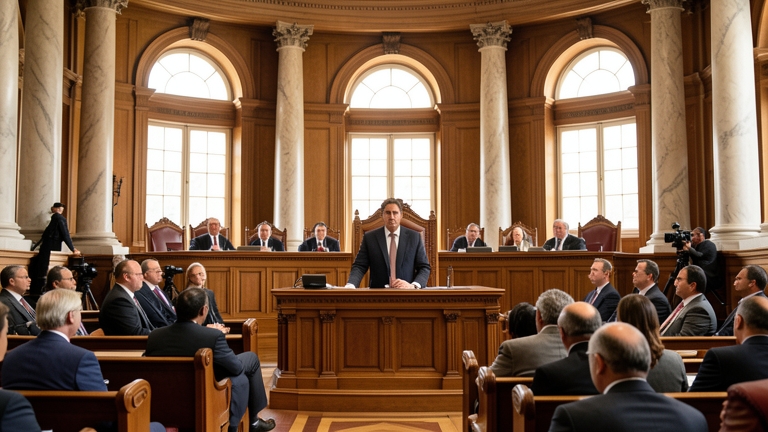
The impeachment of a Supreme Court justice is a constitutional rarity of the highest order — and to this day, it has happened only once. In the early years of the American republic, a fiery Federalist named Samuel Chase became the first and only justice ever impeached by the House of Representatives. His trial before the Senate in 1804 and 1805 did more than determine his personal fate; it forged a foundational principle of judicial independence that has protected the federal bench for more than two centuries. That principle — that a justice cannot be removed simply because the ruling party dislikes their judicial philosophy or rulings — is now understood as a cornerstone of American constitutional law. Understanding the circumstances, the charges, and the acquittal of Samuel Chase provides essential insight into the delicate balance between political accountability and judicial immunity.
The Only Impeached Supreme Court Justice: Samuel Chase
The question posed in our daily trivia feature is deceptively simple: Who is the only Supreme Court justice who has ever been impeached by the House? The answer, as hinted, is Samuel Chase — a signer of the Declaration of Independence, appointed to the Supreme Court by President George Washington in 1796. Chase was a staunch Federalist, openly partisan in his political views, and he did not moderate those views when he put on his judicial robes. His conduct on the bench, especially during the heated partisan battles between the Federalists and the Jeffersonian Republicans, drew the ire of the new Republican-controlled Congress. In 1804, the House of Representatives voted to impeach Chase on eight articles, accusing him of partisan misconduct and arbitrary rulings. The subsequent Senate trial, however, ended in acquittal — an outcome that established a critical precedent: a justice cannot be removed for rulings or opinions that the ruling party finds objectionable.
Historical Context: The Partisan Crucible of the Early Republic
To grasp why Samuel Chase became the target of impeachment, one must understand the raw partisan conflict of the 1790s and early 1800s. The Federalist Party, led by Alexander Hamilton and John Adams, had dominated national politics during the Washington and Adams administrations. But the election of Thomas Jefferson in 1800 swept the Republicans into power, marking the first peaceful transfer of party control in American history — a transfer fraught with bitterness and mutual suspicion. Federalist judges, including Supreme Court justices, were seen by Republicans as entrenched enemies of the new order. Chase, in particular, had made himself a symbol of Federalist overreach. While riding circuit — as Supreme Court justices did in those days — he delivered grand jury charges that amounted to political sermons attacking the Jefferson administration and Republican policies. He presided over the trial of a Republican editor, James Callender, under the Sedition Act of 1798, and his conduct there was widely viewed as bullying and partisan. For the Republican House, impeachment seemed a legitimate tool to purge the judiciary of a man they viewed as a political enemy using the bench as a platform.
The Eight Articles of Impeachment
The House drafted eight articles of impeachment against Chase, each detailing specific instances of alleged misconduct. The charges centered on three areas: his conduct in the Callender trial, his behavior in a later trial in Baltimore, and his grand jury charges. The articles accused Chase of:
- Refusing to dismiss biased jurors in the Callender trial.
- Excluding defense witnesses unlawfully.
- Conducting the trial with a “manifest intent to oppress and procure a conviction.”
- Delivering intemperate and partisan grand jury charges designed to influence public opinion against the administration.
- Allegedly making inflammatory statements about the government and the press.
Notably, none of the articles accused Chase of bribery, corruption, or personal financial gain. The core of the Republican case was that his conduct was politically partisan and tyrannical — that he had used his judicial office to advance a political agenda and to punish those who disagreed with him. This distinction would prove crucial in the Senate trial.

The Senate Trial: A Test of Constitutional Meaning
The trial began in the Senate chamber on February 9, 1805, with Vice President Aaron Burr — himself a controversial figure after the duel with Hamilton — presiding. The prosecution was led by leading Republican congressmen, including Joseph Nicholson and John Randolph of Virginia. Chase’s defense team included some of the finest legal minds of the era, such as Luther Martin, Robert Goodloe Harper, and Charles Lee. The defense strategy was simple and powerful: they argued that the charges did not rise to the level of “high crimes and misdemeanors” required by the Constitution for removal from office. Partisan commentary and even judicial errors, they contended, were not impeachable offenses unless they involved corrupt intent or a clear abuse of power that threatened the Republic.
The Acquittal: Eight Votes Short of Conviction
On March 1, 1805, the Senate voted on each of the eight articles. The Constitution requires a two-thirds majority to convict; with 34 senators at the time, 23 votes were needed for conviction. On the strongest article — concerning Chase’s conduct in the Callender trial — the vote was 18 guilty to 16 not guilty, falling five votes short. On the remaining articles, the margin was even wider, with some articles failing by as many as ten votes. Chase was acquitted on all counts. The outcome reflected defections among Republican senators who feared that a conviction would undermine judicial independence, as well as a solid block of Federalist senators voting uniformly for acquittal.
What the Chase Trial Established: The Doctrine of Judicial Immunity from Political Removal
The acquittal of Samuel Chase established a critical constitutional norm: a Supreme Court justice cannot be impeached and removed merely because the Congress disagrees with his or her rulings, political leanings, or even intemperate statements. To remove a justice, the House must prove serious criminal misconduct or a clear and corrupt abuse of office. This precedent has been invoked in every subsequent discussion of impeaching a federal judge. It is the reason that no Supreme Court justice has been impeached since — despite many controversial decisions and sharply partisan divisions over the Court’s composition. The Chase trial effectively drew a line between political accountability and judicial independence, ensuring that the third branch of government could operate free from legislative intimidation.
Direct Answer: Who Was the Only Impeached Supreme Court Justice?
For readers seeking a concise, featured-snippet-ready answer: The only Supreme Court justice ever impeached by the House of Representatives was Samuel Chase, a signer of the Declaration of Independence appointed by George Washington. He was impeached in 1804 on eight articles alleging partisan conduct and abuse of power. He was acquitted by the Senate in 1805, establishing that a justice cannot be removed simply for rulings the ruling party dislikes.
Why This Precedent Matters Today
The legacy of the Chase trial reverberates in modern debates over the Supreme Court. In recent decades, calls to impeach justices have arisen from both sides of the political spectrum — most notably following decisions like Bush v. Gore (2000), the healthcare rulings, and the reversal of Roe v. Wade. Yet no serious impeachment effort has gained traction, precisely because of the norm established in 1805. The Chase acquittal taught Congress that using impeachment as a political weapon against judicial decisions is constitutionally untenable. It also reinforced the idea that the remedy for unpopular judicial rulings lies not in removing justices but in the political process of appointing new ones when vacancies occur. That norm has proved remarkably durable: in over 230 years, no Supreme Court justice has been removed from office, and only one has been impeached.
The Role of the Senate in Safeguarding Judicial Independence
The Senate’s refusal to convict Chase, despite the Republican Party’s control of both chambers and the presidency, demonstrated that impeachment is a structural safeguard, not a political cudgel. Many senators, including some Republicans, understood that to convict Chase on the charges presented would set a dangerous precedent. If a justice could be removed for partisan grand jury charges or for biased rulings, every subsequent Congress could attack any justice whose opinions they opposed. The Senate’s acquittal thus preserved the independence of the judiciary at a critical formative moment — a decision that Chief Justice John Marshall, a fellow Federalist, undoubtedly applauded from his seat on the bench.
Lessons for Understanding the Limits of Impeachment
The Samuel Chase impeachment trial offers a clear lesson in constitutional interpretation. “High crimes and misdemeanors” — the standard for impeachment — does not encompass mere judicial error, partisan bias, or unpopular political speech. It requires conduct that constitutes a serious crime or a fundamental abuse of the office that undermines the integrity of the judicial system itself. Chase was accused of bias, intemperance, and political advocacy from the bench. Those are serious concerns, and they led to the first — and only — impeachment of a justice. But they were not deemed sufficient for removal. The Senate, in effect, defined the outer boundary of acceptable judicial behavior: a justice can be impeached, but to be removed, the conduct must be egregiously corrupt or criminal.
What Would Happen If a Justice Were Impeached Today?
If a modern Supreme Court justice were impeached by the House, the proceeding would follow the same constitutional path: the House would vote on articles, and the Senate would hold a trial, likely with the Chief Justice presiding (as the Constitution mandates when a president is impeached, but not for other officials). However, the precedent of the Chase acquittal would loom large. Any House charged with purely political offenses — such as “partisan rulings” or “failure to recuse” — would face an uphill battle in the Senate. Conviction would require a two-thirds majority, which in the current hyper-partisan environment is nearly impossible to achieve for either party. The Chase case thus remains the authoritative guide: impeachment of a Supreme Court justice is a constitutional option, but it is reserved for the most serious and corrupt misconduct, not for policy disagreements.
The Enduring Significance of the Chase Case in Legal Education
Law students and constitutional scholars study Samuel Chase’s impeachment precisely because it illustrates the tension between judicial accountability and independence. The case is cited in textbooks, law review articles, and in congressional hearings whenever the idea of impeaching a justice surfaces. It provides the historical foundation for the argument that the judiciary must be protected from political retaliation. Without the Chase acquittal, the Supreme Court might have evolved into a more politically dependent institution — one where a change in party control could trigger a purge of the bench. That did not happen, and the stability and legitimacy of American constitutional government owe a great debt to this single trial from 1805.
Why the Trivia Question Matters
The question “Who is the only Supreme Court justice who has ever been impeached by the House?” is not just a piece of trivia. It is a doorway into understanding a core feature of American governance: the separation of powers and the independence of the judiciary. Knowing the answer — Samuel Chase — and understanding the outcome — acquittal — helps citizens appreciate why the Supreme Court has remained free from political removal for more than two centuries. The Chase precedent is a living part of our constitutional fabric, one that continues to shape debates over judicial reform, court-packing, and the limits of congressional oversight.
In a time when the Supreme Court’s legitimacy is regularly questioned and when political actors on both sides have floated the idea of impeachment, the story of Samuel Chase offers both a warning and a reassurance. It warns that impeachment is a blunt instrument that, if misused, could destroy the very independence that makes the judiciary effective. It reassures that the Senate, historically, has acted as a bulwark against that outcome. The only impeached Supreme Court justice walked free, and in doing so, he secured a constitutional inheritance that every justice since has enjoyed: the right to judge without fear of political retribution.
That is the real answer behind the trivia question — and the reason the question remains worth asking today.