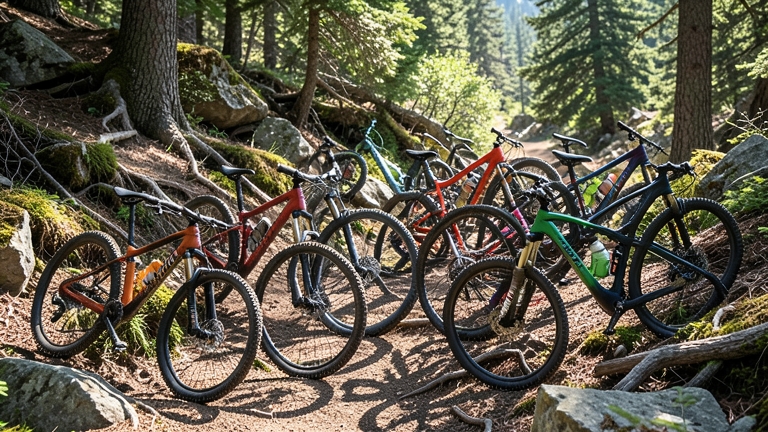
The 2027 Scott Strike has arrived, and its pricing says as much about the state of the e-MTB market as it does about the bike itself. Scott has opened the new full-suspension Strike lineup at €4,199 and capped it at €5,799 across four specifications — a deliberate move that lowers the entry threshold while keeping Scott firmly in the premium lane. In an industry consumed by discount pressure and new competition from China, the new Strike range is a measured response: a strong e-bike, a more honest price than before, and no panic.
Scott Strike 2027 lineup at a glance: four models, six colourways, €4,199 to €5,799
The 2027 Scott Strike family is built around four specifications: the Scott Strike 10, the Scott Strike 20, the Scott Strike 30, and the Scott Strike 40. The Strike 10 leads the range at €5,799, while the Strike 40 enters the lineup at €4,199. Between those two bookends, the Strike 30 and the Strike 20 fill out the range with progressively ascending component levels.
Scott has also given the range genuine visual diversity. The flagship Strike 10 and the entry-level Strike 40 are each offered in two colourways. The Strike 30, likely to be the volume model of the family, offers a choice of three colour variants. Only the Strike 20 is restricted to a single colourway — a slightly unusual decision for the middle of the range, and one that suggests Scott expects the 20 to play a supporting role rather than lead the sales charts.
This distribution of colour options is more than cosmetic detail. Scott is steering buyers toward the models it most wants to sell. The Strike 30, with three paint schemes, is positioned as the most attractive step in the range — a model that balances specification and customisation. The Strike 20’s single colourway, by contrast, makes it the clearest stepping stone: easy to identify, easy to compare, and easy to skip past on the way to a more interesting option.
How the 2027 Strike pricing compares with the 2023 Strike Evo generation
Scott’s pricing reset becomes clearer when set against its own recent history. When the previous-generation Strike Evo models were launched for the 2023 season, the range spanned a particularly wide price window. The most expensive model with an aluminium frame, the Scott Strike eRide 910 Evo, carried a price of €6,599. At the other end of the scale, the most affordable model, the Scott Strike Evo eRide 940, started at €4,599.

The 2027 lineup undercuts both figures. The new Strike 40 at €4,199 is €400 below the old eRide 940. The range-topping Strike 10 at €5,799 sits €800 beneath the 910 Evo. For a brand that has historically been comfortable holding premium price points, this is a real move toward the centre of the market — even if Scott itself frames it as a slight adjustment.
The comparison also reveals a structural change in the range. The €6,599 figure from the 2023 season was the ceiling of the aluminium-framed side of the Evo family, which means the old lineup extended into even more expensive territory beyond it. The 2027 Strike 10, by contrast, sits at the absolute top of the entire lineup. Scott has effectively consolidated its pricing architecture — pulling the ceiling down while compressing the entire model family into a narrower, more approachable band.
That has practical implications for buyers. A rider who previously had to stretch into a range’s upper tier for the best aluminium model now finds the flagship of the whole line at a more accessible figure. The distance between the entry-level Scott Strike and the range-topping Scott Strike has shrunk from around €2,000 to €1,600 — a tighter ladder, and one that makes the step up feel more achievable.
Discount marathons and Chinese challengers: why Scott isn’t chasing the bottom of the market
The timing of this strategy matters. The e-bike market has spent the past two years navigating what has widely become known as a “discount marathon” — a sustained period of aggressive price cutting, inventory clearances, and margin compression that has forced many brands into promotional tailspins. Some companies have had no choice but to run. Scott has chosen not to sprint.
At the same time, new competition is emerging from China, and it is arriving with pricing that makes established European brands look exposed. Amflow, the Chinese e-bike maker backed by DJI, has become the benchmark example. Its Amflow PR Carbon — a full-carbon e-MTB with an almost identical suspension system — is available at around €4,500. That is unmistakably in the same conversation as the new Scott Strike range.
The unavoidable conclusion: Scott is not the brand you turn to when you want the absolute market-floor price. The company has implicitly acknowledged this, noting that even in economically challenging times, with an industry-wide discount marathon and new entrants pushing from below, its pricing is not intended to chase the bottom of the market. This is a deliberate brand choice, not an oversight. Scott is betting that its name, its race pedigree, its dealer network, and its engineering reputation still justify a premium over the new wave of disruptive competitors.
It is also a bet with strategic logic behind it. Chasing Amflow’s price point would be a race Scott could not ultimately win — not with its cost base, its development overheads, and the dealer margins it needs to protect. The rational response for a brand in Scott’s position is not to compete on price per specification, but to compete on the strength of the whole package: the bike, the warranty, the service network, the proven reliability of established components. That is precisely the argument the 2027 Strike is built around.
Does the 2027 Scott Strike offer electronic gear shifting?
No. There is not a single model in the entire 2027 Scott Strike range that features electronic gear shifting. Every bike in the lineup uses a mechanical drivetrain, with Shimano groupsets across the board — Deore XT on the flagship Strike 10 and more accessible Shimano spec levels further down the range. Scott’s decision stands in sharp contrast to Amflow, which offers its carbon PR model exclusively with electronic shifting at around €4,500.
That omission is worth examining, because it reveals how Scott sees its buyers. Electronic shifting has moved from premium novelty to near-standard in the upper reaches of the e-MTB market. Brands like Amflow have turned it into a defining specification, presenting it as part of the expected package on a modern e-bike. Scott, meanwhile, has concluded that mechanical shifting still makes sense for its riders — whether for reasons of cost, durability, repairability, or rider preference.
There is a solid engineering argument on Scott’s side. Mechanical drivetrains are simpler to maintain, cheaper to replace, and in many cases easier to fix on the trail. A misaligned derailleur can often be coaxed back into action with basic tools and a bit of patience; a failed electronic shifter can mean the end of the ride. For an e-MTB rider planning backcountry trips, that reliability argument carries real weight.

But the counterargument is equally valid. At prices ranging from €4,199 to €5,799, with a direct competitor selling a carbon-frame e-MTB with electronic shifting at around €4,500, buyers may reasonably ask what exactly the Scott premium is purchasing. The answer — brand heritage, proven build quality, a comprehensive dealer network — is legitimate, but it is also increasingly difficult to communicate in a market where specification sheets are the primary comparing tool.
Scott’s own position — that the comparison with Amflow is unfair, given the two manufacturers’ very different starting points — is reasonable from a corporate perspective. A long-established Swiss brand carries overheads, racing programmes, and dealer obligations that a young Chinese entrant does not. But consumers do not base purchase decisions on a manufacturer’s cost structure. They base them on what they receive for their money. In this market reality, a fully carbon e-MTB with electronic shifting at €4,500 is a formidable point of reference.
How does the 2027 Scott Strike differ across the range?
The core platform is shared across all four models, with differentiation expressed through component choices. Scott has graded the range across four critical areas: the electric drive, the suspension system, the gear system, and the brakes. This is a classic cascade architecture — the frame remains constant, and each step up the model ladder improves the hardware around it.
The entry-level Strike 40 is specified to reach its €4,199 price point while preserving the essential character of the platform. Riders looking for the full Scott Strike experience at the lowest possible entry figure will find the 40 a thoughtfully equipped starting point. The Strike 30 builds on that foundation and adds the widest colour selection in the range, making it the natural choice for buyers who want both specification and expression. The Strike 20 continues the climb up the component ladder, albeit in a single colourway. And at the top, the Strike 10 carries the most sophisticated components Scott fits to this platform, setting it clearly apart from the rest of the family.
What all four models share is the fundamental design and ride character of the new Strike platform. Scott has deliberately kept the frame the same across the range, which means the geometry, kinematics, and handling traits are consistent regardless of price. This is good news for entry-level buyers — the Strike 40 is not a watered-down bike in terms of its structural design; it simply carries less exotic components than the models above it.
The specs diverging across drive, suspension, gears, and brakes means buyers should think carefully about which area matters most to them. A rider who prioritises suspension quality may find the jump from one tier to the next very worthwhile; a rider who barely touches technical terrain may be better off in the middle of the range and saving the difference.
Scott Strike 10: Fox Rhythm, Shimano Deore XT, and the Bosch system
The Scott Strike 10 is the clearest expression of what this generation of the Strike platform is designed to deliver. Up front, the Fox 36 Rhythm suspension fork is a performance-level unit that combines fork stiffness with proven damping performance. Out back, the Fox Float Rhythm LV Evol rear shock uses Fox’s EVOL air sleeve technology, which provides a supple initial stroke while retaining support further into the travel — a combination well suited to the additional weight and torque of an e-MTB.
Gears and brakes come from Shimano’s Deore XT groupset, widely considered the sweet spot in Shimano’s mountain bike hierarchy. XT does not carry the flagship XTR badge, but in practice it delivers a large share of the performance at a fraction of the replacement cost — exactly the kind of trade-off that makes sense on a heavy, high-output e-bike where components face hard use and regular maintenance.
The electric drive system is anchored by the Bosch PowerTube 800, an integrated 800-watt-hour battery designed to be mounted within the frame. The display and controls come from the Bosch Intuvia 200, which provides the rider interface for the e-bike system. Together, these form a coherent and proven electrification package from the market-leading Bosch ecosystem.
- Suspension: Fox 36 Rhythm fork, Fox Float Rhythm LV Evol rear shock
- Drivetrain and brakes: Shimano Deore XT
- Battery: Bosch PowerTube 800
- Display and controls: Bosch Intuvia 200
The combination of the Rhythm-line suspension, a Deore XT drivetrain, and the Bosch system adds up to a package that prioritises durability and serviceability over headline-grabbing specifications. There is no question that the 2027 Scott Strike 10 is a well-sorted e-MTB; the only debate is whether that specification is exciting enough in a market that now treats electronic shifting as an entry-level expectation.

Who is the 2027 Scott Strike actually for?
The 2027 Strike is a bike that knows exactly who its buyer is. It is for the rider who values engineering consistency, component reliability, and the backing of a major brand with a mature dealer network. It is for the rider who looks at a mechanical Shimano drivetrain and sees not a missing feature, but lower running costs and easier trailside repairs. It is for the rider who wants a proven Bosch power system rather than an unfamiliar new entrant.
It is also, admittedly, not for the rider who compares spec sheets line by line against the Chinese newcomers. On paper, the Amflow PR Carbon — carbon frame, electronic shifting, around €4,500 — is a hard argument to beat. The 2027 Strike answers with less measurable attributes: brand polish, long-term support, and a ride feel refined through years of engineering development.
With the 2027 Strike, Scott has delivered a capable, coherent e-MTB range at its most honest prices in years — while simultaneously drawing a line between itself and the new wave of Chinese competition. The bike is a statement of what Scott believes its product is worth after adjusting for a changed market. Whether that belief holds up against a market that now offers carbon frames and electronic shifting at comparable prices will be one of the defining storylines of the season.