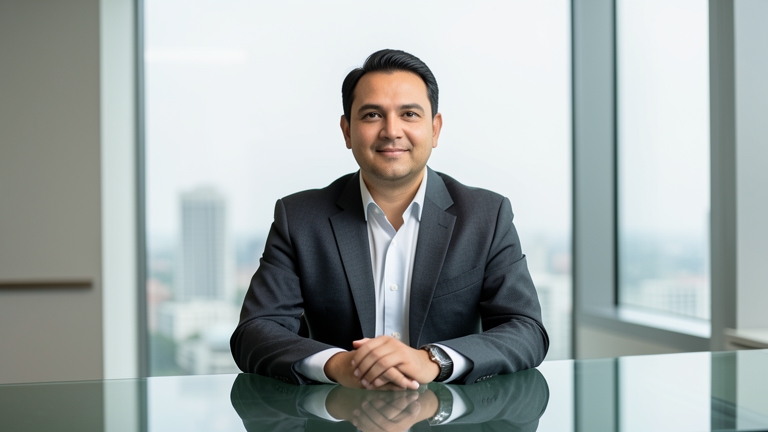
The role of the chief information security officer has undergone a fundamental transformation in banking, shifting from a purely technical gatekeeper to a strategic business enabler. In a recent video interview, Standard Chartered’s group CISO offered rare, candid insights into this evolution, detailing how artificial intelligence is simultaneously strengthening defensive postures and empowering adversaries. The discussion underscored a central truth: security leadership today demands not only deep technical knowledge but also acute business acumen — and AI is accelerating that demand.
The Journey from Technical Expert to Strategic Leader
Standard Chartered’s group CISO described a career arc that many senior security executives now recognize. The path began with deep technical roots — understanding network protocols, vulnerability management, and incident response. But the transition to strategic leadership required a deliberate reorientation. “You cannot lead security for a global bank by simply knowing the latest exploit,” the CISO noted. “You must understand the business: its revenue drivers, its regulatory obligations, its risk appetite.”
This shift is not merely personal; it reflects a broader industry maturation. Fifteen years ago, most bank CISOs reported to the chief information officer and focused almost exclusively on technology risks. Today, many report directly to the board or the CEO, and their remit includes operational resilience, third-party risk, fraud prevention, and even brand reputation. The CISO must speak the language of the business — return on investment, cost of risk, competitive advantage — while still maintaining credibility with technical teams.
Standard Chartered’s CISO emphasized that this dual fluency is hard-won. It requires continuous learning outside of security: reading annual reports, attending strategy sessions, and building relationships with business unit heads. The reward is influence. A CISO who can articulate how a security investment enables a new digital product or simplifies customer onboarding will secure budget far more effectively than one who only warns about threats.
Why Business-Savvy Security Executives Are No Longer Optional
The interview also highlighted a critical gap in the talent pipeline. Many security professionals are promoted based on technical brilliance, yet they lack the strategic and communication skills needed at the executive level. Standard Chartered’s group CISO argued that the industry must develop these competencies deliberately, through mentorship, rotational assignments into business roles, and formal training in finance and corporate strategy.
Business-savvy security executives bring several advantages. They can translate complex risk scenarios into board-friendly language. They can anticipate how regulatory changes — such as the Digital Operational Resilience Act in Europe or the Monetary Authority of Singapore’s guidelines — will affect specific product lines. They can also champion security as a differentiator rather than a cost center. In digital banking, where trust is a currency, a robust security posture can directly influence customer acquisition and retention.
Standard Chartered, with its footprint across Asia, Africa, and the Middle East, faces uniquely diverse regulatory and threat landscapes. The CISO noted that a one-size-fits-all security strategy fails in such a context. Business acumen allows the security team to tailor controls to local market conditions, balancing compliance with commercial agility. This is exactly where AI tools are beginning to play a transformative role.
How AI Reshapes Banking Security: Defensive Capabilities Under the Hood
Artificial intelligence is not a futuristic concept in banking security — it is already embedded in core operations. Standard Chartered’s group CISO described how machine learning models are being used to detect anomalous behavior across millions of transactions, flagging potential fraud or insider threats in real time. These models learn from historical patterns, adapt to new tactics, and reduce false positives far more effectively than static rule-based systems.
One of the most impactful applications is in identity and access management. AI-driven systems can continuously assess user behavior — typical login times, device fingerprints, transaction velocities — and dynamically adjust access privileges. If an employee suddenly accesses a sensitive database from an unusual location at 3 a.m., the system can automatically step up authentication or block the session. This zero-trust approach, powered by AI, significantly reduces the attack surface without hampering productivity.
Network security also benefits. AI algorithms analyze traffic patterns to detect command-and-control communications, data exfiltration attempts, or lateral movement by attackers. Standard Chartered uses advanced threat detection platforms that correlate signals from endpoints, cloud workloads, and network sensors, giving security analysts a unified view of potential incidents. The CISO highlighted that AI does not replace human analysts — it augments them, prioritizing the most critical alerts so that teams can focus on investigation and response.
AI in Fraud Detection: A Case Study in Speed and Scale
Fraud remains one of the biggest financial threats to banks. Standard Chartered processes billions of dollars in payments daily. Traditional fraud detection relied on rules such as “if amount exceeds X, flag for review.” But fraudsters quickly learned to game these rules. AI models, by contrast, can evaluate hundreds of variables simultaneously — transaction amount, merchant category, device reputation, geolocation, even the time between keystrokes on a mobile app. They can score each transaction in milliseconds and approve or block it automatically.
The CISO explained that the bank is now using deep learning models to detect synthetic identity fraud, a growing problem where criminals combine real and fake information to create new identities. These models can spot subtle correlations — such as multiple accounts sharing the same device fingerprint or exhibiting identical spending patterns — that would be impossible for rule-based systems to catch. The result is a significant reduction in fraud losses and fewer false declines that frustrate legitimate customers.
Automated Response and Orchestration
Beyond detection, AI is reshaping incident response. Security orchestration, automation, and response platforms, or SOAR, use AI to automate repetitive tasks: collecting logs, enriching indicators of compromise, opening tickets, and even executing containment actions. Standard Chartered’s group CISO noted that automation has cut average incident response times from hours to minutes for certain classes of threats. This is critical because the window between initial compromise and impact is shrinking — ransomware groups now move from entry to encryption in under an hour in some cases.
However, the CISO warned against over-automation. Every automated action must be carefully tested and gated to prevent unintended consequences, such as blocking a legitimate transaction or isolating a critical server. Human judgment remains essential for high-stakes decisions, especially those involving regulatory reporting or customer communication.
AI Reshapes Adversarial Tactics: The Dark Side of Innovation
The same technology that empowers defenders also arms attackers. Standard Chartered’s group CISO addressed this dual-use nature directly. Adversaries are leveraging generative AI to craft highly convincing phishing emails, deepfake audio for vishing attacks, and even deepfake video for impersonating executives in boardroom calls. The quality of these attacks has improved dramatically, making them harder to distinguish from genuine communications.
One emerging threat involves AI-powered reconnaissance. Attackers can use large language models to scrape publicly available information about bank employees — LinkedIn profiles, conference presentations, internal directory leaks — and generate personalized spear-phishing campaigns at scale. The CISO cited an internal simulation where an AI-generated email mimicking a senior manager’s writing style fooled more than 30% of recipients, compared to fewer than 10% for a conventional phishing test.
AI also enables more adaptive malware. Traditional malware follows a fixed playbook; AI-driven malware can modify its behavior based on the environment it detects. If it finds itself in a sandbox, it can lie dormant. If it encounters antivirus software, it can obfuscate its code. This cat-and-mouse dynamic is accelerating, requiring defenders to continuously update their models.
What is the role of AI in banking security according to Standard Chartered’s CISO?
According to Standard Chartered’s group CISO, AI plays a dual role in banking security: it enhances defensive capabilities by enabling real-time anomaly detection, automated incident response, and advanced fraud modeling, while simultaneously empowering adversaries through more convincing social engineering, adaptive malware, and automated reconnaissance. The CISO emphasizes that banks must invest in AI-driven defenses as aggressively as attackers invest in AI-driven tools, and that security teams must develop new skills to manage and interpret AI outputs effectively.
The Strategic Implications for the Banking Industry
Standard Chartered’s perspective offers a window into how the largest global banks are rethinking security. The CISO’s emphasis on business alignment suggests that AI adoption in security is not just a technology upgrade — it is a strategic imperative. Banks that lag in AI-powered defenses will face higher fraud losses, slower incident response, and greater regulatory scrutiny. Those that lead will gain a competitive edge through lower operational risk and stronger customer trust.
But the CISO also issued a caution. AI models are only as good as the data they are trained on. Biased or incomplete data can lead to false positives that discriminate against certain customer segments or overlook novel attack patterns. Banks must invest in data governance, model validation, and continuous monitoring to ensure fairness and accuracy. Additionally, the reliance on AI creates new attack surfaces: adversaries can attempt to poison training data or manipulate model outputs through adversarial inputs.
The talent challenge extends to AI as well. Standard Chartered’s group CISO stressed that the bank needs professionals who understand both cybersecurity and data science — a rare combination. The bank has invested in internal upskilling programs, partnerships with universities, and recruiting from adjacent fields like quantitative finance and machine learning research. The goal is to build a team that can not only deploy AI tools but also explain how they work to regulators, auditors, and business leaders.
Regulatory Considerations and Future Outlook
As AI reshapes banking security, regulators are paying close attention. Financial authorities in Singapore, Hong Kong, the UK, and the US have issued guidance on the use of AI in risk management, requiring banks to document model governance, bias testing, and explainability. Standard Chartered’s CISO noted that the bank proactively engages with regulators to demonstrate its AI frameworks, turning compliance into a competitive advantage rather than a burden.
Looking ahead, the CISO predicted that AI-driven security will become indistinguishable from normal banking operations. Security controls will be embedded in transaction flows, customer interfaces, and backend systems — invisible to users but continuously adaptive. The role of the CISO will evolve further, from a leader of a security function to a chief risk architect, designing systems that are resilient by design.
Standard Chartered’s own roadmap includes expanding the use of AI for threat hunting, integrating external threat intelligence feeds with internal data, and exploring quantum-resistant cryptography as a hedge against future risks. The group CISO acknowledged that no bank can be perfectly secure, but AI offers the best chance to stay ahead of adversaries — provided that the human element remains at the center of the strategy.
The interview made clear that the future of banking security is not about choosing between humans and machines. It is about building an ecosystem where AI amplifies human judgment, business understanding guides technical investments, and strategic leadership ensures that security enables growth rather than constrains it. For Standard Chartered, and for the banking industry at large, that is the only path forward.