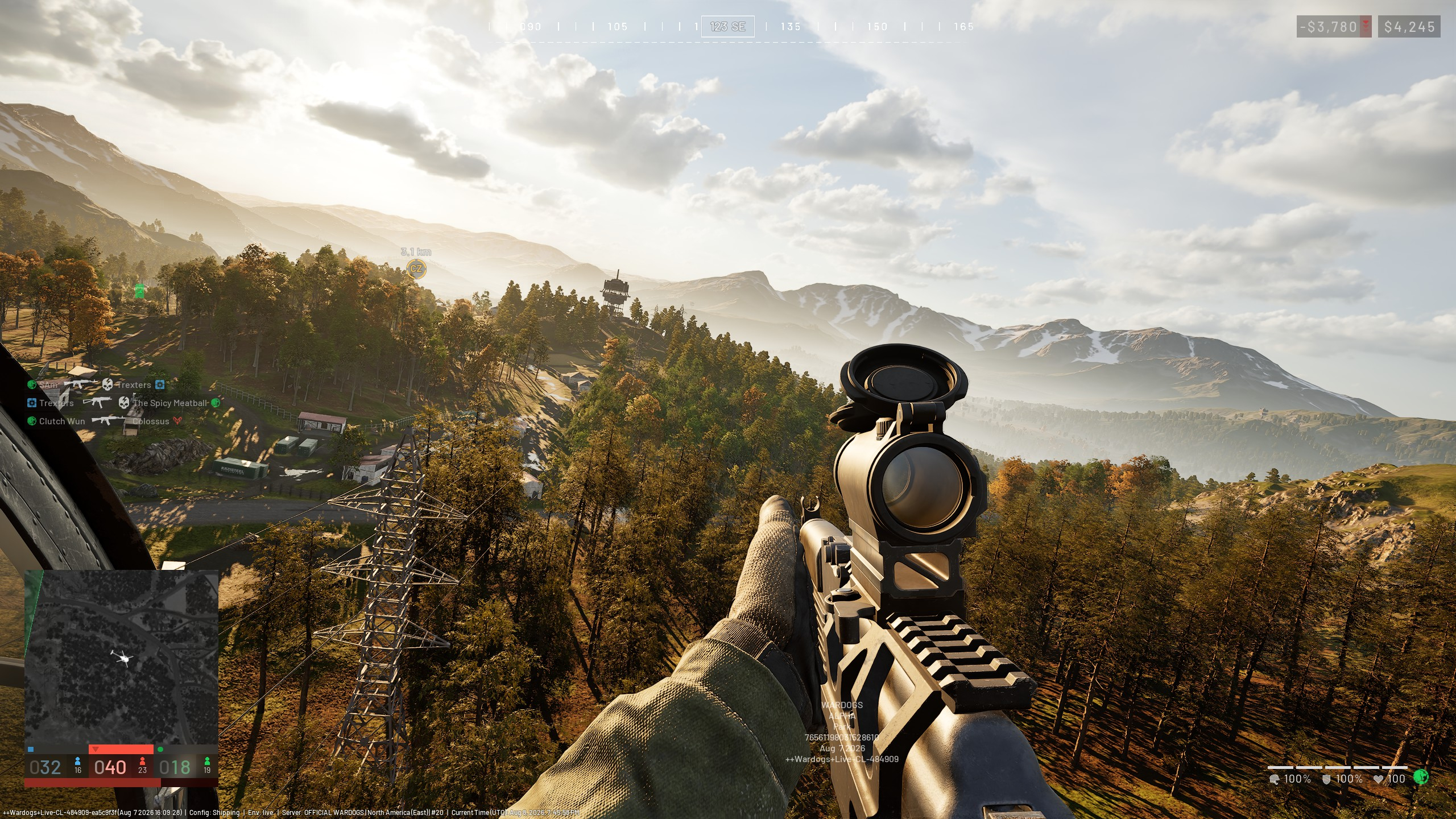
The core of WARDOGS is brilliant. A sandbox where pilots ferry troops, drivers haul supplies, builders erect defenses, and recon spots targets — all inside a single, persistent battle. The raw mechanics work. Helicopters handle well. Gunplay feels weighty. The risk-reward economy of spending your own cash to gear up creates tension that most shooters lack. But there’s a crack running through the foundation, and it’s not the bugs or the crashes. Those will get patched. The real problem is the progression system. Specifically, how it forces players to grind unrelated tasks to unlock the gear they actually want. Until Bulkhead fixes this, WARDOGS will hemorrhage players who hit the level 6 wall and quit.
Here are seven critical issues — but the first four all trace back to one root cause.
Vehicle Gating Makes Logistics a Chore
Drivers start with a Kodiak that can only carry small logistic crates. To get the Ural — the truck that can haul proper pallets — you need driver level 4 (now level 3 after a post-beta update, but that still requires multiple matches of grinding). The problem: those small crates require you to manually unload each item into your backpack, walk it to the FOB, and deposit it one piece at a time. One crate holds 10 units of building materials. A pallet holds 1,000. The difference in efficiency is enormous.
So new drivers spend hours doing tedious fetch quests instead of actually playing the logistics role. By contrast, pilots buy a Little Bird and start ferrying troops immediately. Their XP flows naturally. Drivers have to earn the privilege of doing their job. That’s backwards.
The Support Class Grinds Without Building
Support players combine building and anti-tank roles. At level one, you get an IED that rarely kills vehicles and a basic hammer that can’t even build doors. To unlock the medium hammer (level 7) and large hammer (level 8), you must grind support XP. The fastest way? Join a match, buy a FOB, and build Hesco walls for 45 minutes. Nothing strategic about it. New players plop down random walls just to level up, consuming limited supplies and leaving the base cluttered.
The intended escalation should be: you build small things to unlock bigger things. Instead, you build anything — even poorly — to grind levels. That’s not emergent gameplay. That’s a chore disguised as progression.
The Starting Sniper Rifle is a Noob Trap
The first recon weapon is a break-action single-shot rifle. It costs money to buy, requires a scope unlock, and cannot one-shot an unarmored head. In a milsim-adjacent game where positioning and stealth matter, a sniper that fails to kill on a clean headshot defeats its purpose. Players quickly learn to ignore it and just bring the recon spotting device to level up faster, then switch to the SKS.
The rifle could have a longer reload to balance a one-hit kill. Instead, it does less damage than some assault rifles. That’s a design failure that punishes new recon players who expect a sniper to function like a sniper.
Anti-Tank Forces Irrelevant Play
Support also covers anti-tank. At early levels, you have only the IED — a slow, risky tool that rarely works. To reach the RPG at level 5, you have to grind support XP by… building. That means a player who wants to fight vehicles must spend hours constructing walls and unloading crates. It would be like making pilots wave flags on the helipad before they can fly.
Bulkhead could add a single-shot disposable launcher at level one — weak but functional — so anti-tank players can actually do the job while leveling. Right now, the path to the RPG is so tedious that many players simply never bother. They stay on assault or pilot instead.
The Hot Zone Doesn’t Pay Enough
The central capture point is the hot zone. It’s where the most intense fights happen. Being inside the zone gives 320 in-game cash per 30-second tick. Over ten minutes, that’s 6,400 — not bad. But you almost never survive ten minutes. Mortars, snipers, and infantry converge on that spot. One death costs you your gear. The risk doesn’t match the reward.
A simple fix: triple the tick rate or add a multiplier for kills inside the zone. As it stands, many players ignore the hot zone entirely, treating it as an afterthought until the final minutes. That undermines the entire conflict structure.
Team Coordination Tools are Too Thin
Squad pings vanish after about ten seconds. There’s no personal persistent waypoint. Driving toward a location requires continuously opening the map and re-pinging. Free look for infantry is absent — you can’t scan left and right while moving forward, which is a standard feature in Arma, DayZ, and even Escape from Tarkov. Grenade throwing uses a toggle system (overarm vs. underarm) rather than the intuitive left-click/right-click method that most players expect.
These small annoyances compound. They make WARDOGS feel less polished than its contemporaries. Bulkhead has stated they want a sandbox where players learn by doing. But that philosophy should not extend to ignoring basic quality-of-life features that every other game in the genre already has.
The Missing Tutorial Compounds Everything
WARDOGS has a brief tutorial that teaches basic movement and shooting. It says nothing about hot zones, tower codes, spawn vehicles, or how the supply chain works. New players land in the safe zone and have no idea where to go or what to buy. They die, lose money, and quit.

A tutorial doesn’t have to hold hands. It should explain the core loops: “Here’s the spawn vehicle. It appears at 20 points. One player drives it in and earns cash. This is how you buy ammo. This is how you build a FOB.” Without that, the already-steep progression wall becomes a cliff.
Why the Counterargument Misses the Mark
Some players argue that the grind gives early game meaning. They say the slow progression forces teamwork and makes unlocks feel earned. That’s true — for the first ten hours. After that, the grind becomes a barrier to the fun part: using tanks, artillery, and large-scale logistics. The issue is not that progression exists. It’s that the wrong actions grant XP. You should advance by doing your class job, not by doing unrelated side tasks. Pilot levels fast because pilots fly. Drivers should level by driving supplies, not by wrestling with small crates. Support should level by building useful structures, not by spamming walls.
Bulkhead has already shown they can adjust numbers. They lowered the Ural requirement from level 4 to 3 after feedback. They flattened the XP curve from level 35 onward. But those are band-aids. The deeper fix is to align XP with role identity. Let drivers drive. Let builders build. Let anti-tank players fight tanks. The content is there. The path to it should not feel like homework.
WARDOGS has the bones of a generational tactical shooter. The multiplayer sandbox, the risk economy, the sheer variety of roles — it’s all there. What it needs is the confidence to let players reach the good stuff faster. Not by removing grind, but by making the grind mean something. Every level should say: “You earned this by doing the thing you wanted to do in the first place.” Right now, too many players are building walls when they want to blow up tanks. That’s the fix Bulkhead cannot afford to delay.