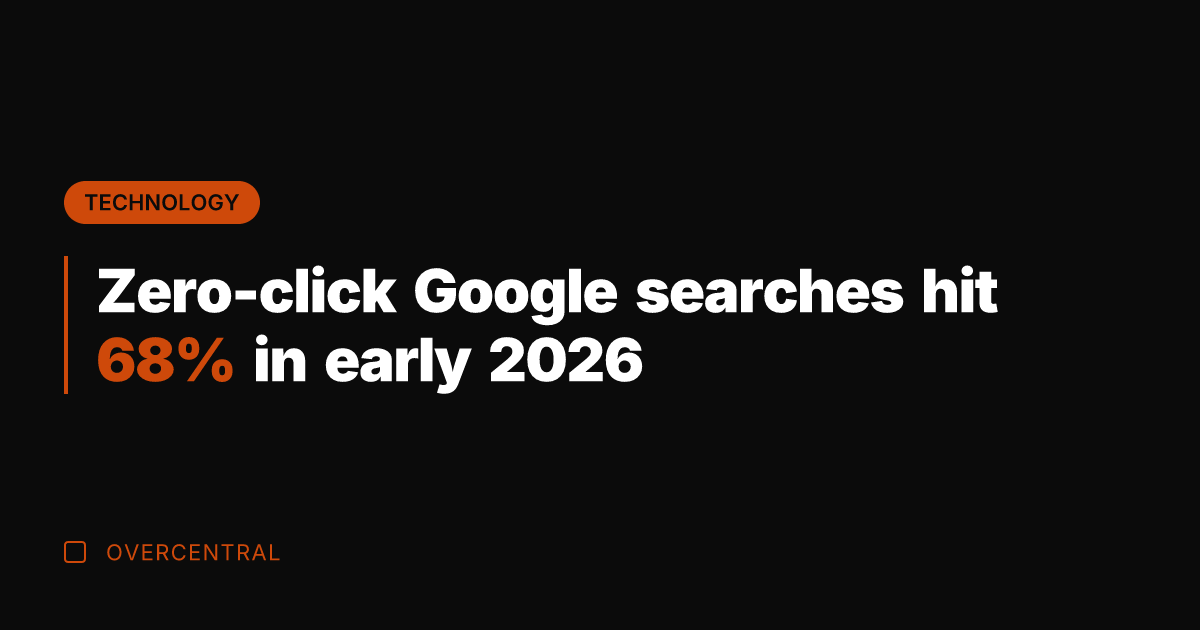
More than two-thirds of all Google searches in the United States now end without a single click to an external website, according to new research that underscores how fundamentally the search landscape has changed. Between January and April 2026, a staggering 68.01 percent of Google searches resulted in zero clicks, up from 60.45 percent in 2024 — a jump of 7.56 percentage points in just two years. The data, published by SparkToro and drawn from Similarweb’s clickstream panel, paints a stark picture for publishers, marketers, and anyone whose traffic depends on Google referrals.
The phenomenon known as zero-click search — where a user finds the information they need directly within Google’s search results and never navigates to an external site — has been climbing for years. But the acceleration between 2024 and 2026 marks a critical inflection point. The share of searches that generated at least one click to any destination, including organic results, paid ads, or Google-owned properties such as Maps and YouTube, fell by 9.51 percentage points during the same period, representing a 22.9 percent decline in click-through activity. Meanwhile, the proportion of searches that led to another Google search — meaning the user refined their query or clicked a follow-up suggestion within the search engine — rose by 7.2 percentage points. This dual trend reveals a search ecosystem that increasingly satisfies queries internally while actively encouraging users to stay within Google’s walls.
AI Overviews Are Accelerating the Zero-Click Shift
Google’s AI Overviews, which generate synthetic answers at the top of search results using generative artificial intelligence, are a major driver of the zero-click trend. SparkToro’s analysis found that AI Overviews now appear on more than 20 percent of all Google searches. When they appear, click-through rates to external sites drop by nearly 60 percent. That collapse in traffic is not subtle: presenting users with a comprehensive AI-generated summary directly in the search results makes clicking through to a publisher’s page far less necessary for many informational queries.
The research does not isolate exactly how much of the overall increase in zero-click behavior between 2024 and 2026 can be attributed specifically to AI Overviews, but the timing is telling. Google began rolling out AI Overviews broadly in mid-2024, and the feature has expanded in both frequency and sophistication since then. The simultaneous rise in zero-click rates strongly suggests a causal relationship, even if the study’s methodology does not attempt to quantify it precisely. What is certain is that the presence of an AI Overview fundamentally changes the economics of search for publishers: the top organic result on a page where an AI Overview appears receives dramatically less traffic than it would have received just a few years ago.
AI Mode: Limited Role So Far, But Rapid Growth Ahead
Google’s AI Mode, a more immersive conversational search interface, played only a minor role during the study period from January to April 2026. SparkToro found that just 0.34 percent of searches transitioned into AI Mode during those months. That figure may seem negligible, but the trajectory demands attention. At Google I/O 2026, the company announced that AI Mode had surpassed 1 billion monthly users and that query volume was more than doubling each quarter. If that growth rate holds, AI Mode could become a significant contributor to zero-click behavior within the next year, especially as Google integrates it more deeply into the core search experience.

The distinction between AI Overviews and AI Mode is important for understanding the landscape. AI Overviews are brief, inline summaries that appear within the standard search results page. AI Mode is a separate, chat-based interface that users can enter from the search results, where they can ask follow-up questions and receive conversational responses. Both reduce the need to visit external websites, but AI Mode does so in a more sustained way, potentially keeping users engaged within Google’s ecosystem for extended sessions rather than sending them elsewhere.
What Is a Zero-Click Search and Why Does It Matter?
A zero-click search occurs when a user enters a query into Google and receives the information they need without clicking any link in the search results. The answer might come from a featured snippet, a knowledge panel, a local business listing, an AI Overview, a direct answer box, or another Google-owned property such as Maps or YouTube. The user finds their answer, or decides to refine their search, and never leaves the search results page.
The implications for businesses and publishers are profound. Every zero-click search represents a lost opportunity to drive traffic to a website, build brand awareness through content consumption, or generate advertising revenue from page views. For years, the standard playbook for digital publishers and marketers centered on search engine optimization: rank highly for relevant keywords, attract organic traffic, and monetize that traffic through advertising, subscriptions, or lead generation. That playbook becomes less effective with every percentage point increase in zero-click behavior.
SparkToro co-founder Rand Fishkin has been tracking zero-click search trends for nearly a decade, and his firm’s research has consistently shown the upward trajectory. The 2026 figure of 68.01 percent is the highest ever recorded in the firms studies, though direct comparisons across years must be treated cautiously because SparkToro has changed its data providers and methodologies over time. Earlier studies relied on different clickstream panels and analytical approaches, so the precise year-over-year numbers are not perfectly comparable. Nevertheless, the directional trend is unmistakable: zero-click searches are becoming the norm, not the exception.
How SparkToro Conducted the Research
The study relied on Similarweb’s desktop and mobile web panel data, covering U.S. Google searches from January through April 2026. SparkToro assumed that two-thirds of searches occurred on mobile devices and one-third on desktops, reflecting typical usage patterns. The analysis excluded searches conducted through Google’s mobile search app, which SparkToro notes may exhibit even higher rates of zero-click behavior because the app environment is designed to keep users within Google’s ecosystem. If the mobile app data had been included, the overall zero-click rate might have been higher than the reported 68.01 percent.
The definition of a click in the study is inclusive: it counts clicks to organic search results, paid advertisements, and Google-owned properties such as Maps, YouTube, and Google Images. It does not count follow-up searches within Google as clicks, which is why the rise in re-searches and the rise in zero-click searches are treated as related but distinct trends. The study also does not count clicks that occur after a user leaves Google and returns later through a different entry point. This methodology provides a conservative estimate of zero-click behavior, meaning the actual rate may be even higher under broader definitions.
Strategic Implications for Publishers and SEO Professionals
The data forces a difficult reckoning for anyone whose business model depends on Google search traffic. If two out of three searches never result in a click, the pool of available clicks is shrinking rapidly, and competition for them is intensifying. For many publishers, doubling down on traditional SEO tactics alone will not be enough to recover historical levels of Google-referred traffic. The search engine is increasingly functioning as an answer engine, not a referral engine, and that distinction changes everything.
Fishkin recommends a strategic pivot toward brand awareness and audience development on the platforms where target audiences already spend their time. This means investing in content and presence on social media platforms, video platforms, podcasts, newsletters, and other channels that do not depend on Google’s intermediation. The goal is to build direct relationships with audiences so that when users need information or products, they think of the brand first — and go directly to its website or app — rather than relying on a Google search that may end in zero clicks.
This does not mean abandoning SEO entirely. Certain categories continue to deliver significant value from search optimization. Branded searches — where users already know the business name and search for it specifically — still generate high click-through rates. Local business queries, such as searches for nearby restaurants, plumbers, or retailers, remain a strong traffic source because Google often displays local results that include clickable links, phone numbers, and directions. High-intent transactional searches, where users are actively looking to make a purchase, also tend to produce clicks because the user’s objective is to complete a transaction on a merchant’s site. These pockets of search behavior remain viable for SEO investment, but they represent a shrinking share of overall query volume.
The Long-Term Trajectory of Zero-Click Search
SparkToro’s historical data, while not directly comparable due to methodological changes, consistently shows a long-term rise in zero-click behavior. The trend predates the generative AI era. Google has been adding features to its search results page for years — knowledge panels, direct answer boxes, calculator tools, flight price comparisons, sports scores, weather forecasts, and more — that reduce the need to click through to external sites. The company’s business incentives align with this shift: keeping users within Google’s ecosystem allows the company to serve more ads, collect more data, and provide a more controlled experience that reduces the risk of users leaving entirely.

AI Overviews and AI Mode represent the next phase of this evolution, not a departure from it. Generative AI allows Google to synthesize information from multiple sources and present it in a coherent, conversational format that often eliminates the need for any further exploration. The technology is improving rapidly, and as it becomes more accurate and comprehensive, the share of queries that can be fully satisfied within Google will only grow. The question for publishers is not whether the zero-click trend will continue, but how to adapt their businesses to a world where direct search traffic is a diminishing resource.
One of the most telling statistics in the SparkToro study is the rise in re-searches within Google. When users do not find exactly what they need, they increasingly refine their query rather than clicking a result and browsing an external site. This behavior suggests that users have learned, through repeated experience, that clicking a search result often leads to a page that is less immediately useful than the search results page itself. Google has trained its users to stay put, and the data shows that training is working.
Practical Steps for Navigating a Zero-Click World
Publishers and marketers who recognize the trajectory can take concrete steps to reduce their dependence on Google search traffic. Building an email list or newsletter subscriber base creates a direct communication channel that does not rely on any search engine. Investing in original research, proprietary data, and unique analysis gives audiences a reason to visit a site directly because they cannot find that information aggregated in Google’s search results. Developing a strong brand identity and maintaining an active presence on social media platforms, YouTube, podcasts, and industry events helps ensure that when users think about a topic, the brand comes to mind before they open a search engine.
Content strategy must also evolve. In a zero-click environment, the goal of content can no longer be solely to rank in Google and attract clicks. Content should be designed to build authority, demonstrate expertise, and create demand that manifests through direct visits, branded searches, and word-of-mouth referrals. The content itself may still be discovered through search, but the business model for that content must account for the high probability that many users will see the content summarized in an AI Overview or featured snippet and never click through.
Technical SEO remains important, but its role shifts. Rather than focusing exclusively on driving traffic volume, SEO should focus on appearing in the search features that Google prioritizes — AI Overviews, featured snippets, knowledge panels, and local packs — so that a brand’s information is presented to users even when no click occurs. Being the source that Google chooses to summarize is valuable for brand visibility, even if that visibility does not translate directly into website visits.
The 68 percent zero-click figure is not just a statistic. It is a signal that the relationship between search engines and publishers has fundamentally changed. For years, that relationship was symbiotic: Google sent traffic, publishers created content, and both benefited. The new model is less reciprocal. Google increasingly keeps the value for itself, delivering answers directly to users and capturing the advertising revenue that those users generate, while publishers are left to compete for a shrinking pool of referral traffic. Adapting to this new reality requires not just tactical adjustments in SEO, but a strategic rethinking of how brand value is built and captured in an era when the search engine no longer needs to send visitors anywhere else.