
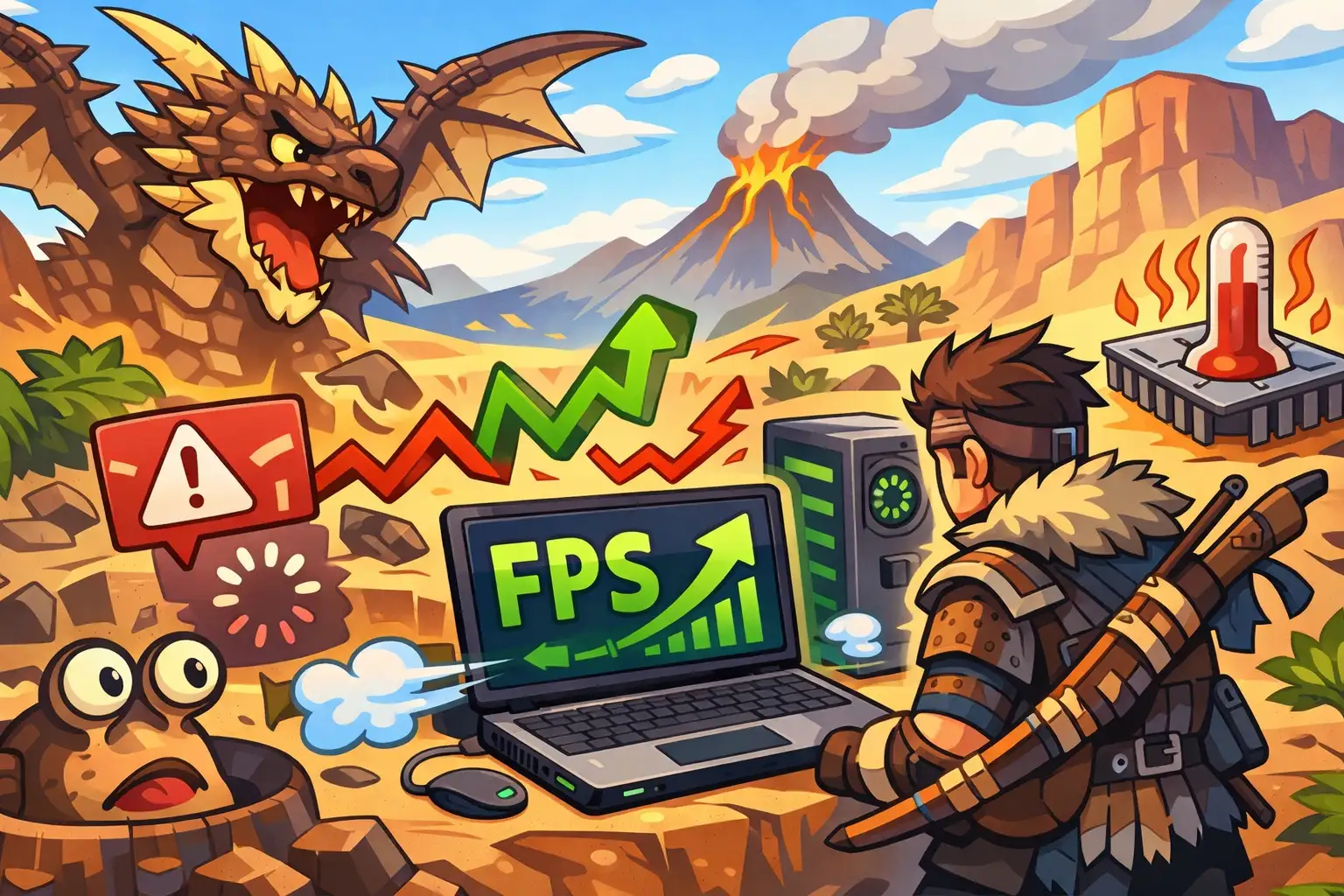
Capcom released a significant performance-focused update for Monster Hunter Wilds and Resident Evil Success“>Monster Hunter Wilds on PC this week, addressing widespread complaints about stuttering, frame rate instability, and optimization problems that have plagued players since the game’s launch. The update, deployed globally on Tuesday, specifically targets technical issues that have hindered the gaming experience for PC users running the highly anticipated action RPG.
Technical Challenges Plaguing PC Launch
Monster Hunter Wilds launched with notable performance discrepancies between PC and console versions. Players reported inconsistent frame rates, particularly during intense combat sequences with multiple large monsters. The game’s demanding graphics and complex creature AI pushed many PC configurations to their limits.
Digital Foundry’s technical analysis revealed that even high-end systems struggled with frame time inconsistencies. Their testing showed frame rate drops of up to 40% in areas with dense vegetation and particle effects. This performance degradation occurred across various hardware combinations, suggesting engine-level optimization issues rather than specific hardware incompatibilities.
Update Breakdown: What Changed
The highly anticipated new patch for the title represents a substantial and focused engineering effort, primarily zeroing in on core system-level performance bottlenecks that have long been a point of discussion within the PC gaming community. This comprehensive update delivers a suite of sophisticated optimizations targeting two of the most critical components of any gaming system: CPU utilization and memory management. By re-architecting how the game’s engine handles these resources, the developers at Capcom have made significant strides in creating a markedly smoother and more consistent experience for players.
Delving into the specifics outlined in the official patch notes, a primary achievement of this update is a complete overhaul of the game’s texture streaming efficiency. Texture streaming is the process by which high-resolution textures are dynamically loaded from the storage drive into the GPU’s video memory as needed, preventing the game from requiring an impossibly vast amount of VRAM all at once. However, inefficient streaming can cause noticeable and immersion-breaking stuttering and frame-time spikes, particularly when the player swiftly turns a camera or rapidly traverses into a new, graphically dense area. The latest patch introduces a more intelligent and predictive streaming algorithm. This enhanced system better anticipates the assets required next, loading them seamlessly in the background during gameplay moments that are less resource-intensive. The result is a dramatic reduction, if not a full elimination, of the frustrating hitching that previously occurred during these intense transitional moments.
Furthermore, the development team has directly confronted the pervasive and notoriously complex issue of shader compilation stutter, a challenge that has plagued a significant number of modern PC game releases. Unlike console games, where every system has identical hardware, the immense diversity of PC graphics cards and drivers means that the game cannot ship with pre-compiled shaders for every possible configuration. Instead, these crucial bits of code, which tell the GPU how to render specific lighting, shadow, and material effects, must be compiled on-the-fly the first time they are encountered. This compilation process is computationally demanding and, if not handled gracefully, can cause the game to freeze for a fraction of a second. Capcom’s patch implements a more robust and efficient approach to this process, likely involving optimizations to the compilation pipeline itself and potentially a more effective background caching system. This crucial fix ensures that these necessary compilations cause minimal disruption, leading to a far more fluid and stable framerate throughout the entire gameplay experience, from the opening cinematics to the final credits.
Graphics settings receive granular controls allowing better hardware-specific tuning. Players can now adjust shadow quality, texture filtering, and post-processing effects independently. The update adds DLSS 3 and FSR 3 support, providing frame generation options for compatible hardware. These technologies can significantly boost performance on mid-range systems.

Community Response and Testing
Early adopters report noticeable improvements in gameplay smoothness. Steam user reviews show a recent uptick in positive ratings specifically mentioning performance gains. Hardware testing channels like Hardware Unboxed documented frame rate improvements of 15-25% on equivalent settings compared to pre-patch benchmarks.
Community testing reveals that CPU-bound scenarios show the most significant improvements. Areas with multiple AI-controlled creatures now maintain more stable frame rates. The patch reduces CPU overhead by optimizing how the game handles simultaneous creature behaviors and environmental interactions.
Technical Deep Dive: The Fixes Explained
The latest update introduces a suite of behind-the-scenes optimizations, with the most impactful change being the sophisticated implementation of dynamic resolution scaling. Previously, the system might have struggled to maintain a consistent frame rate when encountering sudden, graphically demanding scenes, such as explosive particle effects or densely populated urban environments. The revised system is now far more responsive and intelligent. It continuously monitors the GPU’s workload in real-time, making subtle, granular adjustments to the rendering resolution the instant it detects potential performance bottlenecks. This proactive approach ensures that the game can gracefully lower the resolution for a few frames to counteract a dip in performance, then seamlessly scale it back up once the demand subsides. The result is a remarkably stable and fluid frame rate that effectively eliminates the jarring, sudden frame drops that previously disrupted gameplay immersion during the most critical and visually spectacular moments.
Complementing this dynamic scaling is a comprehensive overhaul of the game’s memory management, specifically targeting VRAM (Video Random Access Memory) allocation and streaming. The engine now demonstrates a much more efficient and predictive approach to handling high-resolution textures and asset data. Instead of over-allocating or suffering from cache misses, the new system preemptively loads necessary assets and purges unused ones with greater intelligence, significantly reducing the incidence of VRAM-related stuttering and hitching. This is particularly transformative for players using systems equipped with 8GB graphics cards, a common hardware configuration. These users will notice a dramatically smoother experience, especially when traversing large open worlds or quickly panning the camera across complex scenes, as the game no longer struggles to fetch texture data under memory pressure. The combined effect of these two key improvements—swift dynamic resolution and smarter memory handling—creates a consistently responsive and visually stable environment, allowing players to fully engage with the game’s content without technical distractions.
Capcom engineers rewrote portions of the rendering pipeline to better utilize multi-core processors. Previous versions showed poor CPU thread distribution, leaving performance potential untapped. The new implementation better balances workload across available cores, especially important for CPUs with higher core counts.
Industry Context: PC Port Quality Trends
Monster Hunter Wilds joins a growing list of high-profile games facing PC optimization challenges at launch. The industry has seen increasing scrutiny of port quality following several problematic releases. Digital Foundry’s John Linneman notes that Capcom’s relatively quick response sets a positive precedent for post-launch support.
Recent industry analysis by Nvidia indicates that properly optimized PC ports can see sales increases of up to 30% compared to poorly optimized counterparts. This economic incentive drives publishers to prioritize performance patches, especially for multiplayer-focused titles where technical issues directly impact player retention.
Expert Analysis: Why PC Optimization Matters
“PC gaming’s hardware diversity creates unique optimization challenges,” explains Dr. Elena Rodriguez, computer science professor at Stanford University. “Games must perform adequately across thousands of hardware combinations. Capcom’s approach of addressing both high-end and entry-level systems shows understanding of the PC market’s segmentation.”
Industry analyst Michael Pachter notes that performance patches significantly impact long-term player engagement. “Games that receive prompt technical support see higher concurrent player counts months after launch. For live service titles like Monster Hunter Wilds, this directly translates to sustained revenue from cosmetic and expansion sales.”
Hardware Requirements Revisited
The performance improvements make the game more accessible to mid-range systems. Pre-update, systems meeting minimum specifications often struggled to maintain 30fps at 1080p. Post-update testing shows these same configurations achieving consistent 45-50fps with optimized settings.
Recommended specifications now more accurately reflect actual performance. Systems with RTX 3060 or RX 6600 XT graphics cards can now achieve stable 60fps at 1440p with DLSS or FSR enabled. This represents a significant improvement over launch conditions where even high-end hardware struggled with consistency.

Multiplayer Performance Enhancements
The update specifically addresses network-related performance issues during four-player hunts. Previously, joining other players’ sessions could introduce additional stuttering as the game synchronized complex creature behaviors across clients. The patch improves netcode efficiency, reducing the performance penalty of multiplayer sessions.
Capcom’s implementation of rollback networking for certain gameplay elements helps maintain smooth performance during latency spikes. This technique, common in fighting games, proves effective for action RPGs where timing precision matters for combat mechanics.
Future Optimization Roadmap
Capcom’s communications indicate continued performance monitoring and additional optimization passes. The development team specifically mentions investigating ray tracing performance for future updates. Current ray tracing implementation remains demanding even on high-end hardware.
The company plans to gather performance data from the updated version to guide further improvements. Player feedback through official channels will help prioritize which areas receive attention in subsequent patches. Community testing suggests VRAM optimization remains an area for potential future gains.
Broader Implications for PC Gaming
This update demonstrates the growing importance of post-launch support in the games-as-a-service era. Players increasingly expect ongoing optimization, especially for full-priced titles. Capcom’s responsive approach may influence industry standards for PC port quality assurance.
The successful implementation of modern upscaling technologies sets a benchmark for other developers. Proper DLSS and FSR integration can significantly extend the viable lifespan of hardware, particularly important as GPU prices remain elevated. This approach benefits both players and developers by expanding the potential audience.
What to Watch Next
Industry observers will monitor whether these performance improvements translate to increased player retention. Steam player count data over the coming weeks will indicate whether technical fixes successfully address launch-period attrition. Capcom’s next financial report may reveal whether the update positively impacted sales figures.
Future patches will show whether Capcom maintains this commitment to optimization. The company’s handling of eventual expansion content will test whether learned optimization techniques carry forward. Competitors may study this case when planning their own PC launch strategies.