Twenty-five years ago, a massive black box crashed into the living room and changed the console wars forever. The original Xbox was brash, oversized, and unapologetically American — a bet from a software company that had never built hardware before. Now, for the 25th anniversary of that gamble, Microsoft is bringing back the one design element that defined its first console more than any specification: the translucent green shell. The Xbox Series X25 Limited Edition is not a next-generation machine. It is a collector’s item, a time capsule, and perhaps the most emotionally resonant piece of hardware Microsoft has ever produced for the Xbox brand.
What Is the Xbox Series X25 Limited Edition?
Unveiled at the Xbox Games Showcase 2026, the Xbox Series X25 Limited Edition is a commemorative variant of the existing Xbox Series X, wrapping the current-generation hardware in a translucent green chassis that directly echoes the iconic “OG Green” of the original 2001 console. Under the hood, the specifications remain identical to the standard Xbox Series X — the same custom AMD processor, the same 1TB SSD, and the same 12 teraflops of graphical performance. This is not a mid-generation refresh or a performance upgrade. It is a deliberate exercise in nostalgia, a collector’s model designed to commemorate two and a half decades of Xbox history through industrial design rather than raw power.
The details, however, are where the X25 distinguishes itself. The top-facing “X” logo glows in green, a direct callback to the boot animation of the original Xbox. The front panel carries a 25th anniversary emblem. Microsoft has also teased the presence of “hidden surprises” embedded in the console, inviting owners to examine every surface of the unit for Easter eggs and community-specific callbacks. For a generation of players who grew up with the original Xbox, the X25 offers something no spec sheet can capture: the feeling of unpacking a machine that looks like the one they remember, but built with two decades of engineering refinement.
The Controller: A Duke Homage in Translucent Green
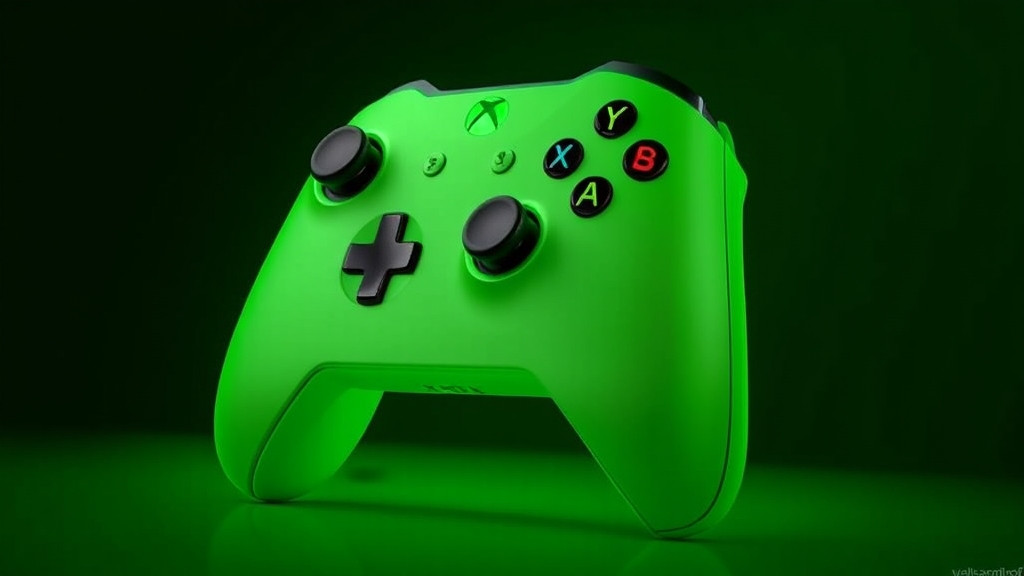
Microsoft is releasing a matching controller — the Xbox Wireless Controller X25 Special Edition — a full month ahead of the console itself, in October 2026. The controller is arguably the more interesting piece of the announcement, because it reaches further back into Xbox history than the console shell alone.
The X25 controller adopts the translucent OG Green finish, but its design language is a deliberate homage to the original “Duke” controller — the famously oversized, divisive gamepad that shipped with the first Xbox. The ABXY buttons revert to the original color scheme: green A, red B, blue X, and yellow Y. The bumpers follow the Duke’s black-and-white layout. Most strikingly, the rear shell and battery cover are fully transparent, revealing an internal Xbox logo embossed on the chassis inside the controller.

For Japanese players, the Duke homage carries a particular historical irony. When the original Xbox launched in Japan in February 2002, the Duke was deemed too large for local hands and was replaced in-box with the smaller “Xbox Controller S” — which later became the global standard for Xbox gamepads. Twenty-five years later, Microsoft is effectively celebrating the design it had to abandon to win outside its home market. That the company now feels confident enough to issue a Duke-inspired controller as a flagship anniversary product says something about how far the brand has come — and how differently it views its own history.
Pricing, Availability, and the Specter of Scalping
Microsoft has not announced pricing or pre-order dates for either the console or the controller. As a reference point, the standard Xbox Series X with a disc drive and 1TB storage currently retails for approximately 87,980 yen in Japan. A limited-edition model will almost certainly carry a premium, but the company has declined to provide specifics.
Availability is described as “select markets,” a phrase that raises immediate questions for international buyers. Whether Japan — a market where Xbox has historically struggled — will be included remains unconfirmed. The limited nature of the run, combined with the nostalgic appeal, has already triggered concerns about scalping. For collectors in regions where the console does not launch officially, the secondary market may be the only option, and prices there are unpredictable.
The decision to release the controller a month early, in October 2026, is a smart logistical move. It gives fans something to purchase and enjoy while they wait for the console, and it may also help Microsoft gauge demand before the higher-priced console units ship in November.
Xbox Through the Generations: A 25-Year Timeline
To understand what the X25 represents, it is worth placing it against the full arc of Xbox hardware history. The original Xbox launched in North America on November 15, 2001, and in Japan on February 22, 2002 — a delayed entry that set the tone for the platform’s long, complicated relationship with the Japanese market. The Xbox 360, released in November 2005, became the brand’s high-water mark in Japan, achieving a brief but real presence. The Xbox One generation, launching in November 2013, saw that position erode significantly. The Xbox Series X|S, which arrived in November 2020, stabilized the brand but did not reverse the broader trend.
The X25 sits at the end of this arc as a commemorative capstone — a device that does not try to win new converts but instead rewards those who have stayed. It arrives at a moment when Microsoft’s strategy is shifting: Japanese-developed titles have begun appearing more prominently in Xbox showcases, and the company’s acquisition of Activision Blizzard has reshaped its library. The X25 is not the product of a company fighting for market share. It is the product of a company celebrating its survival.
Why the Japanese Market Still Matters for This Launch
The original Xbox’s Japanese launch was a spectacle. Bill Gates himself handed units to customers at the Shibuya TSUTAYA store — a moment captured in photographs that still circulate among Xbox historians. Yet the platform never achieved sustained momentum in Japan. The “Western game box” label stuck, and it never fully came off.
That history makes the X25’s “select markets” language particularly loaded. If Microsoft includes Japan in the launch, it would signal a continued commitment to a market that has never been profitable for the brand. If it excludes Japan, it would be consistent with recent sales realities but would disappoint the small but devoted Japanese Xbox fanbase that has kept the platform alive there. A Japanese release would be the clearest possible message that Microsoft sees its anniversary not just as a North American celebration, but as a global one.
For Japanese collectors, the X25 may end up being more difficult to obtain than any Xbox before it — not because of price, but because of geography. And in a strange way, that exclusivity may only deepen its appeal.
The Xbox Series X25 is not a console that needs to prove anything. It does not need to sell millions of units or shift market share. It exists to mark time — to remind anyone who remembers the original translucent green box that the brand has endured, evolved, and, in its own way, found reasons to celebrate. For the people who were there in 2001, that may be enough.