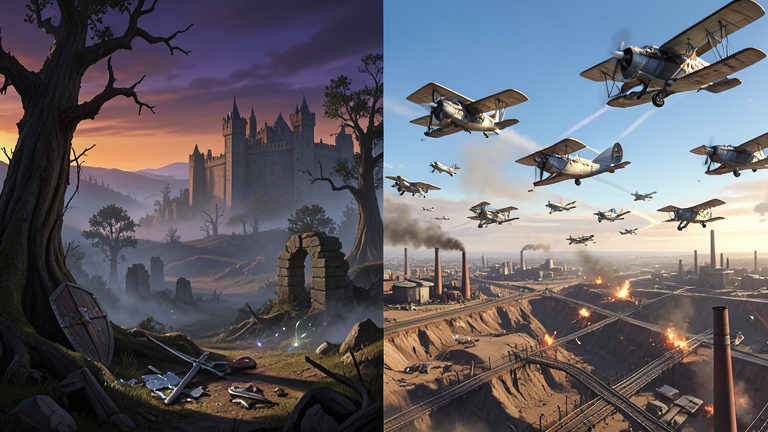
This week, the indie MMO landscape took a decisive turn skyward as two very different titles pushed aerial gameplay to the forefront. Eldramoor, the ambitious sandbox fantasy MMO from indie developer Team Peregrine, officially launched its closed beta testing phase, inviting players to explore its magical floating continents. Meanwhile, Foxhole, the persistent war simulation that has defined large-scale logistic and tactical combat for years, introduced a comprehensive revamp of its aerial warfare systems, fundamentally altering how players approach air superiority. Together, these updates signal a broader trend in the indie space: developers are no longer treating flight as a mere traversal mechanic, but as a core pillar of strategic depth and worldbuilding.
Eldramoor Enters Closed Beta: A Floating World Takes Shape
Eldramoor’s closed beta launch marks a critical milestone for a project that has been steadily building community interest since its initial concept reveal. The game positions itself as a purely sandbox-driven MMORPG, where player agency dictates everything from settlement construction to magical research. The beta, which went live early this week, grants access to a carefully curated slice of the world — a series of floating islands connected by wind currents and ancient teleportation gates. This vertical geography is not just aesthetic; it fundamentally changes how exploration, resource gathering, and PvP encounters unfold. Players must learn to harness flight mechanics that are unlike the typical mount-based or glide systems seen in mainstream MMOs. Instead, Eldramoor treats flight as a skill tree, with abilities such as controlled hovering, wind-draft riding, and combat aerial maneuvers unlocked through progression.
The beta includes the game’s first major PvE region, the Skyreach Archipelago, where players face airborne elemental creatures and corrupted aether spirits. Crafting and housing systems are also present, allowing testers to build floating platforms and airships. Community feedback from the first few days suggests that the flight model’s learning curve is steep but rewarding. Several early testers have noted that aerial combat feels intuitive once they adjust to the three-dimensional movement, and that the verticality adds a much-needed layer of strategy to base building — players can now construct defensible positions that are difficult to reach without proper flight training. What remains to be seen is whether Eldramoor can maintain this sense of wonder over the long haul, especially as the beta progresses into endgame content and large-scale player-versus-player territory wars.
What Exactly Is Eldramoor? A Quick Overview
For readers unfamiliar with the title, Eldramoor is an indie sandbox MMORPG built on a custom engine that emphasizes dynamic world simulation. There are no level caps in the traditional sense; instead, players accrue expertise across a wide spectrum of disciplines — combat, crafting, exploration, and magic. The game world is divided into floating landmasses, and travel between them relies on mechanical or magical flight. There are no fast travel points; players must navigate the sky using either their own flight skills or built airships. This design forces a constant engagement with the environment, and the new beta is the first public test of how those systems hold up under player load. The developers have stated that the beta will run for several weeks, with wipes planned before the full launch. Early adopters who provide detailed bug reports and balance feedback will receive exclusive cosmetic rewards and permanent early access to certain flight skill lines at launch.
Foxhole’s Aerial Gameplay Revamp: Bombers, Fighters, and Supply Lines
Across the indie MMO spectrum, Foxhole has been undergoing its own transformation in the skies. The game, known for its realistic persistent war mechanics where every bullet, tank, and building is player-made, has historically limited air power to simple transport planes and improvised gliders. That changed this week with a significant patch that introduces a full suite of new aerial combat systems. The update adds two new aircraft classes: the light fighter, designed for dogfighting and reconnaissance, and the heavy bomber, capable of dropping large ordnance on enemy fortifications. Both aircraft are built in player-operated factories, requiring a steady supply of rare materials such as aircraft aluminum and high-octane fuel. This means that air power is not just a tactical decision — it is a logistical investment that must be planned days in advance by the war effort’s logistics squads.

The revamp also reworks the existing flight controls, adding a more physics-driven model with drag, lift, and stall mechanics. Pilots now have to manage engine temperature and fuel consumption, making long-range bombing runs a true test of planning and skill. The patch introduces anti-aircraft emplacements that can be built by both factions, creating a new arms race between ground-based air defense and airborne attack. Early reports from the Foxhole community indicate that the new system has dramatically shifted frontline dynamics. Where previously battles were decided by infantry and armor pushes, now coordinated air strikes can break sieges and threaten enemy supply convoys from unpredictable angles. However, the complexity of the supply chain means that only well-organized regiments can field effective air forces, which has led to a higher barrier to entry for solo players. The developers have acknowledged this and mentioned that they are monitoring balance data to possibly introduce air-dedicated logistics roles in future updates.
How Does Foxhole’s New Aerial Combat Work?
The revamped aerial gameplay in Foxhole centers on two key mechanics: aircraft production and piloting physics. Players must first research aircraft technology in their faction’s tech tree, then construct airfields near the front lines. Building a single light fighter requires around 200 components of refined materials, including steel plates and explosive powder for ammunition. Once airborne, pilots control their aircraft using a combination of throttle, pitch, yaw, and roll. The new physics engine introduces stall behaviour if the aircraft loses too much speed during sharp turns, and dive bombing requires careful angle control to avoid crashing on impact. The heavy bomber, in particular, demands a crew of two — a pilot and a bombardier — who must coordinate to accurately drop bombs on static installations such as bunker bases or resource mines. Anti-air defenses, which include machine gun batteries and radar-guided flak cannons, can be built by both factions and are now a critical part of any fortified position.
Two Approaches to Aerial Gameplay: Sandbox Magic vs. Persistent War
While Eldramoor and Foxhole are both indie MMOs that have taken to the skies this week, their design philosophies could hardly be more different. Eldramoor treats flight as a personal journey of skill advancement — a player can spend hours mastering the wind currents and unlocking new maneuvers. Foxhole, by contrast, treats flight as a team-dependent industrial project. In Eldramoor, a single player can craft their own flying mount and explore the archipelago at will. In Foxhole, fielding even one bomber requires the coordinated effort of half a dozen players across logistics, construction, and combat roles. This distinction reflects a deeper split in the indie MMO space between player-driven narrative sandboxes and simulation-driven persistent war games. Eldramoor’s beta invites players to define their own stories through exploration and creative base-building. Foxhole’s update reinforces its core value proposition: that every action has a cost, and that victory in war is as much about resource management as it is about reflexes.
Interestingly, both games have seen a surge in player interest following their aerial updates. SteamDB data shows that Eldramoor’s beta launch weekend attracted over 15,000 concurrent players, a strong showing for a title that has not yet held a large marketing campaign. Foxhole, already a well-established game with a dedicated player base, saw its average concurrent users increase by roughly 20% in the week following the aerial revamp patch. The cross-pollination of interest is notable: players who enjoy Foxhole’s logistical depth are also checking out Eldramoor’s sandbox, and vice versa. This suggests that the thirst for meaningful, player-driven aerial gameplay is not genre-specific.
What This Means for the Indie MMO Landscape
The simultaneous release of major sky-centric updates from two prominent indie MMOs is unlikely to be a coincidence. Both developments reflect a maturation of the indie development ecosystem, where small teams can now tackle complex systems like physics-based flight and supply-chain logistics that were once the province of AAA studios. The rise of procedural generation and advanced networking solutions has made it feasible to create worlds where vertical movement is not just a gimmick but a core mechanic. For Eldramoor, the successful beta launch demonstrates that there is an audience for high-risk, high-reward sandbox systems that eschew hand-holding. For Foxhole, the revamp shows that even a six-year-old game can find new life by deepening its systems rather than simply adding new content. Both titles are now well-positioned to attract players who are dissatisfied with the often formulaic flight implementations in bigger-budget MMOs like World of Warcraft or Final Fantasy XIV, where flying is often a convenience feature unlocked after hitting level cap.
Another important takeaway is the growing emphasis on player agency. In Eldramoor, the ability to fly from the very start of the beta empowers players to explore and make meaningful choices about where to build and what to fight. In Foxhole, the new aircraft give players a new tool of asymmetric warfare — a small squad of pilots can disrupt a much larger enemy force if they can secure the supply lines to operate. This is a direct response to the community’s long-standing requests for more strategic depth. The developers of both games have been transparent about their design goals, releasing detailed patch notes and design diaries that walk through the technical challenges of implementing flight. They have also established direct feedback channels where players can report issues and suggest balance changes. This level of engagement builds trust and ensures that the updates are shaped by the actual player base, not just top-down design.
Will Eldramoor Succeed Long-Term? Key Questions Players Are Asking
Many potential players are asking whether Eldramoor will have enough content to sustain interest beyond the beta. Based on the current beta build, the game offers several hours of exploration and base-building, but endgame progression is still in development. The developers have indicated that the full launch will include at least three distinct island biomes, each with unique resources and enemies, as well as a player-run economy where trade between islands is facilitated by airships. The success of the game will likely hinge on the depth of its crafting and magic systems, both of which are being stress-tested during the beta. Another common question is whether the flight system will be accessible to casual players. The initial feedback suggests that while the learning curve is present, the game does offer a tutorial mode for flight basics. The developer has also promised to add optional flight assist features for players who find the raw physics model too challenging. In contrast, Foxhole players are more concerned with balance: will the new bombers make ground fortifications obsolete? Early data from the first week of the revamp shows that well-built bunker bases with anti-air coverage are still highly effective, but that bombers can break sieges that have stalled for days. The developers have promised to monitor and adjust aircraft health and damage values if air power becomes dominant.
Technical Hurdles and Future Outlook
Both updates required significant engineering work. Eldramoor’s beta runs on a heavily modified version of the Unreal Engine 4, with custom shaders for volumetric clouds and wind simulation. The server-side authority system for flight is notoriously difficult because prediction errors in networked environments can cause rubber-banding. The team has implemented a client-side interpolation system that smooths out network imperfections, but early testers have reported occasional desync during high-speed chases. The developers have acknowledged these issues and are working on a server tick rate increase for the next patch. Foxhole, meanwhile, operates on its own custom netcode designed for large-scale persistent warfare. Adding physics-driven aircraft to a game already dealing with thousands of players, thousands of vehicles, and hundreds of player-built structures was a monumental task. The developer has mentioned that the new aircraft physics are calculated on a separate thread to prevent lag, and that the anti-air system uses a simplified hit-scan model to reduce server load. Both teams have shown a willingness to iterate quickly, which bodes well for the long-term health of these features.
Looking ahead, the next few weeks will be critical for both games. Eldramoor’s beta will test the servers’ capacity to handle a full population, especially during weekend events. The developers have announced a first major in-game event, the Aether Storm, where players must band together to defend a central floating city from waves of corrupted creatures. Foxhole’s next war will begin shortly with the new aircraft systems active, and the community is already speculating about how combined arms tactics will evolve. Both titles are setting a high bar for what indie MMOs can achieve, proving that you don’t need a AAA budget to deliver compelling, dynamic aerial gameplay. For players who love the idea of mastering the skies — whether as a lone mage gliding between islands or as a bomber pilot coordinating a strike with a ground assault — this week has been one of the most exciting in recent indie MMO history. The sky, it seems, is no longer the limit; it is the new frontier.