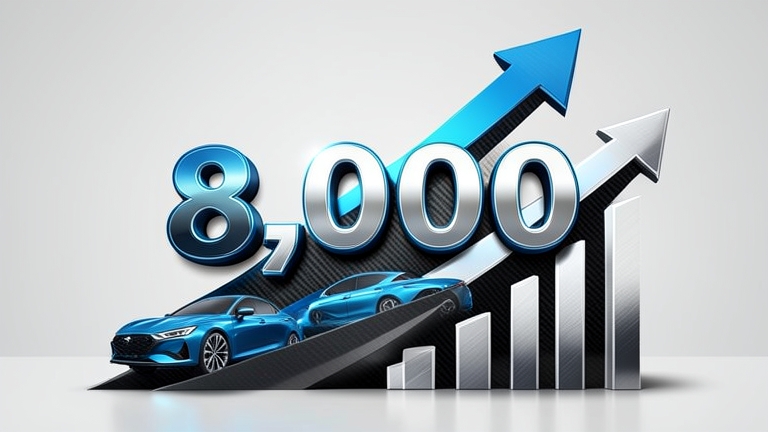
When Kia first unveiled the EV2, the automotive world took notice not because of radical design or blistering performance, but because of the price tag. A genuinely affordable, European-built electric SUV from a major manufacturer represented a gamble: would buyers trust a small, entry-level EV in a market still navigating range anxiety and charging infrastructure? The answer, delivered in the first three full months of sales, is a resounding yes. Kia has reported that over 8,000 EV2s were sold between May and July 2026, following its April order launch, signaling that the strategy of accessibility is paying off in a tangible and significant way.
Kia EV2 Sales Surpass 8,000 Units in First Quarter of Availability
According to early sales data from the first half of 2026, Kia EV2 sales reached 8,567 units. Critically, since the model went on sale in mid-April, over 8,000 of those units were sold in the three-month period spanning May, June, and July. This rapid uptake positions the EV2 as a serious contender in the fiercely competitive European electric vehicle market. In June alone, the EV2 became Kia’s second-best-selling electric vehicle in Europe, trailing only the popular EV3 SUV. This internal performance is particularly noteworthy because the EV3 is a larger, more established model with a longer sales history. The EV2’s ability to immediately challenge its sibling for market share within the same brand underscores the pent-up demand for a smaller, more affordable electric option.
The EV2 is Kia’s first electric vehicle designed and built in Europe, a strategic move that likely enhances its appeal to buyers who prioritize local manufacturing and supply chain efficiency. This European pedigree, combined with a starting price of just €26,600 ($30,500) in Germany, creates a compelling value proposition. In the UK, the entry-level EV2 Air long edition is available from £24,245 ($32,500) when factoring in the government’s £3,750 Electric Clean Car Grant (ECG). Kia has also aggressively targeted the leasing market, offering terms as low as €199 ($229) per month in Germany, a tactic that lowers the barrier to entry for consumers hesitant about the upfront cost of an electric vehicle.
A Compact Footprint Engineered for European Streets and Families
Understanding the EV2’s success requires a closer look at its physical dimensions and interior packaging. The vehicle measures just over 4,000 mm long, 1,800 mm wide, and 1,575 mm tall, making it even smaller than Volkswagen’s ID.3 hatchback. This is a deliberate design choice that prioritizes maneuverability and parking ease in dense European urban centers. However, Kia has avoided the common pitfall of sacrificing interior space for a compact exterior. The company claims the EV2 offers “segment-leading” rear passenger legroom, a critical factor for families who might use the car as a primary or secondary vehicle. Furthermore, the cargo capacity reaches an impressive 403 liters, a figure that rivals some larger hatchbacks and confirms the EV2’s practicality for daily errands and weekend trips.
The interior is a study in applied technology and cost-conscious design. The EV2 features Kia’s latest ccNC infotainment system, which is shared with other new Kia models. This setup includes dual 12.3-inch driver-cluster and infotainment screens, alongside a 5-inch climate-control display. To manage costs, Kia has introduced a new “Lite” version of the system as standard. This version retains the same high-definition displays and core functionality but omits the built-in navigation. Drivers can still access turn-by-turn directions via smartphone integration with apps like Google Maps, which seamlessly connect to the vehicle’s system. This is a smart compromise: it delivers a premium-looking digital cockpit without the recurring cost of a standalone navigation module, keeping the base price low while preserving a modern user experience.

Price, Range, and Battery Options: A Breakdown of Value
The EV2 is offered in four distinct trims: Light, Air, Earth, and GT-Line. Customers can choose between two battery pack options: a 42.2 kWh unit and a 61 kWh unit. According to the WLTP standard, these provide a driving range of up to 317 km (197 miles) and 453 km (281 miles), respectively. Kia has emphasized that the EV2 “offers one of the longest ranges on a single charge of all EVs under £25,000.” This claim is substantiated by a direct comparison with a key rival: BYD’s Dolphin Surf. The BYD model starts at £18,675 ($25,000) but offers a WLTP range of just 137 miles. The larger BYD Dolphin Boost model starts at £21,975 ($29,000) with a WLTP range of up to 200 miles. The Kia EV2 Air, with its 61 kWh battery, delivers a 281-mile WLTP range for £24,245 (including the Kia Reservation Saving), providing a significant range advantage at a competitive price point.
Here is a detailed table of the Kia EV2’s UK pricing and specifications, illustrating the value proposition across the lineup:
- EV2 Air: 61.0 kWh battery, 281 miles WLTP range, On-the-Road (OTR) price of £27,995, or £24,245 after a £3,750 Kia Reservation Saving.
- EV2 First Edition: 42.2 kWh battery, 190 miles WLTP range, OTR price of £28,495, or £26,995 after a £1,500 Kia Reservation Saving.
- EV2 GT-Line: 61.0 kWh battery, 261 miles WLTP range, OTR price of £32,745, or £28,995 after a £3,750 Kia Reservation Saving.
- EV2 GT-Line S: 61.0 kWh battery, 257 miles WLTP range, OTR price of £36,345, or £32,595 after a £3,750 Kia Reservation Saving.
Engineering and Platform Strategy: Balancing Cost with Core EV Performance
How does Kia achieve such a compelling price-performance ratio? A key part of the answer lies in the EV2’s technical architecture. The vehicle is built on the same E-GMP platform that underpins Hyundai’s IONIQ series and Kia’s larger EVs, including the EV6 and EV9. However, Kia has made a critical adaptation for the EV2 and the similar EV3: it uses a 400-volt electrical architecture instead of the 800-volt system found in its more expensive siblings. This single decision significantly reduces component costs, primarily related to power electronics and battery management systems. While 800-volt architecture enables faster charging on ultra-rapid chargers, the 400-volt system remains highly practical. Using a 118 kW DC fast charger, the EV2’s battery can still charge from 10% to 80% in approximately 30 minutes, a rate that is perfectly adequate for most daily driving scenarios and long-distance journeys with scheduled breaks.
This engineering trade-off is a masterclass in market segmentation. It allows Kia to deliver a vehicle that meets the core expectations of a modern EV—good range, a digital interface, and fast charging capability—at a price point that undercuts many competitors. The decision to build the EV2 in Europe also helps avoid import tariffs and provides a logistical advantage in terms of parts supply and dealer networks. This European-first strategy is not just about marketing; it is a fundamental part of the business case that allows the EV2 to be priced aggressively while maintaining profitability.
Who Benefits from the EV2? The Search for an Affordable Electric Car
For English-speaking buyers, particularly in the UK and Europe, the EV2 answers a direct question: what is the most affordable electric car that does not feel like a compromise? The data suggests that the market is responding to a vehicle that offers a complete package. It is not just a compliance car or a stripped-down city runabout. It is a genuine SUV with a stylish interior, useable rear legroom, and a real-world range that eliminates range anxiety for a significant portion of daily commuters and regional travelers. The leasing options, such as the €199 per month deal in Germany, directly target consumers who might otherwise remain in the internal combustion engine market due to high EV purchase prices.
However, there is a notable caveat for the North American audience. While the EV2 is setting sales records in Europe, Kia has confirmed it will not be sold in the United States. This decision, while perhaps disappointing for American buyers seeking an ultra-affordable EV, is offset by the launch of the 2027 Kia EV3 in the US market. The EV3, a slightly larger model, starts at $29,890, positioning it as one of the most affordable electric vehicles available in America. This clarifies Kia’s global strategy: the EV2 serves as the volume leader for the price-sensitive European market, while the EV3 occupies the entry-level slot in the US, where consumer preferences tend toward slightly larger vehicles and where profit margins might be more favorable on the higher-priced model.
Strategic Implications: More Than Just Initial Volume
The sales figures of over 8,000 units in three months are not just a number; they are a signal. They validate a thesis that many industry analysts have debated for years: that the mass-market electric vehicle breakthrough will come through small, affordable cars, not solely through high-end luxury models. Kia has executed this with remarkable speed, moving from order book to significant sales volume in a single quarter. The success of the EV2 also creates a positive halo effect for the entire Kia EV lineup. When a customer leases an EV2 and has a positive experience with its range, technology, and build quality, they are more likely to consider a larger Kia EV, such as the EV3 or EV9, for their next purchase. This is a textbook product ladder strategy.
The competition will not stand still. BYD, MG, and other Chinese manufacturers are aggressively pushing similar affordable models into the European market. But the EV2 has the advantage of being built in Europe, by a brand with an established service and parts network. The early sales data proves that Kia has successfully captured the attention of first-time EV buyers and those looking to downsize from a larger, more expensive electric vehicle. The challenge now is scaling production to meet demand and maintaining the quality and supply chain resilience that will be required as sales volumes continue to climb. The next quarterly report will be closely watched to see if this initial surge can be sustained or if it represents a temporary spike in demand upon launch.