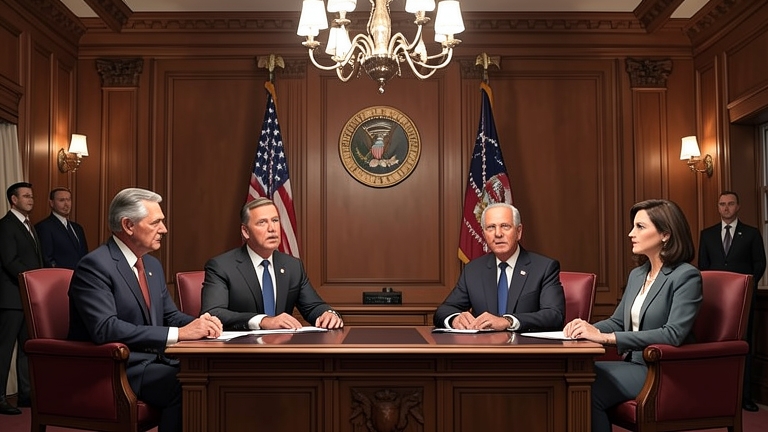
On August 7, 2026, the U.S. Senate confirmed two nominations by President Donald Trump to the National Labor Relations Board (NLRB), including a new Republican member whose addition shifts the Board’s political composition to a 3–1 Republican majority. The confirmations, delivered through a single en bloc vote on 74 nominations, give the Board the three affirmative votes required under its own tradition to revisit and overturn precedential decisions issued under the previous administration — a development with immediate and far-reaching consequences for American labor relations.
James Macy and David Prouty: Profiles of the Two Confirmed NLRB Members
The Senate confirmed Republican James Macy, a U.S. Department of Labor (DOL) official and former management-side labor attorney, alongside Democrat David Prouty, who was renominated for a second term on the Board. Prouty, first nominated by President Joe Biden in 2021, has served through a period of significant labor-law expansion and has been a consistent Democratic voice in Board decisions. His renomination ensures that a Democratic presence remains on the Board even as the Republican majority takes control of its agenda.
Macy’s professional background is particularly instructive. As a former management-side labor attorney, he has represented employers in union organizing campaigns, collective bargaining disputes, and unfair labor practice proceedings. His current role at the DOL gives him direct exposure to federal labor policy administration. This combination of private practice and government experience positions him as a member steeped in the practical realities of labor law from the employer perspective — a perspective that will inform his approach to adjudication and rulemaking.
Both nominees will serve five-year terms running until August 2031. The length of those terms is strategically significant: they extend well beyond the current presidential term, meaning the confirmed members will shape NLRB jurisprudence for years regardless of the outcome of the 2028 election cycle. This structural durability is a defining feature of independent agency appointments, and it is precisely why the confirmation battles over NLRB seats carry such weight.
S. Res. 817: The En Bloc Vote That Confirmed 74 Nominations
The NLRB confirmations were not standalone acts. They came as part of a slate of 74 nominations confirmed en bloc under S. Res. 817 on a 51–47 vote. The en bloc procedure, which packages multiple nominations into a single resolution for a combined vote, has become an increasingly common mechanism in the Senate for processing large numbers of executive and independent agency appointments efficiently.
The 51–47 vote reflects the narrow partisan division in the Senate. Packaging the NLRB nominations together with dozens of other appointments was a strategic decision by Senate leadership to move a large batch of pending positions in a single procedural stroke, avoiding individual floor debates and the threat of extended consideration. For the NLRB nominees, inclusion in the package ensured a straight party-line vote rather than a potentially more uncertain individual confirmation process.
The breadth of the package also signals that the White House and Senate leadership viewed the NLRB appointments as part of a broader administrative reshaping effort, rather than isolated personnel decisions. By advancing them alongside dozens of other executive nominations, the administration maximized efficiency and minimized the opportunity for labor-focused opposition to slow the process.
How the Board Arrived at a 3–1 Republican Majority
The confirmation of Macy and Prouty represents the latest chapter in a rapid transformation of the NLRB under President Trump. The process began in January 2025, when Trump removed former Democratic member Gwynne Wilcox from the Board — an unprecedented action that immediately drew legal challenges and sharp criticism from labor advocates. Wilcox’s removal reduced the Board to two members, leaving it without a quorum and unable to decide cases.
In December 2025, the Senate confirmed two Republican nominees, Chairman James Murphy and Scott Mayer, restoring the Board to a functioning three-member quorum. With those confirmations, the Board could resume issuing decisions, but the 2–1 Republican-to-Democratic split meant the majority lacked the third Republican vote needed to overturn existing precedent under the Board’s long-standing tradition. The addition of Macy in August 2026 changes that calculus entirely.
The removal of Wilcox, the subsequent confirmations, and now Macy’s addition together represent a deliberate and sustained effort by the Trump administration to reshape the NLRB’s ideological balance and, with it, the direction of federal labor policy. The speed and coordination of these moves are unusual in the history of the Board, where composition changes typically occur through natural term expirations and staggered appointments. The rapidity of the transformation underscores the administration’s prioritization of labor policy as a key front in its broader regulatory agenda.
The Three-Vote Precedent Rule: Why the Majority Matters
Under long-standing Board tradition, reversing or overturning existing precedent requires at least three affirmative votes from Board members. This practice, designed to ensure that precedent is not overturned on a bare 2–1 partisan split, has historically served as a brake on rapid doctrinal change. The rule is not codified in the National Labor Relations Act but is a self-imposed institutional norm honored by Boards of both parties for decades.
With Macy’s confirmation, the Board now has four sitting members: three Republicans (Murphy, Mayer, and Macy) and one Democrat (Prouty). The three Republican votes satisfy the three-vote requirement, meaning the Board can now overturn precedential decisions issued during the Biden administration. This capacity was not available when the Board operated with a 2–1 Republican majority, because any effort to reverse a precedent would have required at least one Democratic vote — an unlikely prospect on contested issues.
The practical significance of this change cannot be overstated. The Board’s precedent governs everything from how union representation elections are conducted to when employers must bargain with unions, how workplace policies are evaluated, and what constitutes an unfair labor practice. A Board able to reverse precedent with a simple 3–1 majority can redirect the entire course of U.S. labor law.
What does the NLRB’s 3–1 Republican majority mean for labor law?
The 3–1 Republican majority gives the NLRB the three affirmative votes required under Board tradition to overturn existing precedent. This means the Board can now revisit and reverse key decisions issued during the Biden administration on issues such as joint-employer liability, union election procedures, and workplace speech rules, without needing Democratic support. Employers and unions should expect a wave of reconsidered decisions and new rulemaking that reflects the Republican majority’s management-friendly orientation.
A Quorum Gap Narrowly Avoided: The Timing of the Confirmations
The timing of the confirmations was not incidental. The Board was set to lose its three-member quorum with Prouty’s prior term expiring in August 2026. Had the Senate failed to act before that expiration, the Board would have been reduced to two members — Murphy and Mayer — and would have lost its quorum, rendering it unable to decide cases or issue decisions. Such a quorum gap would have created a backlog of unresolved unfair labor practice charges and representation petitions, delaying justice for both employers and workers.

The confirmation of both Macy and Prouty on August 7, 2026, came just in time to avoid that gap. Prouty’s renomination ensures continuity of a Democratic voice on the Board, while Macy’s addition provides the Republican majority the Board needs to act decisively. The carefully orchestrated timing underscores the coordination between the White House and Senate leadership on the NLRB appointments — and highlights how dependent the Board’s operational capacity is on the sometimes unpredictable rhythms of the confirmation process.
The near-miss on the quorum gap also illustrates a broader vulnerability: the NLRB’s five-member structure means that the departure of even one member can jeopardize the Board’s ability to function. The fact that the Board has repeatedly come close to losing its quorum in recent years has prompted calls for structural reform, though no consensus has emerged on how to address the issue.
The Fifth Seat: One Vacancy Remains Open
Despite the two confirmations, the five-member Board still has one vacancy. President Trump may seek to fill that seat, though no nominee has been announced at this time. The identity of any future nominee — and whether the seat is filled with a Republican or a Democrat — would further shape the Board’s composition and its ability to act.
If the President nominates another Republican, the Board would hold a 4–1 Republican majority, further solidifying the conservative direction of NLRB jurisprudence and making the reversal of precedent even more certain. If a Democrat is nominated, the Board would retain a 3–2 split, maintaining the current balance but adding a fifth voice to deliberations. The vacancy also raises questions about the Board’s long-term stability. With terms running until 2031 for the newest members, the Board’s composition is now largely fixed for the medium term, barring early departures or removals.
Employers, unions, and practitioners should watch the vacancy closely. The nomination process for the fifth seat will signal whether the administration intends to press its advantage further or is content with the current balance. It will also provide an early indication of the administration’s priorities for the Board’s long-term agenda.
What Employers, Unions, and Practitioners Should Expect Now
For employers, the new majority represents an opportunity to see the rollback of several Biden-era NLRB decisions that expanded union rights and imposed broader liability on companies. Areas likely to be revisited include the joint-employer standard, which determines when companies can be held liable for labor violations by contractors or franchisees; the rules governing union organizing and representation elections; and the Board’s approach to workplace policies concerning employee speech and conduct. The direction of travel is clear, even if the specific cases and rulemakings have not yet been announced.
For unions, the shift is a significant setback. The Biden-era Board issued a series of decisions and rules that made organizing easier, expanded bargaining obligations, and restricted employer communications during campaigns. Many of those gains are now vulnerable to reversal. Unions may be expected to challenge any such reversals in court, arguing that the Board’s departure from precedent is arbitrary and capricious — though courts typically afford the Board substantial deference in interpreting the National Labor Relations Act, and the Board’s own precedential history is replete with reversals following changes in administration.
For labor practitioners, the new majority means a period of significant doctrinal flux. Advice to clients will need to account for the possibility that existing precedent may be overturned, and litigation strategies will need to be flexible enough to adapt to a rapidly shifting legal landscape. The practical effect of the 3–1 majority will unfold incrementally — Board decisions take time to issue, and the process of identifying which precedents to revisit, holding hearings, and drafting opinions will occupy the Board for months. Nevertheless, the direction of change is unmistakable.
The Board’s rulemaking agenda is also likely to shift. The Biden administration engaged in significant rulemaking on issues such as joint-employer status and election procedures. The new majority may seek to rescind or replace those rules, using the notice-and-comment process to establish new regulatory frameworks that reflect a more employer-friendly orientation.
The Next Milestone: Chairman Murphy’s Term and the 2028 Election
While the immediate quorum crisis has been resolved, the Board’s composition remains subject to future changes. Chairman James Murphy’s term is set to expire on December 16, 2027. If Murphy were to depart at that point without a successor, the Board would again face the prospect of reduced membership and potential quorum issues. The timing of Murphy’s departure — if it occurs — would coincide with the run-up to the 2028 presidential election, adding a layer of political complexity to the nomination process.
The 2028 election itself adds another layer of uncertainty. If the presidency changes hands, the new administration would have the opportunity to fill the existing vacancy and any future openings, potentially shifting the Board’s balance once again. However, with Macy and Prouty confirmed for terms running until August 2031, a future administration would not be able to immediately replace them — a structural feature of NLRB appointments that ensures a degree of continuity across presidential terms.
For now, the Board’s 3–1 Republican majority is positioned to act, and act quickly. The coming months will reveal which precedents the majority chooses to revisit first, and the decisions that follow will define the state of U.S. labor law for years to come. Employers, unions, and practitioners should monitor the Board’s agenda closely, as the pace and scope of change will be significant. The August 7, 2026, confirmations are not merely a procedural milestone — they are the beginning of a new era in American labor law, one in which the Board’s Republican majority holds the power to reshape the legal framework governing the relationship between employers and workers.