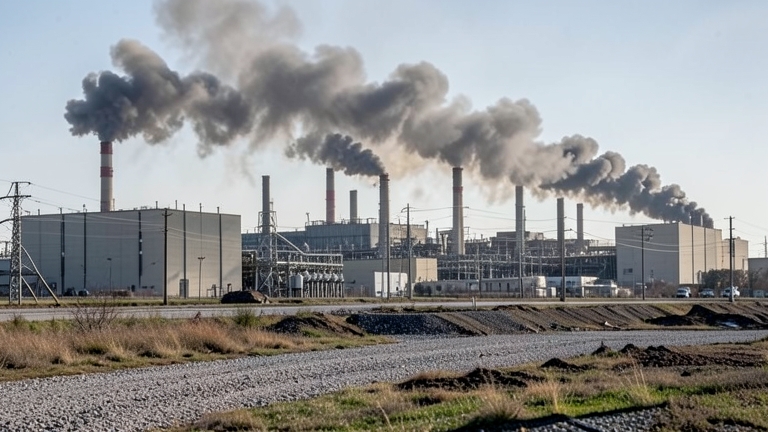
In the sprawling, sunbaked landscape of Pecos County, Texas, Amazon is laying the groundwork for a data center that will come with an unprecedented environmental cost. The on-site power plant designed to fuel this facility is permitted to release 33 million tons of carbon dioxide into the atmosphere each year, a volume of climate pollution that would make it the single largest source of greenhouse gas emissions in the United States. This development, first reported by The New York Times, represents a stark and consequential contradiction: a company that pledged to eliminate its carbon emissions by 2040 is now building infrastructure that locks in decades of fossil fuel dependence on an industrial scale.
The planned natural gas plant would surpass every existing power plant in the country in annual CO2 output. To put that number in perspective, 33 million tons of carbon dioxide is roughly equivalent to the annual emissions from over seven million passenger vehicles. For a region already grappling with the extremes of a warming climate, the irony is difficult to ignore. The facility is being built to power the computational engines of the artificial intelligence revolution, yet its immediate physical footprint is a monument to the very energy system that AI was supposed to help us transcend.
The Scale of the Carbon Commitment: 33 Million Tons and Rising
The sheer volume of permitted emissions demands close scrutiny. The Amazon data center power plant in Pecos County is not merely a large facility; it is a landmark in the American energy landscape for all the wrong reasons. No other power plant in the country has been given the green light to emit this much carbon dioxide on an annual basis. This single facility would eclipse the emissions of the nation’s largest coal-fired plants, some of which have only recently been retired or converted to cleaner fuels.
This development arrives at a moment when the U.S. power sector has been making meaningful, if uneven, progress in reducing its carbon footprint. The rise of renewables, the retirement of coal, and efficiency improvements have all contributed to a downward trend. The Amazon plant represents a dramatic reversal of that trajectory in one specific, highly visible location. It is a bet that the immense and growing energy demands of artificial intelligence can, and will, be met with natural gas, a fossil fuel that, while cleaner than coal, still emits a powerful greenhouse gas when burned.
The permit itself allows for this level of pollution, but the actual operational profile of the plant will depend on the data center’s utilization rate. Data centers, particularly those supporting AI workloads, have notoriously volatile energy demands. Training a large language model can require a massive, sustained draw of power, while inference—the process of using the model to generate responses—can be more sporadic but still energy intensive. The plant must be built to handle peak loads, meaning that even when running below capacity, its carbon emissions will remain formidable.

The Amazon Spokesperson’s Defense and the “Climate Pledge” Paradox
When confronted with the implications of the Pecos County plant, an Amazon spokesperson offered a defense that was both revealing and contradictory. The company confirmed that the data center will “be powered by new on-site generation that won’t raise electricity costs for Texas families.” This framing is politically astute. In Texas, where the grid operator, ERCOT, has faced reliability crises and price spikes, any proposal that appears to offload costs onto the public grid is met with fierce resistance. By building on-site generation, Amazon is insulating itself from grid volatility and, ostensibly, protecting local ratepayers from the financial burden of its expansion.
However, the spokesperson also offered a more troubling admission about the company’s evolving environmental stance. “The world looks different now than when we co-founded the climate pledge,” the spokesperson said, before adding, “Our commitment hasn’t changed.” This is a masterclass in corporate doublespeak. The statement implicitly acknowledges that the economic and technological landscape has shifted—largely due to the explosion of generative AI—in a way that makes the 2040 net-zero goal harder to achieve. Yet it insists that the goal remains intact. The math simply does not add up.
The “Climate Pledge,” which Amazon co-founded in 2019, commits signatories to reaching net-zero carbon by 2040, a decade ahead of the Paris Agreement target. It was a bold, market-shaping move that attracted dozens of other companies. But as the data center boom accelerates, Amazon’s own emissions have moved in the wrong direction. The company reported a 16% increase in carbon emissions last year, a clear warning sign that its operational footprint is expanding faster than its ability to decarbonize. The Pecos County plant will pour jet fuel on that fire.
What is Driving Amazon’s Reliance on Natural Gas for Data Centers?
The answer to this question lies at the intersection of physics, economics, and the unique demands of artificial intelligence. Unlike a streaming service or a social media platform, AI workloads are computationally brutal. Training a frontier model requires thousands of specialized processors, running for weeks or months, consuming enormous amounts of electricity continuously. The power density of an AI data center is far higher than that of a traditional one, often exceeding 40 kilowatts per rack compared to 5-10 kilowatts for standard computing.
Renewable energy sources like wind and solar are intermittent. They produce power when the sun shines or the wind blows, not necessarily when the GPUs need to crunch a training run. While batteries can smooth out some of this variability, the scale required to backstop a 33-million-ton carbon facility would be astronomical and, for the moment, prohibitively expensive. Natural gas plants offer the crucial advantage of dispatchability: they can be turned on and off, or ramped up and down, to match the precise, relentless demand of a hyperscale data center.
Furthermore, the grid interconnection process for a facility of this size can take years. In many parts of the country, including Texas, the queue to connect new renewable projects to the grid is backlogged. Building an on-site gas plant bypasses that bottleneck entirely, allowing Amazon to bring its data center online faster. The company’s decision is thus a pragmatic, if environmentally disastrous, response to the imperatives of speed and reliability in the AI arms race.
This trend is not unique to Amazon. Across the tech industry, companies are backing the development of huge natural gas plants to power their data centers. The calculus is simple: the financial upside of being first to market with a superior AI model is so immense that the short-term cost of building a fossil fuel plant, and the long-term reputational damage of increasing carbon emissions, is deemed acceptable. This is the dark side of the AI boom, a material reality that stands in stark opposition to the industry’s green branding.
The Political and Economic Context in Texas
Amazon’s decision to locate this facility in Pecos County is no accident. West Texas offers several distinct advantages for hyperscale data centers. The land is relatively cheap and abundant. The region has access to high-capacity fiber optic lines. And, crucially, it sits on top of the Permian Basin, one of the most productive oil and gas fields in the world. Natural gas is plentiful and inexpensive here, making an on-site gas plant an economically attractive proposition.
Texas also has a unique regulatory and political environment. The state legislature and the Public Utility Commission have generally been friendly to large industrial developments, prioritizing economic growth and grid reliability over aggressive climate action. The fact that the plant “won’t raise electricity costs for Texas families” is a powerful political shield for Amazon in Austin. By avoiding interconnection with the ERCOT grid for its primary power supply, Amazon sidesteps potential conflicts over grid congestion and cost allocation that have stalled other large-scale projects in states like New York, where the state has halted construction of all new data centers in response to environmental and utility cost concerns.
However, the plant’s emissions will impact Texas air quality and contribute to global climate change, a cost that is externalized onto the public. The 33 million tons of CO2 from this single facility will make it significantly harder for Texas, and the United States, to meet their climate commitments. This is the classic tragedy of the commons, playing out at an industrial scale in the heart of oil country.

Is This the Future of AI Infrastructure?
The question is whether the Pecos County plant is an outlier or a harbinger. The evidence suggests it is the latter. The computational demands of AI are growing at a pace that outstrips the construction of new renewable energy capacity. The largest technology companies are locked in a zero-sum competition to build the most powerful models, and that competition does not pause for the energy transition.
We are witnessing the emergence of a parallel energy grid, built and operated by and for the tech industry. These companies are effectively privatizing their power supply, building plants that serve only their own massive loads. This trend has profound implications for public policy, grid reliability, and climate goals. If a company of Amazon’s size and stated environmental ambition is willing to build a plant of this magnitude, what will smaller, less scrupulous players do?
The tech industry’s response to this critique has been to point toward future solutions: carbon capture, advanced nuclear reactors, green hydrogen, and next-generation geothermal. Amazon itself has invested in nuclear energy startups and purchased large volumes of renewable energy credits. But none of these technologies are ready to scale to the level required by a 33-million-ton plant. Carbon capture, for example, is still expensive and energy-intensive, and it has not been proven at the scale necessary to offset a facility of this size. Nuclear reactors take a decade or more to build. The gap between aspiration and reality is growing by the minute.
How Does This Plant Affect Amazon’s Net-Zero Pledge?
Mathematically, it makes the 2040 target nearly impossible to achieve without the aggressive use of carbon offsets, a practice that is widely criticized for its lack of integrity. Amazon has already seen its emissions rise by 16% in a single year. Adding 33 million tons of annual CO2 from a single new facility will send that number sharply higher. To get back on track for net-zero by 2040, Amazon would need to either decarbonize its entire existing global operations at an unprecedented rate, or purchase enough carbon offsets to compensate for the emissions. Given the current state of the voluntary carbon market, the latter option is both expensive and scientifically dubious.
The spokesperson’s admission that “the world looks different now” is a tacit recognition that the company’s climate strategy was based on assumptions that are no longer valid. When the Climate Pledge was drafted, the AI boom was not yet on the horizon. The company could reasonably project that its energy needs would grow in a linear fashion, and that renewable energy purchases would keep pace. The exponential growth of AI has shattered that model. Amazon is now in the position of having to build the energy equivalent of an interstate highway while simultaneously trying to convince stakeholders it is still committed to walking.
The fundamental issue is structural. The efficiency gains from Moore’s Law and improvements in chip design, which historically helped keep data center energy consumption in check, are being overwhelmed by the sheer volume of computation. Training a single large AI model can consume as much electricity as 100 U.S. homes use in an entire year. When you multiply that across dozens of models, built by multiple companies, the result is a staggering demand for baseload power.
For Amazon, the path forward is fraught with difficult choices. It can continue to build gas plants and watch its emissions balloon, accepting the reputational damage. It can slow its AI investment, ceding ground to competitors like Google, Microsoft, and a host of well-funded startups. Or it can attempt an unprecedented mobilization of capital and engineering talent to build the renewable and nuclear infrastructure needed to power its AI ambitions. The Pecos County plant suggests it has chosen the first path, at least for the near term.
The decision in Pecos County is not just about one data center or one power plant. It is a window into the raw, unvarnished energy calculus of the AI era. We are building the most advanced computational systems humanity has ever created, and we are fueling them, in large part, with natural gas. The contradiction is as clear as the West Texas sky: the machines that may one day help us solve climate change are, for now, making it significantly worse.