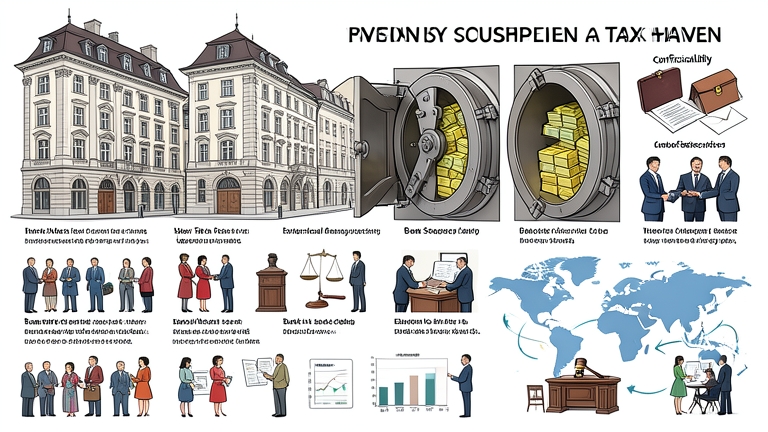
Switzerland has long held a prominent position in global finance, attracting individuals and corporations with its unique combination of political stability, strong privacy protections, and a tax system that offers significant advantages. While the term “tax haven” often carries negative connotations, the reality of Switzerland’s financial landscape is more nuanced. This article explores the specific mechanisms, historical context, and legal frameworks that have led to Switzerland being classified as a tax haven, examining the corporate tax structures, cantonal variations, banking secrecy laws, and the evolving international pressure that continues to shape its fiscal policies.
The Cantonal Tax System and Corporate Advantages
Switzerland’s federal structure grants significant autonomy to its 26 cantons, each of which sets its own corporate tax rates. This creates a competitive environment where businesses can effectively negotiate or choose a canton with a lower tax burden. The effective corporate tax rate in Switzerland typically ranges from 11.9% to 21.6%, depending on the canton and municipality. This is considerably lower than the average corporate tax rate in many other European countries, such as France (around 25%) or Germany (around 30%). For multinational corporations, this cantonal flexibility is a primary draw.
Tax Rulings and Negotiated Agreements
Another critical feature of the Swiss tax system is the practice of obtaining advance tax rulings. A company can approach the cantonal tax authorities and, before establishing operations, secure a binding agreement on how its future tax liability will be calculated. This provides certainty and predictability, which is highly valued by international businesses. While tax rulings are legal and transparent in their application, critics argue that they can be used to tailor tax burdens in a way that is not available to ordinary taxpayers, creating a regime that favors large multinationals over domestic firms.
Holding Company and Mixed Company Regimes
Historically, Switzerland offered preferential tax treatment for holding companies and mixed companies. A holding company that primarily manages investments and receives dividends could benefit from substantial tax relief, effectively paying little to no cantonal tax on its income. Similarly, mixed companies, which conduct most of their business abroad, were taxed only on a portion of their income. While these regimes have been reformed or phased out in response to international pressure, their legacy and the transitional arrangements still provide benefits for many existing structures.
Banking Secrecy and Financial Privacy
Swiss banking secrecy is perhaps the most famous element of the country’s tax haven reputation. Codified in the Swiss Banking Act of 1934, the principle of bank secrecy made it a criminal offense for a bank to disclose information about a client’s account to any third party, including foreign tax authorities, without the client’s consent. This created a powerful shield for individuals and entities seeking to protect their wealth from scrutiny, taxation, or legal claims in their home countries.

The Evolution of Automatic Information Exchange
In recent years, the landscape of banking secrecy has changed dramatically. Under immense pressure from the OECD and the European Union, Switzerland has moved away from its traditional secrecy model. In 2018, Switzerland implemented the Automatic Exchange of Information (AEOI) with over 100 countries. This means that Swiss banks now automatically report account information, including balances, interest, dividends, and proceeds from sales, to the tax authorities of the account holder’s country of residence. While this has significantly reduced the use of Swiss accounts for outright tax evasion, the country’s strong tradition of privacy and data protection remains a key feature for legitimate wealth management.
Legal Distinction Between Tax Evasion and Tax Avoidance
Swiss law makes a clear distinction between tax evasion and tax avoidance. Tax evasion, which involves active concealment of income or assets, is a criminal offense. Tax avoidance, which involves structuring one’s affairs to minimize tax liability within the bounds of the law, is not illegal. This distinction is crucial for understanding how Switzerland operates. The country’s financial system is designed to facilitate legal tax planning, not necessarily illegal tax evasion. However, the line between the two can be blurry, and the strong privacy protections historically made it difficult for foreign authorities to investigate cases of suspected evasion.
Political Stability and Legal Framework
Switzerland’s long-standing political neutrality and stability are foundational to its appeal as a financial center. The country has not been involved in a major war for centuries, and its system of direct democracy and federalism provides a high degree of political continuity. This stability is a powerful attractor for wealthy individuals and companies from regions that are politically unstable or subject to high levels of corruption. The Swiss legal system, based on civil law, is known for its reliability, predictability, and respect for property rights, offering a secure environment for capital preservation.
Strong Property Rights and Contract Enforcement
The Swiss legal framework provides robust protection for property rights and strict enforcement of contracts. The judiciary is independent and efficient, and the rule of law is deeply respected. This creates a low-risk environment for investment and wealth management. For individuals and corporations concerned about expropriation, currency controls, or arbitrary government action in their home countries, Switzerland offers a sanctuary where assets are safe from political interference. This institutional strength is a key component of the country’s attractiveness as a financial hub.
Treaty Network and Holding Structures
Switzerland maintains an extensive network of double taxation agreements (DTAs) with over 100 countries. These treaties are designed to prevent the same income from being taxed in two different jurisdictions. For multinational corporations, these treaties can be used to route income through Switzerland in a way that minimizes overall tax liability. For example, a Swiss holding company can receive dividends from a foreign subsidiary, pay little or no Swiss tax on those dividends, and then distribute the funds to shareholders with reduced withholding tax rates under the applicable treaty.
Participation Exemption and Dividend Relief
Under Swiss law, the participation exemption allows a Swiss company to receive dividends from a qualifying foreign subsidiary largely free of tax. This is a powerful tool for multinational groups. The exemption applies when the parent company holds at least 10% of the subsidiary’s shares or when the shares have a market value of at least 1 million Swiss francs. This regime, combined with Switzerland’s favorable treaty network, makes the country an ideal location for holding companies that manage international investments.
International Pressure and Recent Reforms
The international community, led by the OECD and the European Union, has been actively working to combat tax avoidance and harmful tax practices. Switzerland has been a primary target of these efforts. In 2019, Switzerland was removed from the EU’s list of non-cooperative jurisdictions for tax purposes after implementing a series of reforms. These reforms included the abolition of certain preferential tax regimes for holding companies and mixed companies, as well as the introduction of the AEOI for financial accounts. The pressure continues, with the OECD’s Pillar Two initiative, which aims to establish a global minimum corporate tax rate of 15%, set to significantly impact Switzerland’s tax landscape.
The Impact of the Global Minimum Tax
The introduction of a global minimum corporate tax rate is perhaps the most significant challenge to Switzerland’s status as a tax haven. Large multinational corporations with annual revenues above 750 million euros will be subject to a top-up tax if their effective tax rate in a given country falls below 15%. For many Swiss cantons, where effective tax rates for some companies have been in the single digits, this will require adjustments. Switzerland has already begun to implement the necessary legislation, but the long-term impact on its attractiveness as a low-tax jurisdiction remains to be seen. The country is now focusing on offering non-tax advantages, such as a skilled workforce, high-quality infrastructure, and a favorable regulatory environment, to maintain its competitive edge.
Wealth Management and Private Banking Services
Beyond the tax benefits, Switzerland offers a highly sophisticated ecosystem for wealth management. The country is home to some of the world’s largest private banks, including UBS and Credit Suisse, as well as numerous smaller, specialized institutions. These banks provide a comprehensive range of services, including asset management, estate planning, succession planning, and fiduciary services. The expertise and discretion offered by Swiss private bankers are legendary, and the country’s financial infrastructure is second to none. This high level of service, combined with the tax advantages, creates a compelling value proposition for high-net-worth individuals.
Discretion and Professionalism as Core Values
Swiss banking culture places a premium on discretion, professionalism, and long-term client relationships. Bankers are trained to understand the complex needs of international clients, including the tax and legal implications of their financial decisions. The country’s legal framework supports this by providing strong protections for client confidentiality, subject to the requirements of the AEOI and other regulatory obligations. While the era of absolute secrecy is over, the commitment to professionalism and discretion remains a core part of the value proposition for those seeking legitimate wealth management services.

Switzerland’s designation as a tax haven is the result of a unique confluence of factors: its cantonal tax system with negotiated rulings, its historical banking secrecy, its political stability, its extensive treaty network, and its sophisticated wealth management infrastructure. While international pressure has forced significant reforms, including the adoption of automatic information exchange and the abolition of certain preferential tax regimes, the country continues to offer a highly attractive environment for legal tax planning and capital preservation. The combination of a stable political system, a reliable legal framework, and a deep expertise in international finance ensures that Switzerland will remain a major global financial center, even as the rules of the game continue to evolve. The country’s ability to adapt while maintaining its core strengths of discretion, professionalism, and institutional stability will determine its long-term position in the global financial landscape.