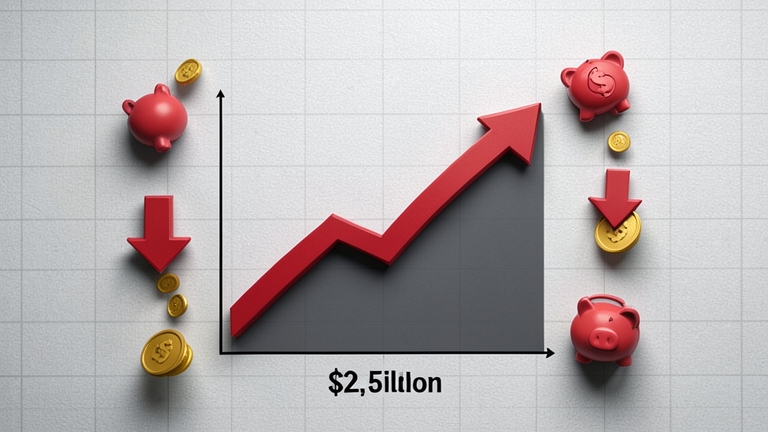
The United States Postal Service reported a net loss of $2.5 billion for the third quarter of fiscal year 2026, a figure that, while representing an improvement from the $3.1 billion loss recorded in the same period last year, underscores the persistent structural financial challenges facing the agency. Released on Friday, the quarterly results arrive as USPS leadership scrambles to identify sustainable solutions to stave off what officials have described as an impending liquidity crisis, a threat that has loomed over the institution for years despite incremental operational gains. The $600 million year-over-year narrowing of losses offers a glimmer of progress, but it does little to mask the fundamental imbalance between the Postal Service’s revenue-generating capacity and its mounting fixed costs, including legally mandated pension prefunding obligations and a sprawling network designed for a volume of mail that no longer exists.
The $2.5 Billion Quarter: Breaking Down the Numbers Behind USPS’s Q3 2026 Performance
The $2.5 billion net loss for the three-month period ending June 30, 2026, reflects an organization still caught in a multiyear financial tailspin, even as the rate of decline moderates. Revenue for the quarter came in roughly flat compared to the prior year, with modest gains in package delivery failing to offset the secular erosion of first-class mail, the Postal Service’s most profitable product category. First-class mail volume continued its decades-long descent, dropping by approximately 5 percent year over year, a trend that shows no sign of reversing as households and businesses shift further toward digital communication. Marketing mail, another significant revenue pillar, also experienced contraction, though at a slightly slower pace than first-class. On the expense side, the Postal Service has made some headroom through aggressive cost-cutting measures and operational restructuring, including the consolidation of processing facilities and adjustments to delivery frequency in certain regions. Yet labor costs, which account for roughly 80 percent of total USPS expenses, remain stubbornly high due to collective bargaining agreements and the difficulty of reducing a workforce scaled for a bygone era of mail volume. The net result is a bottom line that, while less dire than the $3.1 billion loss of Q3 2025, still points to an organization consuming cash at an unsustainable rate.
Year-Over-Year Comparison: What the $600 Million Improvement Actually Means
The $600 million narrowing of losses between Q3 2025 and Q3 2026 is worth examining critically. On its face, the improvement suggests that management’s cost-reduction initiatives and pricing strategies are gaining some traction. A closer look at the components, however, reveals that the gain is attributable primarily to one-time factors and accounting adjustments rather than a durable improvement in the underlying business model. A portion of the improvement came from lower noncash workers’ compensation expenses, driven by changes in discount rate assumptions, a technical accounting item that does not reflect actual cash savings. Another piece came from the timing of certain expense accruals. When stripping out these nonrecurring and noncash items, the Postal Service’s operating loss still exceeded $1.5 billion for the quarter, indicating that the core business remains deeply unprofitable. The distinction matters because the agency’s liquidity crisis is a cash-flow problem, not merely an accounting one. The Postal Service needs to generate positive cash from operations to pay its bills, including $5 billion in annual payments to the U.S. Treasury for retiree health benefits, a requirement that no other federal agency or private company faces. Until the underlying operations produce positive net cash, the agency will continue to approach a liquidity precipice, regardless of what the headline loss number shows.
The Impending Liquidity Crisis: How Close Is the Postal Service to Running Out of Cash?
The phrase “impending liquidity crisis” has become a recurring refrain in USPS financial disclosures, and the Q3 2026 report does nothing to dispel the urgency. What is a liquidity crisis in the context of the Postal Service? It is the point at which the agency can no longer meet its financial obligations as they come due, including payroll, supplier payments, and debt service. The USPS does not receive taxpayer funding for its operations; it is entirely dependent on revenue from postage and package fees. When those revenues fall short of expenses, the agency must borrow from the U.S. Treasury, up to a statutory debt ceiling. As of the end of Q3 2026, the Postal Service had borrowed approximately $22 billion against its $23 billion borrowing cap, leaving virtually no remaining headroom. Without congressional action to raise or eliminate the debt limit, or to restructure the agency’s financial obligations, the USPS is on a trajectory to exhaust its borrowing capacity within the current fiscal year. That scenario would force the agency to take extraordinary measures: deferring payments to suppliers, delaying payroll, or suspending certain operations. The Postal Service has stated in its financial filings that it is evaluating contingency plans, but it has not publicly detailed what those plans entail. The risk of a liquidity event, once a theoretical possibility, is now a near-term reality unless Congress or the administration intervenes.
The Statutory Debt Ceiling: A Self-Imposed Crisis or Necessary Failsafe?
The $23 billion statutory debt limit for the USPS was established to prevent the agency from accumulating unsustainable levels of federal debt, but it has effectively become a mechanism for forcing a reckoning. The Postal Service has warned for several years that it would hit the ceiling, and that moment has now arrived. The agency cannot issue additional debt without legislative authorization, yet its operational losses continue to drain cash. Some policymakers argue that raising or eliminating the debt ceiling is a temporary fix that merely postpones the need for fundamental reform. Others contend that the debt limit itself is an arbitrary constraint that does not reflect the Postal Service’s unique status as a constitutionally established public service. The Q3 2026 report adds urgency to this debate. If the borrowing cap is not addressed, the USPS could face a liquidity freeze before the end of 2026, with cascading consequences for the 1.4 million households and businesses that rely on the Postal Service for mail and package delivery, as well as the 630,000 employees whose paychecks depend on the agency’s solvency. The question is no longer whether the USPS will hit the debt ceiling, but what happens when it does.

Structural Drivers of USPS Financial Decline: Beyond the Quarterly Headlines
To understand why the USPS continues to post multibillion-dollar losses quarter after quarter, it is necessary to look beyond the quarterly figures and examine the structural forces that have been reshaping the agency’s economics for more than a decade. The most powerful of these forces is the substitution of digital communication for physical mail. Email, online bill payment, and digital document exchange have replaced the letters and statements that once formed the bedrock of USPS revenue. First-class mail volume peaked at over 103 billion pieces in 2001 and has declined in every year since, falling to approximately 38 billion pieces in 2025. The rate of decline has slowed in recent years, but the base continues to erode, and there is no plausible scenario in which first-class mail volume returns to growth. The implications are stark: the Postal Service’s most profitable product is shrinking by roughly 5 percent per year, and the agency cannot cut costs fast enough to keep pace with the revenue loss.
The Package Delivery Paradox: Growth Without Profitability
As mail volumes declined, the USPS has leaned heavily into package delivery, leveraging its universal delivery network to compete with FedEx, UPS, and Amazon. Package volume has grown substantially, particularly during the e-commerce boom that accelerated during the pandemic. The paradox, however, is that package delivery is significantly less profitable than first-class mail on a per-piece basis. The USPS is the carrier of last resort under its universal service obligation (USO), meaning it must deliver to every address in the United States, including remote rural locations where the cost of delivery far exceeds the postage paid. Private carriers can cherry-pick high-density, high-margin routes and leave the expensive deliveries to the Postal Service. Moreover, the USPS has entered into pricing agreements with major shippers like Amazon that are designed to be cost-competitive, but which leave the agency with razor-thin margins, particularly after accounting for the cost of last-mile delivery in low-density areas. The result is a situation in which package volume increases but contributes only marginally to the bottom line, while the fixed costs of the delivery network continue to rise with inflation and contractual wage increases.
The Universal Service Obligation: An Unfunded Mandate at the Core of the Crisis
The universal service obligation is the legal requirement that the USPS provide affordable, reliable mail service to all Americans, regardless of geography, six days per week. This mandate is enshrined in the Postal Reorganization Act of 1970 and is widely supported by the public, but it creates a fundamental financial challenge. The USPS must maintain a physical infrastructure of post offices, processing centers, and delivery routes that covers every corner of the country, from dense urban cores to remote Alaskan villages. The cost of this network is largely fixed: the Postal Service cannot close post offices or consolidate processing centers without going through an onerous regulatory approval process that often takes years and is subject to political opposition. Nor can it easily reduce delivery frequency, as the six-day delivery requirement is embedded in law. The result is a cost structure that is out of alignment with the revenue base. The USPS would need to either generate significantly more revenue from its products and services, or achieve substantially greater operational flexibility to reduce its network costs, in order to reach financial sustainability. Neither outcome is achievable without major legislative or regulatory changes.
Comparing USPS to Global Postal Operators: Lessons from Abroad
The financial struggles of the USPS are not unique among postal operators worldwide, but the severity of the crisis is unusual for a developed economy. Postal services in Germany (Deutsche Post DHL), the Netherlands (PostNL), and the United Kingdom (Royal Mail) have all faced declining mail volumes and have pursued various strategies to adapt. Deutsche Post, for example, transformed itself into a global logistics conglomerate, with postal delivery representing a shrinking share of its overall business. Royal Mail was privatized in 2013 and has since undergone significant operational restructuring, though it too continues to face financial pressure. The USPS, by contrast, operates under a hybrid model: it is a government agency with a public service mandate, but it must fund itself through commercial revenue. It cannot easily diversify into non-postal businesses, nor can it exit unprofitable markets. It is also subject to pricing caps that do not apply to private competitors. The comparison to international peers highlights a key point: postal operators that have achieved financial sustainability have typically done so through a combination of privatization, relaxation of the universal service obligation, and diversification into higher-margin logistics services. The USPS has limited access to any of these levers.
What Is the Path Forward? Legislative Options and Executive Actions Under Consideration
The leadership of the USPS, under Postmaster General Louis DeJoy, has pursued a 10-year strategic plan called “Delivering for America,” which aims to achieve financial breakeven by 2031 through a combination of cost reductions, price increases, and operational reforms. The plan has made some progress: the agency has consolidated mail processing operations, reduced overtime, and invested in new sorting equipment and delivery vehicles. But the Q3 2026 results show that the plan is not yet delivering the scale of improvement needed to prevent a liquidity crisis. The Postal Service has requested legislative relief in several areas: elimination of the retiree health benefit prefunding requirement, relief from the statutory debt ceiling, greater pricing flexibility, and authority to offer non-postal services such as notary and banking services. Some of these proposals have bipartisan support in Congress, but legislative action has been slow. The Postal Service Reform Act of 2022, which eliminated the prefunding requirement for retiree health benefits and integrated those costs into Medicare, provided significant financial relief, but it did not address the debt ceiling or the fundamental revenue-expense imbalance.
The Role of the Postal Regulatory Commission in Rate-Setting and Reform
The Postal Regulatory Commission (PRC) plays a critical role in the USPS financial outlook, as it must approve most changes to postage rates and service standards. In recent years, the PRC has granted the USPS greater pricing flexibility, allowing the agency to raise postage rates above the rate of inflation through the use of “exigent” rate increases tied to exceptional circumstances. The USPS has raised postage rates multiple times in the past three years, including a 5-cent increase in the price of a first-class stamp in 2025, bringing it to 73 cents. Rate increases have provided a partial offset to volume declines, but they also risk accelerating the shift to digital alternatives as consumers and businesses seek to avoid higher postage costs. The PRC is currently considering a request from the USPS to modify service standards for first-class mail, which would allow the agency to consolidate processing and reduce transportation costs. The proposal is opposed by some customer groups and members of Congress, who argue that slower delivery would erode the value of the postal service. The outcome of this regulatory proceeding will have significant implications for the USPS cost structure and financial trajectory.
What a USPS Liquidity Crisis Would Mean for Consumers, Businesses, and the Economy
If the USPS were to reach a liquidity crisis, the immediate effects would be felt across the entire economy. The agency processes and delivers approximately 425 million pieces of mail and packages each day, including prescription medications, Social Security checks, tax documents, election ballots, and e-commerce orders. A disruption in service would have cascading consequences for the financial system, the healthcare sector, and the retail industry. Small businesses that rely on the Postal Service for affordable shipping would be particularly affected, as alternatives like FedEx and UPS are significantly more expensive for lightweight and low-volume shipments. Rural communities, where private carriers often charge surcharges or do not offer delivery at all, would be disproportionately impacted. The USPS is also the largest civilian employer in the United States, with a workforce of approximately 630,000, many of whom are unionized. A liquidity event could lead to layoffs, furloughs, or pay delays, with ripple effects through local economies. While the federal government could theoretically step in with emergency funding, such a move would require congressional authorization and would likely be politically contentious. The prospect of a USPS liquidity crisis is not merely a financial story; it is a story about the resilience of a critical piece of the national infrastructure.
The 2026 Election Year Context: Politics, Policy, and the Postal Service
The Q3 2026 financial report lands in a politically charged environment, with the 2026 midterm elections approaching and both parties looking for leverage on issues that affect everyday Americans. The Postal Service has historically enjoyed broad public support, and any disruption to service would carry significant political risk for the party perceived as blocking relief. Legislation to raise the USPS debt ceiling or provide additional financial flexibility has bipartisan sponsors in both chambers, but the path to passage is complicated by disagreements over whether relief should be paired with structural reforms. Some Republicans have called for greater privatization and reduction of the universal service obligation as conditions for financial assistance. Democrats have generally advocated for preserving the current service model and providing the agency with the resources it needs to fulfill its mission. The Q3 2026 loss adds pressure on both parties to find a compromise before the situation escalates from a financial problem to an operational crisis. The timeline for legislative action is tight: the USPS has stated that it expects to exhaust its borrowing capacity within the current fiscal year, which ends September 30, 2026. If Congress does not act before then, the agency could be forced to take emergency measures that would ripple through the economy just as voters head to the polls.
The Strategic Significance of the USPS Financial Crisis for Digital Commerce and Logistics
The financial instability of the USPS has implications far beyond the postal sector, particularly for the digital commerce and logistics industries that have come to depend on the agency’s last-mile delivery capabilities. Amazon, Walmart, and other major e-commerce platforms use the USPS for a significant portion of their deliveries, especially in suburban and rural areas where the Postal Service’s delivery network is more extensive than private carriers. If the USPS were to reduce service frequency or raise prices significantly, these companies would need to invest heavily in their own delivery infrastructure or absorb higher shipping costs, which would ultimately be passed on to consumers. The USPS also plays a critical role in the returns and reverse logistics ecosystem, handling millions of return packages each week for online retailers. A disruption in the postal system would create bottlenecks in the e-commerce supply chain, particularly in the run-up to the holiday season. For investors and analysts tracking the logistics sector, the USPS financial situation represents a systemic risk that is often underappreciated in earnings models and supply chain forecasts.
The $2.5 billion loss reported for Q3 2026 is not an anomaly; it is the predictable result of a business model that has been under structural pressure for two decades and has not yet found a sustainable equilibrium. The narrowing of losses compared to the prior year is a positive development, but it is not a solution. The USPS remains a vital piece of the American economic infrastructure, and its financial fragility poses risks that extend well beyond the agency itself. Whether through legislative action, regulatory reform, or operational restructuring, the path to stability will require difficult choices about what the Postal Service should be and how it should be funded. The clock is running, and the next quarter’s results may well force a reckoning that can no longer be deferred.