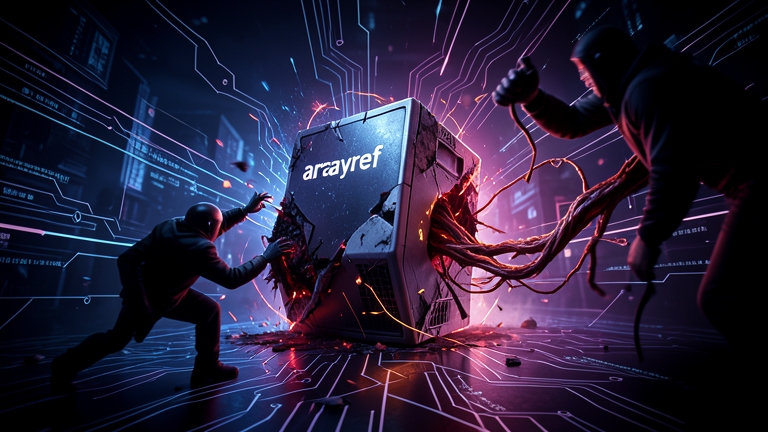
The Rust ecosystem has been shaken by a sophisticated supply-chain attack that saw the maintainer account behind the widely used arrayref crate compromised, allowing hackers to inject malware that executed on developers’ systems during compilation. Within a 23-minute window, two other crates—append-only-vec and internment—were also poisoned in the same campaign, raising urgent questions about the security of the open-source software supply chain and the mechanisms used to protect millions of daily downloads.
This attack, which targeted the Rust package registry crates.io, leveraged a typosquatting dependency named proc-macro1 to impersonate the legitimate proc-macro2 crate. The malicious payload, triggered automatically during build time, exfiltrated credentials from browsers, established persistence across operating systems, and communicated with a command-and-control infrastructure that security researchers have linked to recent North Korean campaigns. The incident underscores the growing sophistication of threats targeting the software development lifecycle, where a single compromised maintainer account can cascade into widespread compromise across thousands of downstream projects.
What is the arrayref crate and why was it targeted?
Arrayref is a popular Rust library that provides a safe, zero-cost abstraction for obtaining references to fixed-size arrays from slices. With more than 53 million downloads in the past 90 days and over 245 million lifetime downloads, it is a foundational dependency in high-stakes domains including cryptography, graphics rendering, and blockchain tooling. Projects such as blake3, the Rust GUI frameworks egui, eframe, and iced, as well as components used in Ethereum and Solana, rely on arrayref. The crate’s widespread adoption made it an attractive target: compromising it gave attackers a direct pipeline into the build environments of thousands of developers and organizations.
The attack also targeted append-only-vec and internment, two crates maintained by the same account. Together, they account for nearly 19 million installs. The attacker’s strategy was to maximize reach by poisoning multiple trusted crates under a single compromised account, ensuring that even projects not directly using arrayref could be affected through transitive dependencies.
How did the hackers poison the Rust crates?
The attack began with the creation of a GitHub account impersonating prominent Rust developer David Tolnay at 01:17 UTC on August 20. A similar impersonating account was then registered on crates.io. At 01:55 UTC, the attacker published [email protected], a benign copy of the legitimate proc-macro2 crate. This was a deliberate step to establish the typosquatting package as a seemingly normal dependency before introducing the malicious payload.

At 07:11 UTC, the attacker pushed a malicious update to proc-macro1 via version 1.0.107. This version contained a build.rs script that automatically executes during compilation. The script reconstructs its infrastructure from base64-encoded fragments and selects a payload matching the host operating system: Linux x86-64, Windows x86-64, macOS x86-64, or macOS ARM64. Four minutes later, at 07:15 UTC, the attacker published arrayref 0.3.10 through the legitimate droundy (David Roundy) account, which had been compromised. Versions 0.3.5 through 0.3.9 were removed from the registry, a tactic likely intended to force developers to install the malicious release when they tried to update or build their projects.
Attackers also published multiple versions of four additional crates—aovine, arone, aronenao, and tinymember—which have since been removed from crates.io. The entire operation from the first impersonation account to the publication of the malicious arrayref release took less than six hours, with the actual exposure window for developers being approximately 1.5 hours until the incident was reported at 07:54 UTC. Crates.io deleted proc-macro1 at 08:03 UTC and removed arrayref 0.3.10 from the index at 08:41 UTC.
What does the malware do? A technical breakdown
The malicious build.rs script in proc-macro1 is designed to execute during the normal compilation process, making it invisible to most developers who use standard build commands. The script decodes base64-encoded fragments stored in the crate to recreate a full payload that is tailored to the target operating system. This multi-platform approach ensures that the malware can infect Windows, Linux, and macOS development environments alike.
On Unix-based systems, including Linux and macOS, the malware writes a binary to /tmp/rust-setup, marks it as executable, and launches it as a detached process. On Windows, it creates %TEMP%\rust-setup.ps1 and uses a hidden wscript.exe and VBS launcher to keep the process running in the background. The payload receives an address as an argument, which security researchers believe is a command-and-control (C2) server.
Credential theft and persistence mechanisms
The second-stage payload is far more than a simple dropper. According to analysis from cloud security company Wiz, the malware is designed to exfiltrate host information and credentials. It specifically targets login data from Google Chrome, Brave, and Edge browsers by querying their SQLite login databases. This credential theft capability is a hallmark of information-stealing malware used in advanced persistent threat (APT) operations.
To ensure long-term access to compromised systems, the malware establishes persistence through platform-specific mechanisms:
- Windows: Adds a Registry Run key so the payload executes on system startup.
- macOS: Creates a LaunchAgent plist file to launch the malware on user login.
- Linux: Uses systemd service units to maintain persistence across reboots.
This multi-platform persistence strategy mirrors tactics observed in previous North Korean threat actor campaigns, particularly those targeting the cryptocurrency and blockchain sectors.
Who is behind the attack? Links to North Korean operations
Researchers at Wiz have noted that the campaign’s infrastructure overlaps significantly with recent DPRK (North Korean) supply chain attacks, including the Mastra and axios campaigns. The Mastra attack, which Microsoft linked to North Korean hackers, targeted AI development environments, while the axios compromise saw hackers push cross-platform malware through a compromised npm package. The shared infrastructure includes similar C2 addresses, payload construction techniques, and the use of typosquatting to inject malicious dependencies.
This attribution is significant because North Korean threat actors have increasingly targeted the software supply chain as a vector for gaining access to cryptocurrency exchanges, blockchain developers, and technology companies. The use of Rust crates, which are heavily used in blockchain tooling, aligns with these strategic interests. The attackers appear to be motivated by financial gain, aiming to steal credentials and private keys that could be used to siphon cryptocurrency funds.
What is the impact on developers and organizations?
The potential impact of this supply-chain attack is substantial. Arrayref alone has over 245 million lifetime downloads, and the collective count for append-only-vec and internment is nearly 19 million. Any project that built using the malicious versions during the exposure window—arrayref 0.3.10, append-only-vec 0.1.9, or internment 0.8.7—could now have compromised build environments. The malware runs during compilation, meaning it can infect CI/CD pipelines, developer workstations, and build servers, often without the developer noticing anything unusual.
Projects that use arrayref include the blake3 cryptographic hash function, which is widely used in security-critical applications, as well as popular Rust GUI frameworks like egui, eframe, and iced. The Ethereum and Solana blockchain ecosystems also depend on arrayref, raising concerns about the security of smart contract development environments. Organizations in the cryptocurrency, finance, and technology sectors should treat this incident with the highest urgency.
How can developers detect and respond to this attack?
Security companies StepSecurity, SafeDep, and Aikido have each published technical analyses of the supply-chain attack and shared indicators of compromise (IoCs). Developers who installed any of the affected crate versions during the exposure window should assume their systems are compromised. Recommended detection steps include:
- Searching Cargo.lock files for references to proc-macro1, arrayref 0.3.10, append-only-vec 0.1.9, or internment 0.8.7.
- Looking for dropped files in /tmp/rust-setup (Linux/macOS) or %TEMP%\rust-setup.ps1 (Windows).
- Reviewing network traffic to the IP address 23.254.165[.]112 on ports 9089 and 443.
- Checking for unauthorized Registry Run keys, LaunchAgent plists, or systemd services.
Where compromise is confirmed, organizations should immediately rotate all accessible credentials, CI tokens, signing keys, and other secrets. The entire build environment should be rebuilt from safe backups, and affected systems should be wiped and restored. For projects that are confirmed clean, developers should pin a known-safe version of the affected dependencies until the maintainer situation is clarified and resolved. The last known benign versions of arrayref are 0.3.4 and earlier; append-only-vec 0.1.8 and earlier; internment 0.8.6 and earlier.
Why does this attack matter for the broader software supply chain?
The compromise of a widely used Rust crate like arrayref highlights a fundamental vulnerability in the open-source software ecosystem: the reliance on a small number of maintainers who often work without compensation or institutional support. The attacker was able to compromise the legitimate maintainer account, likely through credential theft or social engineering, and then publish malicious versions in the name of a trusted developer. This attack vector is not new—similar incidents have hit npm, PyPI, and RubyGems—but the Rust community’s reputation for safety and reliability makes this breach particularly concerning.
The use of typosquatting with proc-macro1 is also a reminder that attackers are becoming more sophisticated in their approach. Rather than simply publishing a malicious crate hoping someone will download it, they compromised a trusted maintainer’s account and then introduced a typosquatting dependency that mimicked the legitimate crate’s name. The fact that the malicious payload was executed during compilation, a process that developers rarely scrutinize, makes detection even harder.
Furthermore, the attack’s link to North Korean threat actors suggests that state-sponsored groups are actively weaponizing the software supply chain. These operations are not random; they are carefully planned and executed to target specific industries and achieve strategic objectives. The cryptocurrency and blockchain sectors, which rely heavily on Rust, are likely to remain prime targets.
Lessons for the Rust ecosystem and package registries
This incident should serve as a catalyst for stronger security measures in the Rust package registry and the broader open-source ecosystem. Several improvements are already being discussed:
- Multi-factor authentication (MFA) enforcement: Crates.io should mandate MFA for all package maintainers, especially those with high-download crates.
- Account recovery and verification: The impersonation of a well-known developer like David Tolnay suggests that account verification processes need to be strengthened.
- Dependency review automation: Tools that automatically scan new releases for suspicious behavior, such as the introduction of typosquatting dependencies or unexpected build scripts, could have flagged proc-macro1 before it was widely adopted.
- Version pinning and auditing: Developers are advised to pin dependencies to specific versions and use lock files effectively. However, the removal of older versions by the attacker demonstrates that even pinned versions can be removed, highlighting the need for immutable package storage.
The attack also underscores the importance of runtime security monitoring in development environments. Build-time malware that executes during compilation is particularly dangerous because it can bypass traditional security tools that focus on network traffic or file execution. Endpoint detection and response (EDR) systems that monitor process creation and file writes in temporary directories could help detect such threats.
As the Rust ecosystem continues to grow in popularity, particularly in performance-critical and security-sensitive domains, the tools and processes used to protect it must mature accordingly. The arrayref attack is a stark reminder that no package is too small or too trusted to be a target. The open-source community, package registries, and security researchers must work together to build a more resilient supply chain—one that can withstand the increasingly sophisticated tactics of state-sponsored and financially motivated attackers.