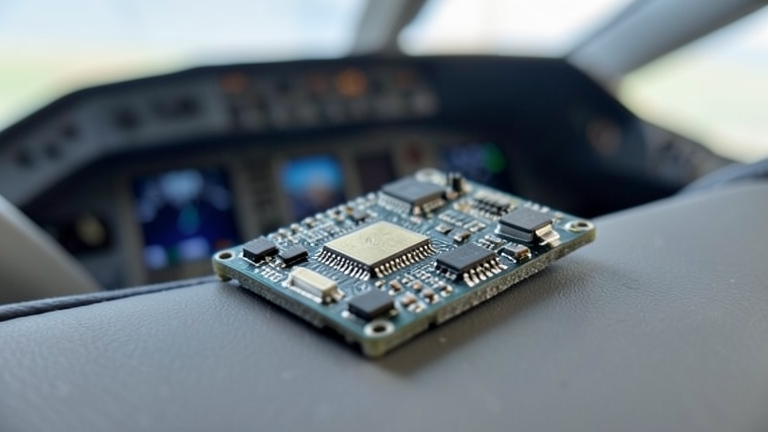
The image is almost implausible: a device the size of a coin, small enough to be concealed inside the dust cap of an obscure avionics plug, that can manipulate the navigation systems of a Boeing 737 from the ground. Yet this is exactly the attack vector described in newly published research, and the potential consequences range from a transoceanic airliner drifting imperceptibly off course until it runs out of fuel, to an aircraft being subtly redirected into sovereign airspace where it could be intercepted by military forces. The finding represents a fundamental challenge to the threat models that have governed aviation security for decades, forcing a reckoning with the reality that 21st-century tools can now be compressed into a form factor that fits in the palm of a hand.
The Anatomy of a Miniaturized Attack on Cockpit Systems
The research centers on a vulnerability in the Multipurpose Control Display Unit (MCDU) found in the cockpits of Boeing 737 aircraft. This unit is the primary interface through which pilots enter and modify flight plan data, including waypoints, altitudes, speeds, and fuel calculations. The attack does not require any breach of the aircraft’s core flight control computers or a compromise of its in-flight entertainment network. Instead, it exploits a physical access point on the aircraft itself—a connector port that, in the researchers’ demonstration, can be reached when the plane is on the ground undergoing routine maintenance or during a turnaround between flights.
The device, described as being roughly the size of a U.S. quarter, contains a complete hardware setup capable of establishing a Wi-Fi connection and relaying spoofed commands directly into the avionics data bus. This technique, which the researchers call “Bus Driver” hacking, allows the device to inject false data into the aircraft’s navigation and performance calculation systems without triggering any of the existing software-level alarms. The physical form factor is the key innovation: previous demonstrations of similar attacks required bulky equipment or direct access to multiple points within the avionics bay. The coin-sized approach collapses that entire capability into something that can be discreetly inserted into a port and covered with a standard dust cap, making it effectively invisible to a walk-around inspection.
Four Catastrophic Scenarios That Could Unfold From a Single Spoofed Signal
The researchers outline a spectrum of possible attack outcomes, each with escalating levels of danger. At the most subtle end of the spectrum is the manipulation of environmental and performance data used for takeoff calculations. By tricking the aircraft’s systems into believing the outside air temperature is significantly colder than it actually is, or by spoofing a lower weight for passengers and cargo, the device could cause the flight management computer to compute an incorrect takeoff speed. A pilot following the displayed V-speeds could find the aircraft unable to rotate or achieve the necessary climb rate before reaching the end of the runway. This scenario is particularly insidious because the pilot has no reason to doubt the numbers presented on the MCDU screen.
A more aggressive attack vector involves modifying the active flight plan stored in the MCDU. A hacker could insert a series of waypoints that cause the autopilot to gradually steer the aircraft into the airspace of another country. The researchers explicitly note that this could create a situation where a country’s air force intercepts and commands the aircraft, potentially with diplomatic and military consequences that escalate far beyond the original cybersecurity breach. This is not a theoretical abstraction: the flight management systems on commercial airliners are designed to follow the programmed route without question, and a pilot engaged in high-altitude cruise duties may not immediately detect a change of a few degrees in heading when flying over open ocean or featureless terrain.

The most dangerous scenario involves a sudden, large-scale navigation change in the vicinity of terrain. The research describes a situation where an aircraft approaching a mountain range could have its flight plan altered in real-time, directing it toward higher ground without any cockpit alert. The autopilot, receiving false steering commands, would fly the aircraft into collision course unless the pilot recognized the discrepancy and intervened with a manual override. Given the time compression of terrain-critical phases of flight, the margin for error could be measured in seconds rather than minutes.
The slow-burn variant of this attack is arguably the hardest to detect. The researchers describe a scenario in which an aircraft crossing the Pacific Ocean is diverted by just three degrees off its intended track. Over thousands of nautical miles, that small angular error accumulates into a positional displacement of hundreds of miles, taking the aircraft far from any diversion airfield or search-and-rescue coverage. The crew, who have no reason to suspect a navigation system compromise, would continue to believe they are on course until the fuel situation becomes critical—at which point the aircraft would be over open water with no nearby landing options. The psychologist and security researcher who worked on the paper described this as the most chilling scenario: blue ocean in every direction, the aircraft steadily burning fuel while heading into nowhere.
Recovery Is Possible for an Alert Pilot, But the Margin Is Thin
The researchers are careful to note that a well-trained, vigilant pilot can recover from almost any of the attacks they have imagined. Taking manual control of the aircraft overrides the autopilot, and the correct values for airspeed, altitude, and heading are displayed on independent instruments that are not fed by the compromised MCDU. The primary flight display and the standby instruments provide a second layer of information that cannot be spoofed by the Bus Driver device. In principle, a pilot who cross-checks the MCDU-derived data against these independent sources should be able to identify a discrepancy and take corrective action.
In practice, the picture is more complicated. The pilot would see that the numbers do not line up, but without any diagnostic indication of why, the cognitive load in an already demanding cockpit environment could lead to delayed or incorrect decision-making. The research paper describes a scenario in which the pilot, confused by conflicting data, might conclude that the aircraft’s independent sensors are faulty rather than suspecting an attack on the MCDU. The pilot might follow a procedure for air data system failure—disengaging the autopilot and relying on manual flying—which would indeed negate the attack, but only after a period of confusion that could be critical in a time-sensitive phase of flight. In a less optimistic scenario, a more subtle change could go completely unnoticed until the aircraft was already in an unrecoverable situation.
What Is the Bus Driver Hacking Technique and How Does It Work?
The Bus Driver technique exploits the architecture of the avionics data bus that connects the MCDU to other flight deck systems. In a typical Boeing 737 installation, the MCDU communicates with the flight management computer, the autopilot, and the display systems over a shared digital bus that uses a standardized protocol. By inserting a device that can both listen to and transmit on this bus, the researchers demonstrate that an attacker can effectively impersonate any of the connected systems. The coin-sized device listens for the electrical signatures of legitimate traffic, then injects its own messages at precisely timed intervals to override or modify data before the receiving system processes it. This is not a software exploit in the traditional sense—there is no buffer overflow or privilege escalation involved. It is a hardware-level manipulation of the communication channel itself, which means that the aircraft’s software has no way to distinguish the spoofed messages from authentic ones.
The physical access point is a maintenance connector located in a position that is reachable from the ground during normal airport operations. The researchers do not specify the exact location of the port for operational security reasons, but they confirm that it is accessible without entering the cockpit or the main avionics bay. This expands the threat model significantly because it means that the attacker does not need to be a highly credentialed insider with access to sensitive areas of the aircraft. A janitorial crew member, a catering truck driver, or a contractor performing routine exterior inspections could potentially insert the device during a brief window of opportunity. The dust cap that normally protects the connector would be replaced over the device, making the tampering invisible to anyone who does not specifically remove the cap and inspect the connector.
Industry Expert Confirms the Practicality of the Attack
Beau Woods, a cybersecurity consultant who has served as an adviser to the U.S. Cybersecurity and Infrastructure Security Agency and as a member of Boeing’s Industry Cyber Technical Council, reviewed the research ahead of publication and describes it as solid empirical evidence about realistic scenarios for high-capability adversaries. Woods emphasizes that the attack does not require a state-sponsored intelligence agency with unlimited resources. It is entirely possible for someone who is already on staff at an airport—a maintenance technician, a refueler, or a security guard—to go up to an airplane when it is on the ground and insert this type of device. The barrier to entry is the technical knowledge required to build the device and program the spoofing payload, but that knowledge is within the reach of any competent hardware hacker or engineering graduate student.
Woods points out that the threat model for any highly sensitive system must change as potential attackers’ technology advances. In the 20th century, the idea of a coin-sized device that can wirelessly interface with an aircraft’s avionics data bus would have been science fiction. In the 21st century, it is a demonstration project completed by a small team of researchers. The aviation industry has built its safety and security frameworks around the assumption that physical access to the aircraft is tightly controlled and that any tampering would be immediately obvious. The coin-sized device overturns both assumptions: it requires only brief, low-level access, and it is designed to be invisible to visual inspection.
The Research Paper Prescribes a Multilayer Fix Strategy
The researchers outline a range of countermeasures, beginning with the simplest and most immediately actionable: physically removing the connector from the vulnerable port altogether, or filling the port with epoxy to prevent any insertion. This would permanently disable the maintenance access point, which could cause logistical problems for airline operators who rely on that port for diagnostic work, but it would completely eliminate the attack vector. For aircraft that cannot accept a permanent loss of the port, the researchers recommend installing tamper-evident covers or seals that make any insertion attempt detectable during a preflight inspection.
The longer-term fixes are more complex but potentially more robust. The aircraft’s software could be updated to detect the Bus Driver injection technique by monitoring the timing and electrical characteristics of messages on the data bus. Anomalies in message intervals or signal voltage levels could trigger an alert in the cockpit, giving the pilot immediate awareness of a potential spoofing attack. A more fundamental architectural change would involve better electrical isolation between the maintenance port and the core flight-critical systems, following the design principles used in military aircraft, where the various systems are physically and electrically separated so that a compromise in one zone cannot propagate to another. The most technically ambitious fix involves adding cryptographic authentication to all messages transmitted on the data bus. Each message would carry a digital signature that any receiving system could verify, making it computationally infeasible for an injected device to spoof legitimate traffic. This approach, however, would require extensive upgrades to the hardware and software of the thousands of aircraft currently in service, representing a multi-year, multi-billion-dollar retrofit program.

Why the Aviation Industry Must Rethink Its Core Security Assumptions
The significance of this research extends far beyond the Boeing 737. The underlying vulnerability—exposed physical access points on a shared data bus—is not unique to Boeing aircraft. Many commercial airliners use similar architectures with maintenance connectors that are accessible from the ground. The exact details of the attack may vary from airframe to airframe, but the principle of injecting spoofed messages into an unprotected avionics bus is applicable across a wide range of platforms. The aviation industry has historically relied on a security model based on physical access control: if you cannot get to the aircraft, you cannot tamper with it. That model assumed that airports have secure perimeters, that maintenance personnel are vetted, and that the time between flights is too short for a sophisticated attack. The coin-sized device invalidates all three assumptions.
The researchers’ work also highlights a structural tension within the aviation ecosystem. The designers of flight deck systems in the 1980s and 1990s, when the MCDU architecture was developed, did not incorporate cryptographic authentication or bus monitoring because the threat of a physically injected spoofing device was not on the security radar. Adding those features to legacy systems is technically challenging and expensive, and the cost of an industry-wide retrofit would be enormous. There is also a certification hurdle: any change to the software or hardware of a flight-critical system must be approved by aviation regulators in multiple jurisdictions, a process that can take years. The industry is therefore caught between the urgency of addressing a demonstrated vulnerability and the glacial pace of its own regulatory and certification processes.
Lessons for the Broader Critical Infrastructure Landscape
The aviation sector is not alone in facing this type of threat. Power grids, water treatment plants, oil and gas pipelines, and transportation networks all rely on industrial control systems that use similar data bus architectures with limited authentication. The same technique that works against a Boeing 737’s avionics bus could, in principle, be adapted to manipulate the programmable logic controllers that regulate a chemical plant or the remote terminal units that control a pipeline valve. The coin-sized form factor is particularly concerning for infrastructure that has widely distributed, physically accessible components. A hacker with brief access to an unlocked substation or a pump house could insert a similar device into a maintenance port and cause operational disruptions that cascade across an entire regional network.
The research underscores a broader lesson about the evolution of threat modeling. Woods put it succinctly: threat models from the 20th century rarely survive contact with 21st-century tools and techniques. The security assumptions that were reasonable when the average attacker needed a van full of equipment and a team of three to execute a hardware injection are no longer valid when the same capability fits in a single person’s pocket. Every operator of critical infrastructure must now consider the possibility that a trusted insider—or a low-level contractor with momentary physical access—could insert a device that is functionally invisible and capable of injecting spoofed commands into systems that were never designed to authenticate their inputs.
The research has been published, and the details are now available to anyone with an internet connection. The reality has changed, as Woods observed, and the aviation industry—along with every other sector that depends on physically accessible, unauthenticated data buses—must now confront the gap between 20th-century threat models and 21st-century capabilities. The fixes are known, from epoxy plugs to cryptographic authentication, but the timeline for implementation remains uncertain. For the thousands of Boeing 737s in service around the world, the next few years will determine whether the industry treats this as a wake-up call or simply adds it to the long list of vulnerabilities that were demonstrated, documented, and then quietly deferred for the next certification cycle.