When building a diversified investment portfolio through mutual funds, the alphabet soup of share classes—A, B, and C—can be a significant source of confusion. While all three classes invest in the same underlying portfolio of securities, their cost structures are fundamentally different, which can dramatically impact your long-term returns. Choosing the wrong share class for your investment horizon and strategy is one of the most common—and easily avoidable—mistakes an investor can make. This article provides a clear, professional, and authoritative breakdown of how Mutual Fund C Shares differ from A and B shares, examining their unique fee structures, conversion features, and strategic applications. It also analyzes the implicit costs and dealer compensation models that make C shares a distinct and often controversial choice in the financial advisory world.
The Foundational Fee Structure of Mutual Fund Share Classes
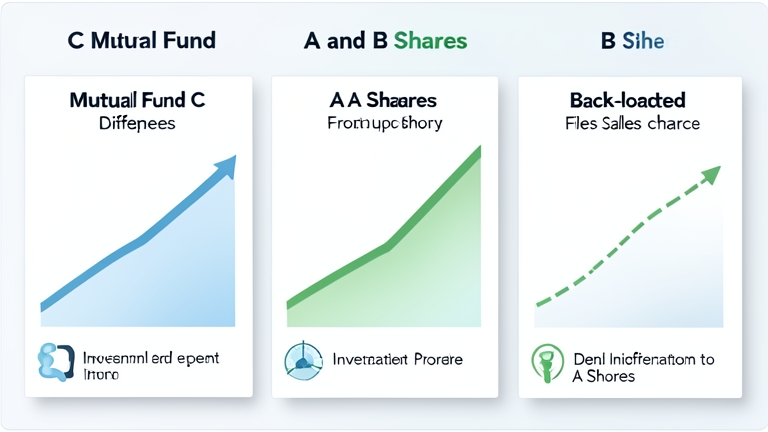
To understand the nuances of C shares versus A and B shares, one must first grasp the core financial mechanics that define each class. The primary differentiators are front-end loads, back-end loads, and 12b-1 fees. A shares typically charge a front-end load, which is a sales fee paid upfront when you purchase the fund. This fee usually ranges from 2% to 5.75% of your investment amount, but it can be dramatically reduced or eliminated for large investments through breakpoints. B shares, in contrast, have no upfront load but impose a contingent deferred sales charge (CDSC) if you sell the shares within a specific holding period, often six to eight years. Crucially, B shares usually convert to A shares after that period, reducing ongoing fees. C shares present a different model where there is typically no upfront load, but they carry a higher annual expense ratio driven by a 12b-1 fee—often around 1% of assets annually—and may have a small CDSC (typically 1%) if sold within the first twelve months.
How Load Waivers and Breakpoints Affect Your Cost Basis
A critical concept in the A share vs. C share debate is the application of breakpoints and load waivers. For A shares, the stated front-end load is the maximum, but any investor investing a qualifying sum—often $25,000 to $50,000 or more—can negotiate a reduced load. Furthermore, charitable organizations, retirement plans, and investors using certain advisory platforms may qualify for a complete load waiver, effectively purchasing the fund at net asset value (NAV). C shares, because they do not charge an upfront load, do not offer such breakpoints. This means that for an investor making a substantial one-time lump sum investment, A shares with a waived load can be far more cost-effective than C shares, which will extract higher fees year after year. The lack of breakpoint leverage is one of the most significant structural disadvantages of holding C shares over a long period.
Mutual Fund C Shares: High Annual Costs and Level Load Structure
Mutual Fund C shares fall under the category of level-load shares. The defining characteristic of a C share is its higher 12b-1 fee, which is a marketing and distribution fee paid to the broker or financial advisor from the fund’s assets. This fee, typically 1.00% per year, is significantly higher than the 0.25% to 0.50% 12b-1 fee found on A shares. The industry compensation model for C shares is designed to generate ongoing revenue for the advisor, rather than a one-time commission. This structure is often recommended to clients with a shorter time horizon, usually three to five years, where the absence of an upfront load is beneficial. However, the steep annual drag on performance means that after five to seven years, the cumulative cost of a C share almost always exceeds the one-time cost of a full-load A share. Therefore, C shares are structurally inefficient for buy-and-hold investors with long time horizons.
The 1% CDSC Trap on Short-Term Trading of C Shares
A frequently overlooked detail of Mutual Fund C shares is the existence of a contingent deferred sales charge on early redemptions. While B shares have a declining CDSC that can last up to eight years, C shares typically impose a flat 1% CDSC if the shares are redeemed within the first twelve months. This mechanism is designed to discourage professional traders and short-term speculators from using the fund. For the average retail investor, this is rarely an issue, as the holding period is usually longer. However, this rule is crucial for those who might need liquidity within a year. Unlike A shares, where the load is paid at entry, and B shares, where the load declines, C shares create a discrete penalty for hasty exits. Financial advisors must document this risk carefully when recommending C shares for an emergency fund or a taxable account with high expected turnover.
A Shares: The Most Economical Choice for Long-Term Horizons
For investors with a holding period exceeding five years, A shares are almost universally the superior choice. The reasoning is purely mathematical. While the upfront load (often negotiable) appears painful, it is a one-time event. The lower 12b-1 fee and overall expense ratio of A shares create a lower annual drag on your assets. Over a 10- or 20-year period, the compounding effect of lower annual fees in A shares dramatically outperforms the compounding drag of the higher annual fees in C shares. This is where industry-specific terminology regarding breakpoints becomes essential. Many fund families allow an investor to aggregate holdings (such as other accounts with the same family) to qualify for a reduced front-end load. An investor with $100,000 to invest in a diversified portfolio of three different funds can often qualify for a breakpoint discount across the total combined investment, effectively lowering the commission to a fraction of the stated maximum.
When to Choose C Shares Over A Shares
There are legitimate, albeit limited, scenarios where Mutual Fund C shares are the more appropriate vehicle. The primary case is for portfolios with a short expected holding period, typically under four years. If an investor expects to need the funds for a down payment on a house, a tuition payment, or a business investment within two or three years, paying the upfront load for an A share is economically illogical. In that short window, the high annual fee of the C share has not had time to accumulate significantly, making it cheaper than the upfront A share load. Additionally, for systematic withdrawal plans or dollar-cost averaging strategies where small amounts are invested monthly, C shares can be practical because they avoid a transaction fee on every small purchase. However, this convenience must be weighed against the long-term cost of the high expense ratio, and a conversion to A shares at a future date should be considered if the investment becomes long-term.
B Shares: The Vanishing Breed with Conversion Features
B shares have become increasingly rare in the modern retail brokerage landscape due to regulatory scrutiny and shifting industry compensation models. However, understanding B shares is critical for comparing the trio of A, B, and C. B shares had no upfront load but carried a high 12b-1 fee (similar to C shares) plus a CDSC that declined over time. The unique selling point of B shares was their automatic conversion to A shares after a specified holding period (usually 6-8 years). This conversion was a substantial benefit, automatically lowering the expense ratio to the A share level for the remaining life of the investment. In contrast, Mutual Fund C shares generally do not convert to A shares, meaning the investor pays the higher expense ratio forever. This lack of conversion is a critical, often negative, structural feature of C shares compared to the now-discontinued B class. Dealers typically received a different type of commission (a trailing commission) for C shares versus an upfront commission for A shares, which influenced advisory recommendations.
Implicit Costs and Dealer Compensation in Share Class Selection
A sophisticated understanding of share class selection goes beyond the disclosed expense ratios. There is an implicit cost related to the advisory relationship. When a financial advisor suggests a C share, they are often being compensated via the ongoing 12b-1 trail. This creates a potential conflict of interest, as the advisor has an incentive to keep the client in the C share indefinitely rather than moving them to a more cost-effective A share or a fee-based advisory account. Under the Department of Labor’s fiduciary rule (and its successor regulations), brokers are required to act in the client’s best interest, which often means recommending A shares for long-term holdings. For the investor, the due diligence process should include asking the advisor specific questions about their compensation for recommending C shares versus A shares. Understanding this dynamic is the final piece of the puzzle for making an informed, cost-conscious decision that aligns with your long-term financial goals.