
The launch of DLSS 5.0 has fundamentally altered the landscape of PC gaming, and Quantic Dream’s Detroit: Become Human serves as the ultimate showcase for this neural rendering revolution. Powered by an uncompromising hardware setup—featuring the NVIDIA RTX 5090, an AMD Ryzen 9 9950X3D, and a stunning 4K OLED 240Hz display—the game transforms into a hyper-realistic, almost unsettling experience. Recent benchmark tests highlight a staggering visual leap when toggling DLSS 5.0 from “Off” to “On,” granting characters and environments lifelike depth, advanced lighting, and perfectly human characteristics. However, this unprecedented visual fidelity comes at a steep performance cost, cutting frame rates nearly in half. But what exactly makes this neural rendering technology so revolutionary, and how does it reshape the philosophical, android-filled world of Detroit? Let’s dive deep into the visual and performance implications of DLSS 5.0.
The Hardware Powering the Neural Revolution
To properly evaluate this technological leap, Overcentral conducted extensive benchmarks using a cutting-edge 2026 test bench. Our testing setup was designed to push neural rendering to its absolute limits, featuring the flagship NVIDIA RTX 5090 GPU, a top-tier AMD Ryzen processor, and 64GB of high-speed DDR5 memory. All tests were conducted on a 32-inch 4K OLED monitor running at 240Hz, providing the perfect canvas to observe the minute details of DLSS 5.0. Even with this monstrous hardware, the computational weight of the 3D-Guided Neural Rendering model is evident. The GPU operates at near-maximum capacity, drawing significant power to sustain the AI-driven calculations, proving that while the technology is revolutionary, it demands the absolute pinnacle of modern hardware to function smoothly.
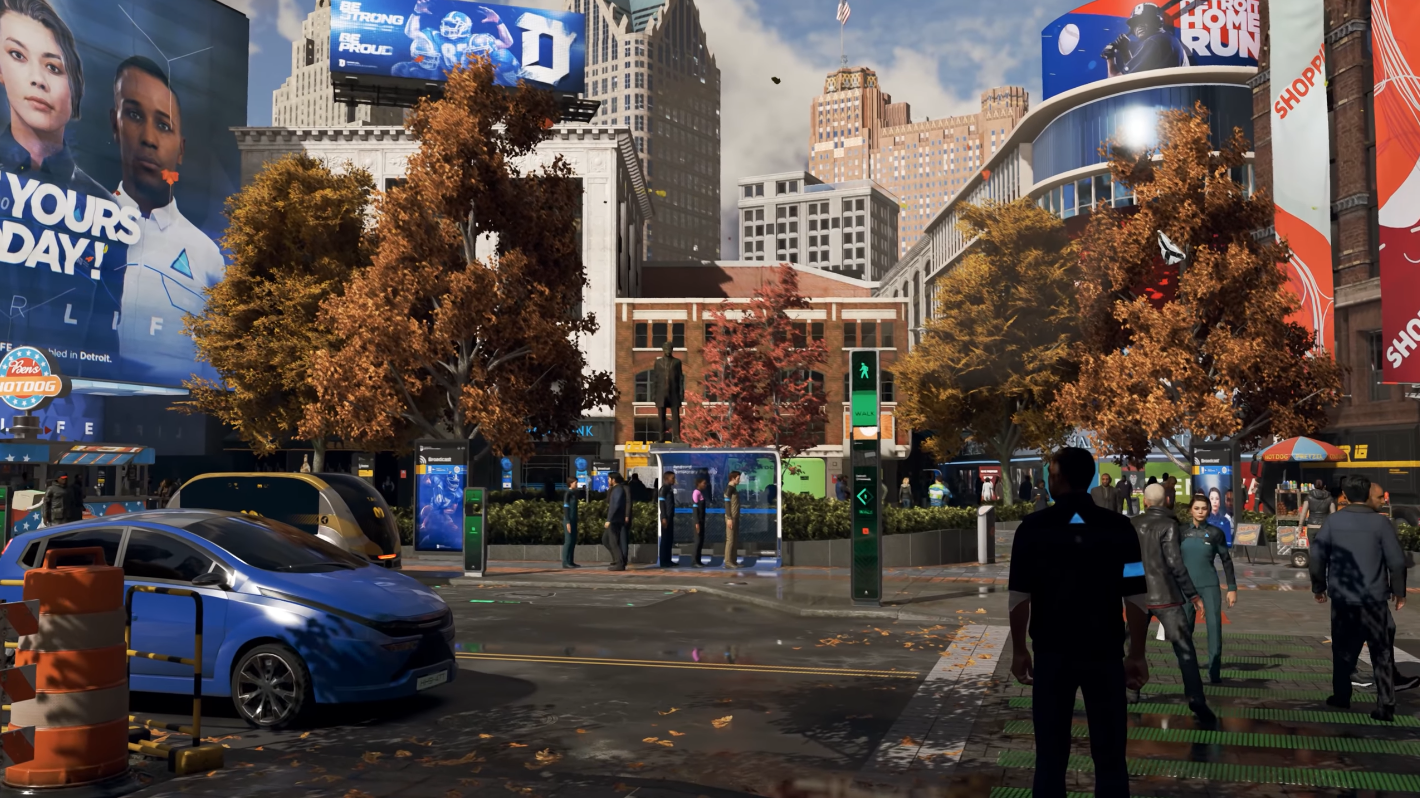
The Visual Leap: A Cinematic Transformation
In our Overcentral benchmark, the visual difference between DLSS 5.0 enabled and disabled is nothing short of breathtaking. When disabled, Detroit: Become Human still holds up as a visually impressive title, but it retains the unmistakable rendering characteristics of a traditional video game. The moment DLSS 5.0 is activated, the experience shifts into cinematic territory. Our analysis shows that the neural rendering engine doesn’t merely upscale the image; it fundamentally reinterprets the scene. The technology injects lifelike depth into character models, granting their skin, hair, and clothing a level of physical accuracy previously reserved for high-end CGI. The environment gains profound atmospheric depth, with lighting and reflections behaving in a hyper-realistic manner. It creates an almost unsettling sense of presence, transforming the game’s world into a living, breathing environment.
The Performance Cost: Pushing the GPU to the Brink
As expected from a technology that actively generates complex visual data, the performance implications are severe. Overcentral’s performance metrics reveal a drastic trade-off: enabling DLSS 5.0 cuts the frame rate roughly in half, even on the RTX 5090. While the system can maintain a steady, highly playable 60 FPS at 4K, this is a massive drop from the uncapped, high-refresh-rate performance seen with traditional rendering. This 50% performance hit highlights the immense computational load of the AI model. Unlike previous DLSS iterations that relied on temporal upscaling, DLSS 5.0 requires the GPU to calculate and render entirely new layers of photorealism frame-by-frame. For enthusiasts, this means that achieving the ultimate visual fidelity requires accepting a significantly lower frame rate, prioritizing cinematic quality over competitive responsiveness.
A Thematic Masterpiece for Neural Rendering
Beyond the raw technical benchmarks, Detroit: Become Human serves as the ideal thematic canvas for DLSS 5.0. The game’s narrative revolves around the philosophical question of what it means to be human, exploring the blurred lines between artificial intelligence and organic life. Applying a neural rendering technology that uses AI to generate “perfectly human” characteristics to a game about androids is a bizarre and profound meta-commentary. As players walk the streets of Detroit, the hyper-realistic rendering makes the artificial characters feel indistinguishable from reality. The technology doesn’t just improve the graphics; it deepens the narrative immersion. In our Overcentral testing, it became clear that this combination creates a unique, almost surreal experience where the player is left questioning the very nature of the digital world they are interacting with.
Developer Control and Artistic Integrity
A critical concern with any AI-driven rendering technology is the potential loss of the developer’s original artistic vision. However, DLSS 5.0 introduces robust tools that empower creators rather than override them. In our Overcentral testing, it became clear that this technology is not a blunt instrument. Developers are equipped with intensity sliders that separate structural and tonal adjustments, allowing them to dial in the exact level of neural enhancement. More importantly, semantic masking allows studios to dictate exactly where the AI applies its effects. For instance, a developer could choose to enhance the environmental lighting and background textures while keeping a character’s face untouched to preserve a specific stylistic choice. This level of granular control ensures that the “perfectly human” realism of DLSS 5.0 never comes at the expense of a game’s unique identity.

Broader Implications for the Gaming Industry
The arrival of DLSS 5.0 marks a definitive turning point in game development. For years, the industry has relied on a combination of raw rasterization and ray tracing to push visual boundaries. Neural rendering represents a third pillar, shifting the burden of photorealism from traditional compute units to dedicated AI tensor cores. As engines like Unreal Engine 5 and proprietary systems adopt this technology, we can expect a new standard for visual fidelity. However, this also introduces a new barrier to entry. The requirement for RTX 50 Series hardware means that this level of fidelity is currently exclusive to the absolute high-end of the market. Over the coming years, Overcentral anticipates that this technology will trickle down to mid-range GPUs, but for now, it remains a luxury reserved for the most dedicated PC enthusiasts.
A Glimpse into the Future of Rendering
In conclusion, Overcentral’s deep dive into DLSS 5.0 running on Detroit: Become Human reveals a technology that is as demanding as it is breathtaking. The ability to transform a last-generation title into a hyper-realistic, cinematic experience is a testament to the rapid pace of AI innovation in gaming. The trade-off is undeniable: players must sacrifice half their frame rate to achieve this level of visual fidelity, even on an RTX 5090. Yet, for those who prioritize immersion and graphical excellence over competitive refresh rates, DLSS 5.0 offers a glimpse into the future of digital entertainment. It blurs the line between pre-rendered CGI and real-time gameplay, forcing us to reconsider what is possible in a virtual world. As the technology matures and hardware becomes more accessible, neural rendering will undoubtedly become the new benchmark for PC gaming excellence. For now, if you have the hardware to run it, the experience is nothing short of revolutionary.













:format(webp)/hull.geekship.com.br/wp-content/uploads/2026/06/Marvels-Wolverine-nao-tera-Spider-Man-crossover-Universo-1048.jpg "Marvel’s Wolverine Combat: The Mistake That Breaks Every Fight")