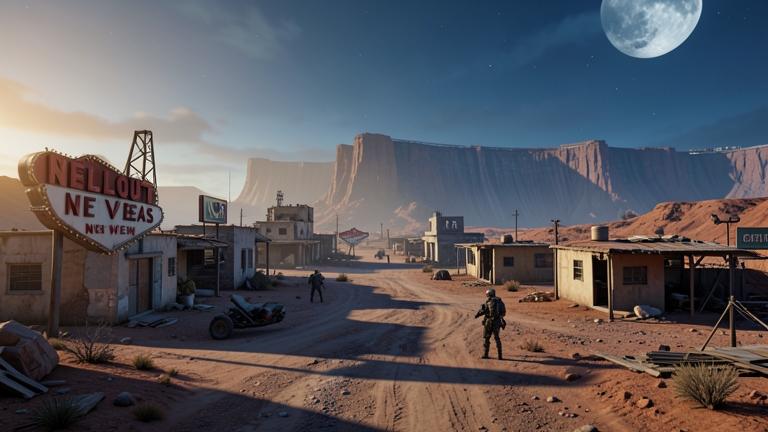
Nick Bryson spent five years building tools and stress-testing frameworks at Blizzard Entertainment, contributing to World of Warcraft: Shadowlands, Diablo 4, and Hearthstone before the Microsoft acquisition led to his layoff in 2024. After landing on his feet as vice president of development at Kind Lending, he discovered an unexpected doorway back into game development: modding. His new project, OpenNV, is an ambitious expansion of the open-source OpenMW engine that aims to bring Fallout: New Vegas to virtual reality — and potentially a whole catalog of Bethesda titles along with it.
“Right now, jumping into modding, it’s just been… I don’t know, exhilarating, honestly,” Bryson told me during a recent interview.
Bryson’s path from AAA development to grassroots VR modding is unconventional but revealing. At Blizzard, he worked on proprietary stress-testing frameworks in QA before joining Team Five, the internal studio behind Hearthstone. There, he focused on tooling — his credit card in the game famously reads “plus three to tools” as his personal mark. It’s a detail that speaks to his engineering mindset: he cares about the infrastructure that makes games work, not just the surface experience. That orientation now defines OpenNV, a project that seeks to rebuild Fallout: New Vegas from the ground up in an open-source engine, making it fully playable in VR while preserving the original experience.
How a Morrowind VR Playthrough Sparked an Open-Source Fallout Engine
Bryson admits he missed the Morrowind train when it originally released in 2002. He had played Oblivion, but The Elder Scrolls 3 slipped past him. That changed when he encountered a VR branch of OpenMW, the open-source reimplementation of the Morrowind engine, created by Mads Buvik Sandvei, one of the project’s main contributors. With over 2,000 hours logged in Fallout 4 as a VR enthusiast, Bryson jumped into Morrowind VR and was immediately hooked. His first playthrough of Morrowind, he says, was entirely in virtual reality.
For a developer with Bryson’s background, the transition from playing to building was inevitable. OpenMW’s open-source, community-led architecture meant the entire engine was available to explore, modify, and extend. If Morrowind could be ported to VR through this framework, why not other Bethesda games? Why not Fallout: New Vegas?
That question gave birth to OpenNV, also called Open Nevada, which Bryson describes as an expansion of the OpenMW framework designed to bring Fallout games — and potentially other Bethesda titles — into the open-source engine. The project’s main goal is to make New Vegas playable from start to finish in virtual reality, but the scope extends far beyond that single game.
“The games are very iterative, especially the game engines to some extent,” Bryson explains. “If you look at Bethesda, I’m sure they just incrementally went from, ‘Oh, we’re using the same set of tools for Morrowind, now let’s use those same ones kind of in the Fallout style.’ And so that really just plays well. I’m able to — if you look at their code base — get Skyrim assets working, Fallout 4, Fallout 76. I could even do Starfield. And then the most interesting thing to me is the fact I even tried to do the Unreal remaster for Oblivion. I was able to get them to render.”
Bryson’s ambition is to achieve what he calls “complete parity” with the original games. The goal isn’t to create a reinterpretation or a demake — it’s to make the open-source versions indistinguishable from their commercial counterparts, then layer VR and quality-of-life improvements on top.
“I want to try to get the originals back exactly, and then we mod them further, right?” he says. “I hope people can get the vanilla experience out of it, so they can see really, ‘Okay, wow, this was just a conversion.’ And then based on that, we can take it a little further, and really go deep.”
Pip-Boy Touchscreens, Terminal Typing, and the Technical Challenges of VR Development
When Bryson first got started with OpenNV, the characters were all T-posing, frozen with their arms outstretched like a box of discarded action figures. Fixing that wasn’t as simple as flipping a toggle. He had to fine-tune weights, bones, and timings to make animations work naturally. It’s a far cry from where the project is now, as Bryson works on recreating some of New Vegas’ most iconic systems: the VATS targeting mechanic, the terminal-hacking minigame, and even a functional Pip-Boy with a working touchscreen.
The VR-specific details are where Bryson’s engineering background shines. He says the first thing he tackled was hands and a Pip-Boy avatar that can articulate fingers. Getting the physics right for hand tracking was a genuine challenge because he wasn’t copying someone else’s code.
“I’ve never done that in a VR game before,” Bryson says. “I thought I was going to sit down and say, ‘How do we model this’ and start looking up algorithms, kind of deeper than just copying someone’s code. I just kind of went naively for a bit. I really want to see how much control I can do. What if you could type at the terminal, right?”
The work isn’t just about gameplay mechanics. Bryson encountered practical hurdles like keeping a VR headset on during long debugging sessions and performing motion capture without a bodysuit — turns out a webcam and some paint work fine. These challenges were worth solving because, for him, tactical interactivity with the world is essential to a true VR experience.
“You wouldn’t consider it a true VR experience without feedback and physics-based combat or anything like that,” he says. “And you can keep modding even Morrowind if you want to try to get a little bit of that built in there.”
Bryson is also looking to collaborate with existing VR modding efforts. He name-drops Team Beef, a group known for porting Doom and other games to VR headsets, who are working on porting OpenMW to Android. “I will probably marry my code with theirs as soon as they do their first release,” he says. “If these guys are going to get OpenMW on the headset, and I know them, they’re a deep, rich, interactive VR company. I want to piggyback off those.”
The Vibecoding Debate: How AI Is Reshaping Mod Development
AI is a contentious topic in gaming, and modding has become one of its most visible battlegrounds. The term “vibecoding” originally referred to software developed entirely through large language model prompts, but it’s now applied to mods like OpenNV that use AI as an assistive tool. Bryson has uniquely relevant perspective — he’s a trained software engineer who worked at a major studio, and he’s now building a high-profile open-source project with AI assistance.
“I’m using AI to help me solve the hard graphics problems, but I’m a trained software engineer,” he says. “I’m doing it very spec driven, very confrontational. ‘Hey, talk to me about this,’ like I would a real engineer. Then, ‘Okay, cool. I agree. Let’s make a plan, and you tell me step one.’ Like I would to any group — start working with them and check on them periodically.”
Bryson views AI as a compiler of sorts — a tool that accelerates the path from concept to code without eliminating the need for skilled judgment. He acknowledges the legitimate concerns about AI infringing on artists’ rights and displacing workers, but he draws a sharp distinction between using AI as an assistant and using it as a replacement.
“It’s almost like these are the new compilers where you can get your binary code quicker than you could before, but you’re still going to have to do the thing, so to speak,” he explains. “AI is accelerating; these things are getting easier for it to put together and assist you with. I don’t know what the endgame is. I do think it still takes a skilled artist and an operator — an engineer-type person — to make a good product no matter what.”
Bryson’s approach is “developing in public.” He keeps his GitHub repository open, posts about his work on LinkedIn, and welcomes feedback from streamers and players. It’s a stark contrast to his years writing proprietary code at Blizzard, and he says the change has been liberating.
“I kept a private GitHub forever, and I’ve always written proprietary code,” he says. “I just changed that this year. I decided I’m going to write everything in public. I even post on LinkedIn, which some people are like, ‘You’re posting some of your vibecode stuff on LinkedIn!?’ Absolutely, because it’s not a secret what I’m doing.”
Why VR Needs Modders: The Gap Left by AAA Studios
Virtual reality has had a turbulent history in the AAA space. We’ve recently seen new Metro, Alien, and Arkham games built for VR, along with a Deadpool title, but the era of studios porting their flat-screen blockbusters into headset experiences has largely subsided. It’s difficult to imagine Bethesda bothering to bring The Elder Scrolls 6 or Fallout 5 to VR as a native experience.
This is where modders like Bryson step in. Countless projects are dedicated to porting beloved titles to virtual reality, from emulated PSX games like King’s Field to retro shooters like the original Doom. The pattern is clear: community developers are filling a vacuum that major studios left behind.
“It’s still too niche,” Bryson says. “It’s more of a passion, and so what you’re going to see is like Trombone Champ. It was very VR centered. That’s where a lot of VR goes because people are like, ‘Oh, I’m going to pick up a thing and do it.’ That’s kind of what it’s about — traditional gaming. It’s really interesting in this time where we’re modding — it’s an explosion of flat to VR mods because all of us modders have decided, ‘Okay, we’ll just do it.’ The studios — they’ll never do this, right — but would they ever expose some VR hooks for us generically so that, ‘Hey, we’re not going to do VR, but here’s three or four things that would make it way easier on everyone.’ That would be my ask.”
This plea to studios is pragmatic and revealing. Bryson isn’t asking for full VR support — he’s asking for API hooks that would let the community do the work without fighting against the engine. It’s a modest request that reflects the reality of VR’s commercial constraints while acknowledging the enthusiasm that keeps the scene alive.
OpenNV’s Identity: Why This Isn’t Skyblivion or Black Mesa
Projects of OpenNV’s scope often evolve into massive volunteer operations. Skyblivion, the long-running Oblivion remake, and Black Mesa, the fan-made Half-Life remake, both operate with dedicated teams, organized Discords, and structured contributor roles. Bryson has deliberately chosen a different path.
“What I really need to do now is kind of treat it not like a job, but at least have it set up so that other people can help me commit some things without it being a real job,” he says. “I don’t think I’ll set up an OpenMW.org, have a contributor role — that’s very job-like to me, and I don’t want a second job. But I don’t want to be siloed. That’s kind of why I did it in open source.”
The distinction matters. Bryson isn’t trying to build a community-led institution; he’s trying to build a project that can grow organically through collaboration without requiring anyone to treat it as unpaid labor. OpenNV is a passion project, and he intends to keep it that way.
What makes OpenNV particularly intriguing is its relationship to the original game. The goal is for New Vegas in OpenMW to be easily mistaken for the original — not a stylized reinterpretation, not a nostalgic homage, but a faithful conversion. Yet it will come with flourishes that only exist in VR, from articulated hands to touchscreen terminals. It’s a fine line between preservation and enhancement, and Bryson seems to be walking it deliberately.
The broader implications for the modding community are significant. OpenNV could open the door to a unified engine that runs multiple Bethesda titles with modern modding tools, better performance, and native VR support — something no official Bethesda release has ever offered. If Bryson succeeds, New Vegas VR won’t just be a novelty; it could become the definitive way to play the game.
Despite the layoff that pushed him out of Blizzard, Bryson’s enthusiasm for game development hasn’t dimmed. He says he would return to a studio immediately if asked, even knowing the risk of being laid off again.
“I would jump right back in because it’s too much of an opportunity to miss out,” he says. “I learned every single day so much from that group. And I gave back as much as I could because I’m so passionate about it. I would do it again.”
For now, though, his energy is focused on OpenNV and the community that’s rallying around it. The project’s open-source nature means anyone can contribute, and Bryson’s willingness to work in public creates a transparency that’s rare in commercial development. Whether OpenNV becomes the gold standard for Bethesda VR mods or a stepping stone to something even more ambitious, the project represents something valuable: a former AAA developer using his skills to build something for the love of it, and inviting the world to watch.