The Genesis GV90 has arrived, and it represents a decisive leap into the ultra-luxury electric SUV segment. Unveiled at the Palace of Fine Arts in San Francisco, this full-size flagship from Hyundai’s premium division is a near-exact production replica of the Neolun concept that first previewed it over two years ago. With coach doors, a 657-horsepower all-wheel-drive powertrain, and a cabin designed to rival private jets, the GV90 is not merely a new model—it is a statement of intent from a brand that has quietly been building one of the most compelling lineups in the automotive world. The GV90 aims to redefine what a luxury electric SUV can be, blending Korean design sensibility with engineering ambition that targets the established supremacy of the Mercedes-Benz EQS SUV, BMW iX, and even the Rolls-Royce Spectre in terms of sheer presence and opulence.
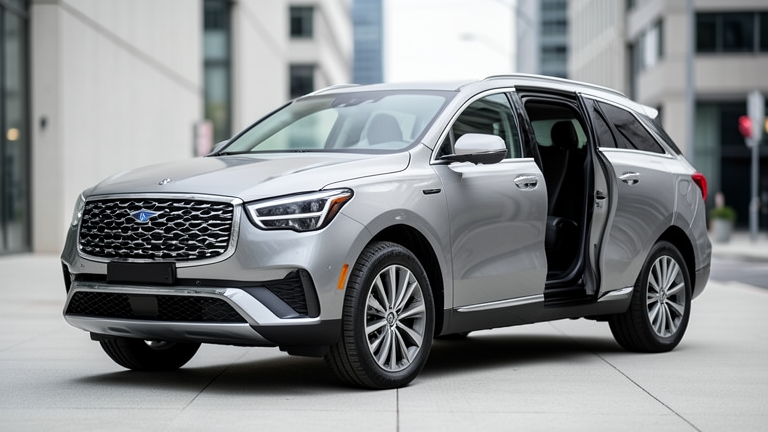
The Genesis GV90 is a near-replica of the Neolun concept, with hidden B-pillar coach doors
When Genesis unveiled the Neolun concept in early 2024, it signaled the brand’s intention to enter the full-size luxury SUV arena with something far more distinctive than a typical three-row electric vehicle. The production GV90 stays remarkably faithful to that vision. The most dramatic feature is the Neolun Arch Gate variant, which eliminates the traditional B-pillar entirely and replaces it with what Genesis calls “the world’s first independently opening and closing hidden B-pillar coach doors.” A newly developed dual-motion hinge mechanism allows the rear doors to swing open and close without interfering with the front doors, creating a wide, unimpeded entryway that transforms the experience of getting in and out of the vehicle.
Genesis engineers did not simply remove a structural pillar for aesthetic effect. The company developed a reinforced body structure that marries the doors to the vehicle’s chassis and added dual steel beams in place of the traditional B-pillar. A concealed roll cage with a frame approximately 1.5 times thicker than the average passenger car reinforces the cabin. The result is a vehicle that sacrifices nothing in safety while delivering a visual and functional statement that sets it apart from every other production SUV on the market. For customers who prefer a more conventional approach, the standard GV90 comes with traditional swing doors.
The exterior design draws inspiration from the Korean moon jar, a traditional ceramic form celebrated for its minimalist, rounded elegance. Genesis describes the design as reductive, with no unnecessary lines or details. The signature Wing Face Micro Lens headlamps span the entire front end beneath a clamshell hood, while the lower bumper incorporates a three-dimensional, dual-layered G-matrix pattern chrome grille. The Two-Line lighting signature, jewel-like in its execution, is unmistakable from any angle.
The GV90 specs: 657 hp AWD, 123.5 kWh battery, and 310 miles of range
Underpinning the GV90 is Hyundai’s new eMP platform, engineered exclusively for Genesis flagship vehicles. This dedicated architecture supports the largest battery pack ever fitted to a Hyundai Motor Group vehicle: a 123.5 kWh unit that Genesis estimates will deliver approximately 310 miles (500 kilometers) of range for the seven-seat configuration. When connected to a 350 kW DC fast charger, the battery can charge from 10 percent to 80 percent in just 22 minutes, a figure that puts it near the top of its class for charging speed.

The dual-motor all-wheel-drive system produces a combined maximum output of 657 horsepower (490 kW) and 590 lb-ft (800 Nm) of torque, making it the most powerful powertrain ever installed in any Hyundai Motor Group production vehicle. This is the first model from the group to feature a Dual Electronic Limited-Slip Differential mounted on both the front and rear motors, providing enhanced traction control and high-speed cornering stability. Active Rear Wheel Steering turns the rear wheels up to five degrees, and Genesis states that this reduces the turning radius to that of a mid-size car—a meaningful advantage for a vehicle that measures 208.1 inches long, 79.9 inches wide, and 71.5 inches tall, riding on a 127.8-inch wheelbase.
A Multi-Chamber Air Suspension system uses air springs with adjustable stiffness to absorb road imperfections and maintain body control. This setup, combined with the low center of gravity inherent to the skateboard battery layout, should deliver a ride quality that matches the vehicle’s luxury aspirations.
Inside the GV90: A cabin designed for VIP experiences with ondol heating and a refrigerator
Step inside the GV90 Neolun Executive Suite, the four-seat configuration that Genesis describes as “the ultimate VIP experience,” and the ambition becomes tactile. The floor is finished with a premium real wood veneer, and a radiant heating system inspired by traditional Korean ondol underfloor heating warms the cabin from below—a feature more commonly associated with high-end residences than automobiles. A Comfort Partition separates the passenger compartment from the cargo area, insulating occupants from road noise and providing roll blinds for complete privacy when desired. A built-in refrigerator, a second-row tower console, and integrated tables complete the executive lounge atmosphere.
The GV90 is the first Genesis vehicle to adopt Hyundai’s new Pleos Connect infotainment system, which is built on the Android Automotive Operating System. The interface behaves much like a smartphone, with customizable screens and a full app ecosystem. Gleo AI, Hyundai’s in-car artificial intelligence companion, responds to voice commands for information retrieval and vehicle settings adjustments. The pop-up center OLED Cinematic Display measures 23.6 inches during driving, combining the instrument cluster, navigation, and media into a single wide panel. When parked, the display extends to 24.6 inches, transforming the front of the cabin into an entertainment hub. A 25-inch Head-Up Display replaces the traditional instrument cluster entirely, projecting speed, navigation prompts, and advanced driver-assistance information onto the windshield.
Hyundai’s New Power Control System reimagines the start-up sequence. When the driver pulls the door handle, the vehicle powers on and closes the doors automatically. The Motion Column Shifter moves from the 12 o’clock position to the 2 o’clock position, signaling readiness for gear selection. Simultaneously, the Crystal Sphere Controller rotates to reveal an integrated controller, and the vehicle starts when the driver presses the brake pedal. It is a choreographed sequence that reinforces the sense of occasion every time the GV90 is driven.
Audio comes from a 25-speaker Bang & Olufsen Premier 3D sound system featuring Acoustic Lens Technology tweeters at both ends of the dashboard, four headliner speakers, mid-range drivers, and subwoofers. The system includes a Virtual Venue feature that recreates the acoustics of iconic performance spaces such as the Boston Symphony Hall and Wembley Stadium. Ambient Glow mood lighting wraps around the dashboard and doors, illuminating intuitively upon entry or when voice recognition is activated.
The world’s first Roof Airbag and 12 airbags set a new safety standard
Safety innovation is a cornerstone of the GV90. It is equipped with the world’s first Roof Airbag, which deploys automatically in a rollover scenario to cover the entire roof glass surface, protecting passengers from head injuries. The system works in concert with 12 airbags distributed throughout the cabin, an in-car Monitoring System, and the reinforced body structure. Remote Smart Parking Assist 3 enables the vehicle to park itself, while Memory Reversing Assist remembers the vehicle’s path to guide it backward out of tight spaces—a practical convenience for a vehicle of this size.
The GV90 Neolun First Edition: Limited production with two-tone paint and wool-cashmere interiors
Genesis also unveiled the GV90 Neolun First Edition, a limited-run model that represents the pinnacle of the Executive Suite lineup. It features a two-tone exterior palette with body-color 24-inch forged wheels, a wool-cashmere interior, and an exclusive First Edition logo engraved on the Crystal Sphere Controller, headrests, and doorsteps. Three color combinations are available: a two-tone Jaipur Rose and Seychelles Beige exterior with a Quince Brown interior; a two-tone Vik Black and Baena Green exterior with a Veiled Indigo and Puglia Green interior; and a two-tone Vik Black and Sonoran Navy exterior with a Majestic Purple and Regal Navy interior.
The standard GV90 offers 16 exterior colors, including 13 glossy finishes, and five interior color combinations: Veiled Indigo and Puglia Green, Folio Brown and Batiste Blue, Vault Black and Shadow Gray, Tyrian Purple and Travertine Beige, and Saddle Brown and Shadow Gray. The GV90 Neolun variant adds five exclusive interior schemes: Regal Navy and Majestic Purple, Quince Brown, Vault Black and Shadow Gray, Tyrian Purple and Travertine Beige, and Saddle Brown and Shadow Gray.
What the Genesis GV90 means for the luxury EV market
The GV90 arrives at a moment when the ultra-luxury electric SUV segment is both expanding and consolidating. Mercedes-Benz has the EQS SUV, BMW offers the iX, and Cadillac has the Escalade IQ. Yet none of these vehicles feature coach doors, a roof airbag system, or a cabin with radiant floor heating inspired by Korean tradition. Genesis is positioning the GV90 not as a me-too entry but as a genuinely different proposition—one that combines the brand’s distinctive design language with engineering details that challenge established conventions.

Hyundai Motor Company CEO José Muñoz stated that the GV90 “opens a new chapter for Genesis,” offering “the very best” that the brand has to offer. That statement carries weight when considered alongside the vehicle’s specifications. The 657-horsepower powertrain, the 123.5 kWh battery with 22-minute fast charging, the hidden B-pillar coach doors, and the meticulous cabin execution all point to a vehicle engineered to compete at the highest level. The GV90 is not merely a flagship for Genesis—it is a proof point for what the Hyundai Motor Group can achieve when it commits its resources to a single, uncompromising vision. The market will now decide whether the world is ready for a Korean ultra-luxury SUV that dares to reimagine what a flagship can be.