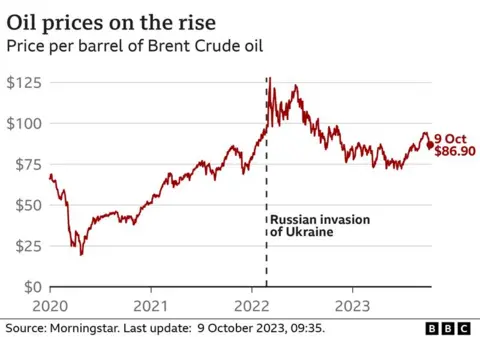
Global oil markets entered uncharted territory this week as benchmark crude prices surged above $90 per barrel for the first time since hostilities erupted in the Middle East. The price threshold, long considered a psychological barrier for traders and policymakers, has been breached amid mounting concerns that the conflict involving Iran could extend for months and disrupt critical production infrastructure across the region.
Market Reaction to Extended Conflict Timeline
Financial markets are recalibrating their expectations as intelligence reports and geopolitical analysts suggest the possibility of a prolonged military engagement. Initially, many traders had priced in a brief, contained conflict, but recent developments indicate a different trajectory. “The market is waking up to the reality that this isn’t going to be resolved quickly,” stated Helena Vance, chief commodities analyst at Global Energy Insights. “We’re seeing a fundamental repricing of risk premiums as the timeline extends from weeks to potentially several months.”
Production Disruptions Across the Gulf
The immediate catalyst for the price surge stems from confirmed shutdowns at multiple production facilities along the Persian Gulf. Satellite imagery analyzed by independent monitoring groups shows decreased flaring activity at several key Iranian fields, while shipping data indicates reduced tanker traffic through the Strait of Hormuz. These visual confirmations have translated into tangible supply concerns for global markets.
According to data from the International Energy Agency, approximately 2.1 million barrels per day of Iranian production has been taken offline due to security concerns and infrastructure vulnerabilities. Neighboring countries, while not directly involved in hostilities, have also reduced output as a precautionary measure against potential escalation. “When you see countries like Kuwait and the UAE voluntarily trimming production for security reasons, you know the situation is serious,” noted energy consultant Marcus Thorne.
Strategic Petroleum Reserves Under Pressure
Governments worldwide are beginning to assess their strategic petroleum reserves as insurance against prolonged supply disruption. The United States Department of Energy confirmed it is “monitoring the situation closely” but has not yet authorized releases from the Strategic Petroleum Reserve. European Union energy ministers are scheduled to hold an emergency meeting to coordinate potential responses, with several member states advocating for a coordinated reserve release if prices remain elevated.
Transportation and Shipping Vulnerabilities
The conflict has exposed critical vulnerabilities in global energy transportation networks. Insurance premiums for vessels traveling through the Persian Gulf have increased by over 400% in the past month, adding significant costs to every barrel shipped from the region. Several major shipping companies have rerouted vessels around the Cape of Good Hope, adding approximately two weeks to transit times and increasing shipping costs by an estimated 30-40%.
“The Strait of Hormuz remains technically open, but practically, it’s becoming a no-go zone for many operators,” explained maritime security expert David Chen. “When you combine heightened insurance costs with the physical risk to vessels and crews, many companies are deciding the risk-reward calculation no longer makes sense.”
Alternative Supply Sources and Limitations
The market is turning to alternative supply sources, but with limited success. Russian production remains near capacity, while Venezuelan output continues to face infrastructure limitations despite recent sanctions relief. The United States, now the world’s largest producer, has limited ability to quickly increase production due to capital discipline among shale operators and persistent supply chain constraints.
OPEC+ Response and Production Policy
The OPEC+ alliance faces a complex decision-making environment. While higher prices benefit member economies in the short term, prolonged price spikes could accelerate the global transition away from fossil fuels and trigger demand destruction. Saudi Arabia, the de facto leader of the organization, has maintained its previously announced production cuts, citing the need for market stability. However, internal discussions reportedly include scenarios for incremental increases if the supply disruption extends beyond current projections.
“OPEC+ finds itself walking a tightrope,” observed Middle East political analyst Leila Nassar. “They want to benefit from higher prices, but not so high that they trigger a global recession or accelerate renewable energy adoption. It’s a delicate balance that becomes more difficult with each dollar increase in the oil price.”
Economic Implications for Global Growth
The price surge arrives at a sensitive moment for the global economy. Central banks in major economies had been signaling a potential pause in interest rate hikes as inflation showed signs of moderating. However, sustained oil prices above $90 per barrel could reignite inflationary pressures, complicating monetary policy decisions worldwide.
Developing Economies Face Particular Vulnerability
Emerging markets with limited currency reserves and high dependence on imported energy face acute challenges. Countries like Pakistan, Egypt, and Sri Lanka, already grappling with debt burdens and currency depreciation, may need to implement additional austerity measures or seek emergency financing. The International Monetary Fund has indicated it is preparing for potential assistance requests from affected nations.
Consumer Impact and Demand Response
Early indicators suggest that demand destruction is beginning to materialize, though not yet at levels sufficient to offset supply concerns. Gasoline consumption in the United States declined by 2.3% last week compared to the same period last year, while European diesel demand fell by approximately 1.8%. Aviation fuel demand remains robust, however, as post-pandemic travel patterns continue to normalize.
“We’re seeing the early stages of demand response, particularly in price-sensitive markets,” explained transportation economist Robert Kim. “The question is whether this demand destruction will accelerate quickly enough to balance the market, or if we’ll need to see more significant economic slowdown to bring prices back down.”
Geopolitical Calculations and Conflict Resolution Pathways
Behind the market movements lie complex geopolitical calculations. Regional powers are assessing their positions, with several attempting to mediate between parties while simultaneously securing their own energy interests. The United States has deployed additional naval assets to the region but has emphasized diplomatic channels as the preferred resolution mechanism.
Energy Transition Implications
The price surge has reignited debates about energy security and transition timelines. Proponents of renewable energy argue that current events demonstrate the vulnerability of fossil fuel dependence, while traditional energy advocates point to continued global reliance on hydrocarbons. Investment patterns in coming months may provide insight into whether this crisis accelerates or delays the global energy transition.
“Every energy price shock creates both challenges and opportunities for transition,” noted energy policy researcher Samantha Wright. “The key question is whether governments and investors interpret this as a reason to double down on fossil fuel security or accelerate diversification. Historical patterns suggest we’ll likely see some of both.”
Market Structure and Trading Dynamics
Trading activity reflects heightened uncertainty, with options markets showing increased demand for protection against both further price spikes and potential sudden declines. The volatility index for crude oil has reached its highest level since the early months of the Russia-Ukraine conflict, indicating trader expectation of continued price swings.
Hedge funds and other speculative investors have increased their net long positions in crude oil futures, though not to the extreme levels seen during previous price spikes. This relative restraint suggests that many market participants remain cautious about the sustainability of current price levels. Commercial hedgers, including airlines and shipping companies, have been particularly active in locking in future prices, reflecting concerns about continued volatility.
As traders brace for what could be an extended period of elevated prices and volatility, the global economy faces renewed inflationary pressures at a delicate moment in the post-pandemic recovery. The breach of the $90 threshold represents not just a numerical milestone but a tangible manifestation of geopolitical risk translating into economic reality. Market fundamentals, geopolitical calculations, and economic policies will all contribute to determining whether this price level represents a temporary spike or a new baseline for global energy costs in an increasingly uncertain world.