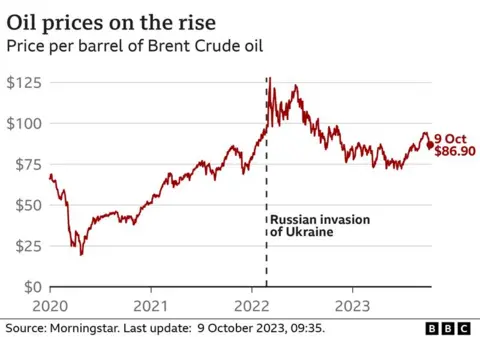
The global oil market has entered uncharted territory as benchmark crude prices surged past $90 per barrel this week, marking the highest level since the outbreak of hostilities in Iran. This unprecedented price spike reflects mounting trader anxiety about prolonged regional conflict and its potential to disrupt energy supplies from one of the world’s most critical production zones. The psychological barrier of $90 has been breached not merely as a temporary fluctuation but as a fundamental recalibration of risk in global energy markets.
Market Reaction to Geopolitical Instability
Trading floors across financial centers from London to Singapore have been dominated by a single narrative: the conflict in Iran is no longer viewed as a short-term disruption. Initial market responses in the early days of hostilities suggested a temporary premium of $5-10 per barrel, with many analysts predicting a quick resolution or limited regional impact. That optimism has evaporated completely. The sustained breach of the $90 threshold signals that institutional investors, commodity funds, and national energy buyers now anticipate a protracted engagement with serious consequences for global oil flows.
The price movement represents more than just reaction to headlines. Trading volumes in Brent and West Texas Intermediate futures have reached multi-year highs, with open interest expanding dramatically as new positions are established. Options markets show extreme skew, with far greater demand for call options at $100 and $110 strike prices than for protective puts. This asymmetry reveals that the dominant fear among market participants is not of a price collapse but of further explosive upside movement. The volatility index for crude oil has spiked to levels not seen since the early days of the Russia-Ukraine conflict, indicating systemic uncertainty about both supply and demand fundamentals.
Production Shutdowns and Supply Chain Disruptions
Physical supply disruptions are already materializing, moving beyond theoretical risk into tangible reduction of barrels reaching global markets. Iran’s direct exports, which had been gradually increasing despite sanctions, have effectively ceased. More significantly, production facilities in neighboring countries are facing operational challenges. Iraq’s southern oil fields, which export through the Persian Gulf, have seen security protocols tightened dramatically, slowing loading operations at key terminals like Basra. Kuwait has reportedly reduced output from fields near the border as a precautionary measure.
Strait of Hormuz Tensions
The most critical choke point remains the Strait of Hormuz, through which approximately 21 million barrels of oil pass daily—about one-fifth of global consumption. While the waterway remains open, insurance premiums for tankers transiting the region have increased tenfold in recent weeks. Several major shipping companies have instructed vessels to avoid Iranian territorial waters entirely, adding days to voyage times and increasing transportation costs. The combined effect of these logistical constraints has effectively removed an estimated 1.5 to 2 million barrels per day from immediate availability, with the potential for further reductions if tensions escalate.
Strategic Petroleum Reserves and Consumer Nations
Consumer nations are responding with varying degrees of urgency. The United States has signaled it will not initiate releases from its Strategic Petroleum Reserve in the immediate term, with administration officials stating they view current prices as reflecting genuine supply risk rather than speculative excess. This marks a significant departure from previous crises where the SPR was deployed more readily. Analysts interpret this restraint as acknowledgment that the SPR’s approximately 600 million barrels would provide only temporary relief against a structural supply deficit.
European nations, already grappling with energy insecurity following the loss of Russian pipeline gas, face particular vulnerability. Several EU members have begun consultations about potential coordinated demand-reduction measures, reminiscent of the 1970s oil crisis responses. China, the world’s largest crude importer, has reportedly accelerated negotiations with alternative suppliers including Russia and Venezuela, though logistical constraints limit how quickly these sources can replace Persian Gulf volumes. India, another massive importer dependent on Middle Eastern crude, has seen its currency weaken against the dollar, exacerbating the local economic impact of higher oil prices.
Energy Transition Implications
The price shock arrives at a pivotal moment for global energy policy, complicating the transition away from fossil fuels. While high prices theoretically accelerate adoption of alternatives by improving their economic competitiveness, the immediate effect may be paradoxical. Several European governments have temporarily relaxed emissions standards to allow increased coal-fired power generation, recognizing that natural gas—already expensive—faces further upward pressure. Electric vehicle adoption rates, which had been climbing steadily, may face headwinds if broader economic uncertainty dampens consumer confidence and large purchases.
Renewable energy projects face their own challenges. Many depend on critical minerals and manufacturing components from global supply chains that are themselves energy-intensive. Higher oil prices increase production and transportation costs for solar panels, wind turbines, and battery storage systems. The inflationary effect could delay project timelines and increase levelized costs of electricity, potentially slowing the very transition that would reduce oil dependence long-term. This creates a complex policy dilemma for governments attempting to balance immediate energy security with decarbonization commitments.
Economic Ripple Effects and Inflation Concerns
Central banks worldwide, which had been cautiously optimistic about containing inflation, now confront a renewed threat. Energy prices feed directly into transportation, manufacturing, and heating costs, with secondary effects throughout consumer economies. The Federal Reserve, European Central Bank, and Bank of England all face difficult decisions about whether to maintain higher interest rates for longer or risk entrenched inflation. Early estimates suggest the oil price surge could add 0.5 to 1.0 percentage points to inflation rates across major economies if sustained through the coming quarter.
Emerging markets face even greater strain. Nations with high fuel subsidies, such as Indonesia and Malaysia, will see fiscal budgets stretched thin. Countries with dollar-denominated debt and trade deficits, including Pakistan and Egypt, risk currency crises as their import bills balloon. The International Monetary Fund has quietly begun contingency planning for potential emergency lending programs, though officials emphasize publicly that the situation remains manageable if confined to current price levels.
Industry Investment and Long-Term Production
Paradoxically, the price surge may not trigger immediate increases in production from non-OPEC sources. U.S. shale producers, traditionally responsive to price signals, remain constrained by investor demands for capital discipline and returns rather than growth. Publicly traded exploration and production companies continue to prioritize debt reduction and shareholder payments over aggressive drilling programs. Private operators have more flexibility but face labor, equipment, and sand shortages that limit rapid expansion.
Major international oil companies confront different constraints. Projects in deepwater basins and other complex environments require multi-year lead times, meaning decisions made today would not affect supply until the latter part of this decade. Many companies remain wary of committing to large capital expenditures amid uncertainty about long-term demand as energy transitions progress. This creates a potential mismatch: prices may remain elevated due to immediate supply constraints, yet those same prices may not catalyze sufficient investment to address medium-term supply needs, setting the stage for continued volatility.
Diplomatic Efforts and Market Psychology
Behind the trading numbers lies intense diplomatic activity. U.S., European, and Gulf Arab diplomats are engaged in what multiple sources describe as the most concentrated Middle East crisis management effort in a decade. The immediate focus is preventing further escalation that could draw in additional regional actors. Secondary efforts aim to reassure markets that alternative shipping routes and supply arrangements exist if Strait of Hormuz transit becomes problematic, though traders remain skeptical about the adequacy of such contingency plans.
Market psychology has shifted decisively. The prevailing sentiment now assumes that even if direct hostilities diminish, the underlying geopolitical tensions will persist for months if not years. Sanctions regimes, already complex, may become further entangled with conflict dynamics. Insurance markets may permanently reassess risk premiums for the region. The fundamental reassessment is that Middle Eastern oil, long considered reliably available despite political tensions, now carries a structural risk premium that may not dissipate quickly. This represents a fundamental change in how global energy markets price one of their foundational commodities.
As trading closes for the week, analysts are revising their price forecasts upward, with several major banks now predicting averages above $95 for the coming quarter and acknowledging triple-digit prices as a distinct possibility. The breach of $90 has reset expectations across the energy complex, from refining margins to petrochemical feedstocks. What began as a regional conflict has triggered a global economic event whose full consequences will unfold in the coming months, testing the resilience of supply chains, the determination of policymakers, and the adaptability of the world’s energy systems in an era of renewed geopolitical competition.