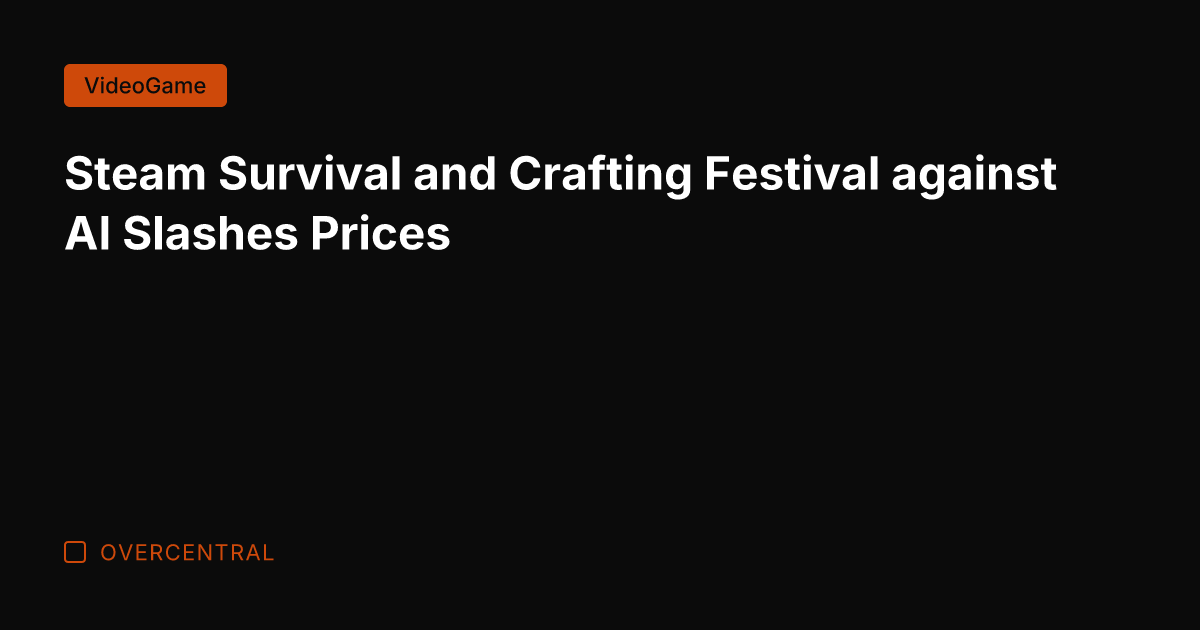
Valve has launched a dedicated thematic sale in the Steam digital storefront: the “Steam Survival and Crafting Festival against AI,” a one-week event that slashes prices on hundreds of games and runs until September 7 at 20:00 Moscow time. Unlike the sprawling, genre-agnostic Steam sales that have become seasonal fixtures, this festival is narrowly focused on a specific subcategory of survival crafting titles: those that pit players against environmental hazards, hostile biomes, and AI-driven threats rather than against other human opponents. The event represents not merely a discount opportunity but a strategic curation by Valve to highlight a growing segment of the PC gaming market that prioritizes cooperative or solo PvE experiences over competitive multiplayer.
The “Against AI” Distinction: PvE Survival Crafting Takes Center Stage
The festival’s full name — “Survival and Crafting Festival against AI” — is a deliberate branding choice that signals a clear departure from the survival genre’s increasingly popular PvP (player-versus-player) battle royale and extraction shooter variants. The content on the official festival page confirms that the event features exclusively PvE (player-versus-environment) projects. In these games, the primary adversaries are not other players but procedural weather systems, aggressive wildlife, toxic atmospheres, alien creatures, hunger and thirst meters, and the sheer unforgiving nature of the world itself. The “against AI” phrasing, while somewhat unconventional for a sale name, directly communicates to shoppers that they will not be forced into competitive engagements with strangers — a key selling point for a large and often underserved audience.
This curated focus has practical implications for players. Survival crafting games have long been split between two camps: those that offer cooperative or solo sandbox experiences (like Subnautica, The Forest, or Valheim) and those that enforce or encourage PvP combat (like Rust, ARK: Survival Evolved on official servers, or DayZ). The festival explicitly excludes the latter, ensuring that every discounted title adheres to the PvE ethos. For players who have been burnt by the toxicity of open-world PvP servers or simply prefer to build and explore at their own pace, this sale is a direct invitation to discover titles they might have overlooked.
Understanding the “Against AI” Mechanism in Survival Games
When a game is described as “against AI,” it typically means that the difficulty curve is generated by non-player character (NPC) behaviors, environmental systems, and scripted events rather than the unpredictable actions of human opponents. In the context of survival crafting, this manifests in several ways. Hunger and thirst systems simulate biological needs. Dynamic weather cycles can force players to construct shelter or risk hypothermia. Predator AI patrols territories and reacts to the player’s presence. Resource nodes are finite and require strategic management. Base-building mechanics must account for structural integrity and defense against AI raids — which are often timed to increase pressure as the game progresses. The absence of other humans means that the game’s difficulty is deterministic and can be learned, mastered, or adjusted through difficulty settings, mods, or gameplay choices. This predictability is a major draw for players who want a challenging but fair experience without the volatility of PvP.
Discounts, Historical Lows, and Notable Titles at the Festival
The festival’s primary value proposition is deep discounts on hundreds of games, with several titles reaching their lowest prices ever recorded on Steam. The content explicitly names four games that have updated their historical minimums: Smalland: Survive the Wilds, PixARK, VEIN, and Everwind. These are not the blockbuster names of the genre — titles like Subnautica or Valheim are absent from the example list — but they represent the diversity of settings and mechanics that the festival aims to showcase.
- Smalland: Survive the Wilds places players in a miniature world where they must survive as a tiny humanoid among giant insects and plants. The game emphasizes exploration, base-building, and taming creatures. Its recent price drop makes it an accessible entry point for players curious about the survival genre but intimidated by its more complex or grindy counterparts.
- PixARK is a voxel-based, blocky reimagining of the ARK: Survival Evolved formula, mixing the creature taming and survival mechanics of its inspiration with a Minecraft-like aesthetic and building system. It offers a more stylized and less graphically demanding experience, and its historical low may attract fans of sandbox building who also want dinosaur companions.
- VEIN is a lesser-known title that blends survival crafting with horror and exploration in a subterranean, procedurally generated world. Its inclusion highlights the festival’s willingness to feature niche, indie projects that might otherwise go unnoticed.
- Everwind is a multiplayer survival game set in a fantasy world with a focus on building, farming, and cooperative exploration. Its price reduction signals that even relatively recent releases are being pushed to attract new players during the sale.
Beyond these specific titles, the festival page aggregates hundreds of games across a wide range of settings: from ocean depths and uninhabited islands to outer space and post-apocalyptic wastelands. The diversity of themes is a deliberate strategy to cater to different player fantasies — the lone sailor, the space colonist, the post-apocalyptic scavenger, the island castaway — all united by the core loop of gathering resources, crafting tools and structures, and surviving against an AI-controlled environment.
Free Demos, Developer Livestreams, and Curated Subcategories
In addition to discounts on full releases, the festival features free demos of upcoming survival crafting games, allowing players to test the waters before committing to a purchase. Developer livestreams are also embedded on the main page, providing a direct line of communication between creators and potential buyers. These live broadcasts and recorded presentations offer a look at gameplay mechanics, development roadmaps, and community interactions. The festival also includes curated subcategories that break down the genre into narrower niches — such as “ocean survival,” “fantasy survival,” “sci-fi survival,” or “cooperative building” — making it easier for players to find exactly the type of experience they want without scrolling through hundreds of titles.
Why Steam’s Thematic Sales Are Gaining Strategic Importance
The “Survival and Crafting Festival against AI” is part of a broader trend in Valve’s approach to Steam sales. The company has moved away from the single, massive seasonal sale model (Winter Sale, Summer Sale) toward a calendar filled with smaller, themed events that serve specific communities. These thematic sales — such as the “Steam Deck Verified Sale,” “Roguelike Fest,” “Fighting Games Fest,” and now the “Survival and Crafting Festival” — allow Valve to curate a coherent selection of games, boost discoverability for niche titles, and create a sense of event around a particular genre. For developers, these festivals offer a predictable marketing window that can be timed with updates, expansions, or full releases. For players, they provide a focused shopping experience that reduces decision fatigue and aligns with their existing interests.
The “against AI” framing is particularly shrewd because it addresses a growing polarization in the survival genre. Over the past five years, PvP-focused survival games like Rust, DayZ, and Escape from Tarkov have dominated the public conversation, thanks in part to their popularity among streamers and content creators. However, a significant portion of the survival gaming audience prefers PvE experiences. Sales data from previous Steam events suggest that PvE survival games consistently outperform PvP titles in terms of player retention and positive review scores, especially among solo players. The festival capitalizes on this latent demand by explicitly excluding PvP and creating a safe space for cooperative and solo play.
What Does “Against AI” Mean for the Future of Survival Crafting?
The term “against AI” may also be interpreted as a subtle nod to the increasing sophistication of game AI systems. Modern survival games employ machine learning-inspired procedural generation, dynamic difficulty adjustment, and emergent behavior trees that create deeply unpredictable and replayable encounters. The festival’s title positions the player as a human fighting against intelligent systems — a framing that resonates with both the science fiction themes of many survival games and the broader cultural anxiety about artificial intelligence. While the sale itself is a commercial promotion, its naming convention reflects a shift in how developers and publishers talk about their games: the enemy is not another player, but the game itself, in its most intelligent form.
Practical Information for Players: Dates, Pricing, and How to Navigate
The festival began on a specific date (the content does not specify the start date, but it ends September 7 at 20:00 Moscow time, so it runs for exactly one week from the start). Players should note that the sale is time-limited and that discounts may vary by game. Historical lows mentioned for Smalland, PixARK, VEIN, and Everwind are likely to be matched by other titles during the event, but not all games will hit their all-time low. The festival page is the central hub for browsing, and Valve’s recommendation algorithms will likely surface additional titles based on the player’s library and wishlist.
For those interested in the survival crafting genre but unsure where to start, the festival’s curated subcategories are the best entry point. The “Ocean Survival” category, for example, includes games like Subnautica (which is not mentioned in the provided content but is a staple of the genre) and Breathedge (a space-themed survival comedy). The “Post-Apocalyptic” subcategory will appeal to fans of Fallout and Metro-style worlds. The “Fantasy Survival” section includes games with magic, mythical creatures, and medieval building. Each subcategory is designed to help players find a game that matches their preferred setting and gameplay style.
Broader Market Context: Steam’s Survival Crafting Ecosystem
The survival crafting genre is one of the most prolific on Steam, with thousands of titles in varying states of development. The genre’s popularity is driven by its core loop of progression: players start with nothing, gather resources, craft tools, build a base, and eventually conquer the environment. This loop is inherently satisfying and lends itself to long play sessions and high replayability. However, the genre also suffers from a reputation for being unfinished, buggy, or overly grindy. The “Survival and Crafting Festival against AI” gives Valve an opportunity to showcase the best of the genre — titles that are polished, feature-complete, and offer a balanced experience — while also promoting early access games that have shown promise.
Steam’s curation of the festival is not arbitrary; it reflects real data on what players are buying and playing. According to SteamDB and other third-party data aggregators, the survival crafting category consistently ranks among the top grossing genres on the platform, with titles like Ark: Survival Evolved, Valheim, Rust, and 7 Days to Die generating hundreds of millions of dollars in revenue. The PvE subsegment, while less media-hyped than PvP, is arguably more stable in terms of player retention and community sentiment. Games like Subnautica, The Forest, and Green Hell have maintained high review scores years after release, whereas PvP survival games often see their player bases ebb and flow with server wipes and balance changes.
Why the “Against AI” Label Matters for Developer Marketing
For independent developers, the festival’s emphasis on “against AI” provides a clear marketing hook. Many survival crafting games previously struggled to differentiate themselves from the PvP giants. By aligning with the festival’s theme, developers can position their games as the “cooperative alternative” or “solo-friendly” option. The festival also encourages developers to create demo versions, which can serve as powerful marketing tools. A well-designed demo can convert a casual browser into a paying customer within minutes, and the festival’s dedicated demo section gives developers a chance to bypass the usual noise of the Steam storefront.

Analyzing the Timing: Why September 2025?
The festival runs from late August to early September 2025 (based on the end date of September 7). This timing is strategic: it falls between the summer sale season (June-July) and the autumn/winter holiday push (November-December). It is also a period when many schools and universities in the Northern Hemisphere are resuming, which means a potential increase in desktop gaming time among students. Additionally, the end of summer often marks the release of major survival game updates or expansions, as developers aim to capture returning players. The festival’s one-week duration creates urgency without overwhelming players’ wallets, and it does not compete directly with major AAA launches that typically cluster around October and November.
The choice of “Survival and Crafting” as the theme is also notable because the genre has seen a resurgence in interest driven by the rise of “cozy gaming” and “slow living” trends. Games like Stardew Valley and Animal Crossing: New Horizons have proven that players crave non-violent, resource-management experiences. Survival crafting sits at the intersection of this cozy trend and the more hardcore survival mechanics. The “against AI” framing adds a layer of challenge without the social anxiety of PvP, making it an ideal genre for players who want a peaceful but engaging experience — or a terrifying one, depending on the game’s difficulty.
What the Festival Does Not Include: The Absence of PvP and Battle Royale
It is worth noting what the festival omits. There are no discounts on Rust, DayZ, Escape from Tarkov, or Fortnite (the latter is not on Steam anyway). Games that blend PvP and PvE, such as ARK: Survival Evolved (which has PvP servers) or Conan Exiles, may appear in the sale only if they are played on PvE servers or solo. The festival’s curation is strict enough that a game like Rust, which is fundamentally a PvP experience, would not qualify even if it were discounted. This exclusion is a deliberate choice to maintain the thematic purity of the event. For players who enjoy the social dynamics of raiding and griefing, this festival offers little. But for those who have been frustrated by the toxic culture of survival PvP, the festival is a breath of fresh air.
Looking Beyond the Sale: What This Means for the Survival Genre
The “Steam Survival and Crafting Festival against AI” is more than a collection of discounts. It is a statement from Valve that the PvE survival crafting subgenre has matured enough to warrant its own curated event. It signals to developers that there is a clear and growing market for games that prioritize cooperation, exploration, and environmental challenge over competitive conflict. It also provides a valuable data point for publishers considering which genre to invest in next. The success of this festival — measured in terms of sales, wishlist additions, and player engagement — will likely influence whether Valve repeats the event in future years and whether other platforms like Epic Games Store or GOG launch similar themed sales.
For players, the festival is a rare opportunity to stock up on some of the most immersive and rewarding games available on PC, all while supporting the developers who create them. The historical lows on titles like Smalland, PixARK, VEIN, and Everwind make it an ideal time to experiment with new genres or to pick up a game that has been sitting on a wishlist for months. With free demos, live streams, and curated categories, the festival removes the guesswork from shopping and presents a coherent, carefully selected array of experiences that demonstrate the depth and diversity of the survival crafting genre.
In the end, the “against AI” label is not just a marketing gimmick — it is a reflection of where the genre is headed. As AI technology improves, survival games will only become more sophisticated, more reactive, and more capable of simulating living worlds. The festival celebrates that progress and invites players to experience it for themselves. Whether you are a seasoned survivalist or a curious newcomer, the festival offers something to discover, build, and survive against.

/i.s3.glbimg.com/v1/AUTH_08fbf48bc0524877943fe86e43087e7a/internal_photos/bs/2026/Y/y/eloBAuRYqsg3YH6XQqQQ/imagem-2026-09-10-200407901.png "WARDOGS Early Access: Why “Just Wait for Full Release”")