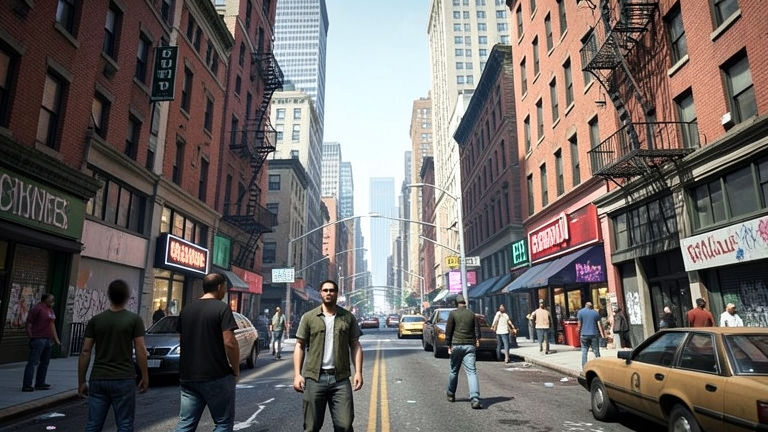
In the sprawling, ambitious development of Grand Theft Auto IV, Rockstar Games envisioned something far beyond the typical open-world cannon fodder. The team initially planned to imbue every single non-player character with a level of autonomy and reactivity so advanced that the streets of Liberty City would feel genuinely alive — a living ecosystem of digital consciousness. This vision, however, proved to be a technical and logistical nightmare, forcing the studio to abandon its plans for fully “living” AI NPCs, ultimately shaping the game into the landmark title we recognize today.
The Unrealized Ambition: A City of Autonomous Minds
During the early conceptual phases of Grand Theft Auto IV, which launched in 2008, the development team was captivated by the idea of creating NPCs that were not merely programmed actors but virtual beings with their own agendas, routines, and complex behavioral loops. The goal was to make every pedestrian, driver, and shopkeeper feel as though they possessed an inner life. These characters would react to the player’s presence and to each other in ways that were emergent and unpredictable, rather than scripted. The team aimed to simulate a city where the player was just one inhabitant among millions, each with a unique, procedurally generated existence.
What Exactly Were the “Living AI” Plans for Grand Theft Auto IV?
The “living AI” plans for Grand Theft Auto IV involved designing NPCs with persistent memory, dynamic daily schedules, and independent decision-making capabilities. These characters were intended to remember past interactions with the player, hold grudges, form relationships with other NPCs, and pursue their own goals — such as going to work, visiting friends, or committing crimes — completely independent of the player’s actions. The goal was to create a simulation where the world continued to operate and evolve even when the player was not present, blurring the line between scripted narrative and emergent gameplay.
The Technical and Practical Hurdles That Sunk the Vision
While conceptually brilliant, the execution of truly autonomous NPCs in Grand Theft Auto IV ran into a series of insurmountable obstacles. The primary issue was sheer computational load. A fully simulated city, with thousands of persistent, self-directed agents, would have overwhelmed the hardware of the PlayStation 3 and Xbox 360, the target consoles for the game. Memory constraints were brutal; storing the state, memory, and complex behavior trees for each NPC was impractical on the limited RAM available at the time.
Beyond hardware, the software challenges were equally daunting. Debugging emergent AI behaviors is notoriously difficult. When thousands of autonomous agents interact, unpredictable chain reactions — often called “emergent chaos” — become the norm. The development team found that NPCs would frequently get stuck in impossible loops, fail to complete their routines, or engage in behavior that broke the game’s fundamental illusion of reality. A shopkeeper who decided to abandon his store, or a pedestrian who developed an irrational fear of a specific street corner, required constant manual intervention, which undermined the very autonomy the system was meant to provide.

Why Did Rockstar Games Cut the Living NPCs From Grand Theft Auto IV?
Rockstar Games cut the living NPCs from Grand Theft Auto IV primarily because the system introduced too many technical problems and failed to deliver a stable, enjoyable gameplay experience. The autonomous behaviors frequently caused game-breaking bugs, performance issues, and narrative inconsistencies. The sheer complexity of managing thousands of independent AI agents on the console hardware of the era made the feature unworkable. The team ultimately decided that a more controlled, scripted, and performance-optimized NPC system would better serve the game’s core identity as an action-adventure title with a strong narrative focus.
The Shift to Scripted Reactivity: A Pragmatic Compromise
Instead of fully autonomous living AI, Grand Theft Auto IV shipped with a highly sophisticated system of scripted reactivity. NPCs in the final game do not possess long-term memory or independent goals. However, they react dynamically to immediate stimuli. A pedestrian will panic and flee if a gun is drawn. A driver will honk, swerve, or stop depending on traffic conditions and the player’s driving style. The Euphoria physics engine, which powers character movement, gives NPCs a convincing sense of weight and momentum, making their reactions to being shot or hit by a car feel realistic in the moment.
This approach was a compromise, but it was an effective one. The city of Liberty City feels alive not because every character has a unique internal life, but because the aggregate of their immediate reactions creates a convincing illusion of life. The game relies on high-quality animation, responsive audio cues, and consistent behavioral rules to keep the world feeling dynamic, even if the underlying AI is far simpler than originally planned.
What Did Grand Theft Auto IV’s NPC System Actually Achieve?
The NPC system that shipped with Grand Theft Auto IV was, for its time, a remarkable achievement in open-world design. The Euphoria physics engine allowed for unprecedented physical realism in character movement and reactions. Pedestrians would stumble, grab onto railings, and react with fear that felt grounded in a physical body. The combat AI, while not autonomous, was aggressive and tactical, using cover and flanking maneuvers that felt intelligent. The traffic system, with its realistic density and driver behavior (including road rage), contributed significantly to the sense of a living, breathing metropolitan environment.
The system also featured a robust police AI with a wanted level mechanic that was celebrated for its escalating intensity and tactical variety. Officers would coordinate their movements, call for backup, set up roadblocks, and employ helicopters. These behaviors were heavily scripted and condition-based, but they were executed with such polish and attention to detail that they felt organic and responsive to the player’s actions.
Industry Context: The Unresolved Challenge of Living AI in Open Worlds
Rockstar’s struggle with living AI in Grand Theft Auto IV is not an isolated failure. The dream of fully autonomous, persistent NPCs has haunted open-world developers for over two decades. Games like The Elder Scrolls and The Sims have attempted various forms of NPC autonomy, but none have achieved the level of emergent depth that was originally envisioned for Liberty City. The core challenge remains a trilemma of computational resources, narrative coherence, and player agency. If NPCs are too autonomous, they can break the main story. If they are too scripted, the world feels static and artificial.
Recent titles, such as Red Dead Redemption 2, have made significant strides by using more sophisticated behavior scheduling and memory systems. NPCs in that game have daily routines, remember the player, and react to their reputation. However, even Red Dead Redemption 2 operates within a carefully managed simulation. The NPCs do not have true autonomy; they follow predetermined schedules and respond to a limited set of player-driven triggers. The industry is still searching for the breakthrough that will deliver the original promise of Grand Theft Auto IV’s living AI without sacrificing performance, stability, or gameplay quality.
How Does Grand Theft Auto IV’s AI Compare to Modern Open World Games?
Compared to modern open world games, Grand Theft Auto IV’s NPC AI feels reactive and physically impressive but limited in autonomy. Games like Red Dead Redemption 2 and Cyberpunk 2077 offer NPCs with more detailed daily routines and contextual responses. However, no current game achieves the fully autonomous, persistent simulation Rockstar originally envisioned for GTA IV. Modern systems rely on a blend of scripted schedules, condition-based reactions, and physics-driven animation, rather than true emergent agency. The fundamental trade-off between believable simulation and stable gameplay remains largely unchanged.
The Strategic Significance of This Cut: Rockstar’s Design Philosophy
The decision to cut living AI from Grand Theft Auto IV reveals a crucial aspect of Rockstar’s design philosophy: narrative and control always take precedence over simulation. Rockstar is a studio that crafts tightly directed, cinematic experiences. Allowing NPCs to behave truly autonomously could undermine the carefully constructed story beats, mission structures, and dramatic pacing that define the Grand Theft Auto series. The cut was not just a technical concession; it was a philosophical choice. Rockstar prioritized the developer’s ability to curate the player’s experience over the potential for emergent, unpredictable storytelling.
This philosophy has defined the studio’s output ever since. The Grand Theft Auto series and its cousin Red Dead Redemption are known for their high-quality narrative writing and set-piece moments. The worlds are incredibly detailed and responsive, but they are designed to serve the story, not to generate their own. The failure of the living AI project in Grand Theft Auto IV reinforced Rockstar’s commitment to authored content, a strategy that has proven commercially and critically successful, even if it leaves the promise of truly autonomous NPCs unfulfilled.

The Legacy: How Grand Theft Auto IV Shaped Future AI Development
Despite the cut, the work done on Grand Theft Auto IV’s NPC systems was not wasted. The lessons learned influenced the development of Grand Theft Auto V and Red Dead Redemption 2. The latter, in particular, is renowned for its detailed NPC routines, where characters eat, sleep, work, and interact with each other in a schedule that changes over time. This system is far more sophisticated than what shipped in GTA IV, but it is still a compromise. The NPCs do not have true free will; they follow a schedule and respond to a list of stimuli. However, the depth of that schedule and the quality of the animation make the world feel profoundly alive.
Rockstar’s experience also contributed to the industry’s broader understanding of the relationship between AI complexity and game design. Developers now recognize that “smarter” AI is not always better AI. An NPC that acts in unexpected ways can frustrate players who are trying to complete a mission or achieve a specific goal. The goal for open-world designers has shifted from creating fully autonomous beings to creating the illusion of autonomy through layered, well-orchestrated systems that respond intelligently to a wide range of player inputs without breaking the game’s core experience.
What the Grand Theft Auto IV AI Story Means for Grand Theft Auto VI
The revelations about Grand Theft Auto IV’s canceled living AI plans have direct implications for the highly anticipated Grand Theft Auto VI. Given the generational leap in hardware with the PlayStation 5 and Xbox Series X|S, the computational constraints that plagued GTA IV are far less restrictive. Modern consoles feature fast SSDs, massive amounts of RAM, and powerful CPUs that can handle far more complex simulations. However, the fundamental design tension between autonomy and narrative control remains.
It is almost certain that Rockstar will push the sophistication of its NPC systems in Grand Theft Auto VI. We can expect deeper routines, more contextual reactions, and a world that feels more responsive to the player’s long-term actions. The studio has already demonstrated its commitment to environmental and NPC detail in recent releases. However, it is equally likely that Rockstar will continue to prioritize authored content and mission structure. The dream of fully living AI that derailed Grand Theft Auto IV’s development is now a technical possibility, but it may remain a philosophical one. The question is not whether Rockstar can build living NPCs, but whether they want to — and whether doing so would make a better game.
The story of Grand Theft Auto IV’s living AI is a cautionary tale about the gap between ambition and practicality, but it is also a testament to the pursuit of innovation. Even in failure, Rockstar’s original vision pushed the boundaries of what was considered possible in an open-world game. That spirit of experimentation, tempered by the hard-won wisdom of that project, will undoubtedly shape the future of Vice City and beyond. The NPCs may never be truly alive, but the effort to make them so has made the worlds we play in richer, stranger, and far more memorable.