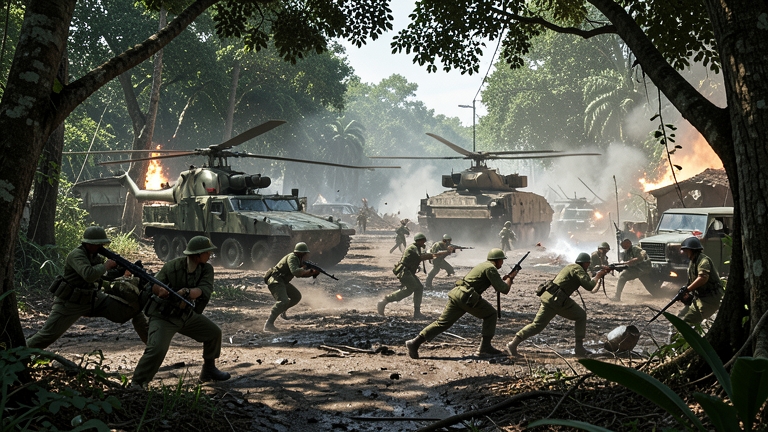
Hell Let Loose: Vietnam is officially coming to PC, PlayStation 5, and Xbox Series X|S on August 13, 2026, with Expression Games developing and Team17 publishing. The new installment takes the long-running tactical military shooter out of the European theaters of World War II and drops it into the jungles, rice paddies, and ruined villages of the Vietnam War. For a game built around coordinated squads, 50-player-per-side engagements, and historically grounded weaponry, this is as much a strategic shift as it is a setting change.
Hell Let Loose: Vietnam Release Date, Platforms, and Developer Details
Expression Games and Team17 have confirmed a fixed release date of August 13, 2026, and a simultaneous launch across PC, PS5, and Xbox Series X|S. The game is described as an action-shooter experienced from the first-person perspective, retaining the core identity of the Hell Let Loose series while transplanting it to a conflict defined by dense vegetation, guerrilla tactics, and vertical air mobility.
The initial information also specifies the language treatment: Russian text and English voice. Players who choose Russian localization will see menus, subtitles, and interface text in Russian, while the spoken dialogue and radio comms remain in English. That distinction matters in a game where communication is a central mechanic, and it signals that the development team is thinking carefully about the Russian-speaking tactical shooter audience while keeping the original English audio intact.
What is Hell Let Loose: Vietnam?
Hell Let Loose: Vietnam is a tactical first-person action-shooter set in the Vietnam War, developed by Expression Games and published by Team17. It is scheduled to launch on August 13, 2026, for PC, PlayStation 5, and Xbox Series X|S. The game builds on the Hell Let Loose framework of large-scale, team-driven infantry combat and adapts it to the terrain, weapons, and operational conditions of Southeast Asia. It will ship with Russian text and English voice acting.
When is Hell Let Loose: Vietnam coming out?
Hell Let Loose: Vietnam will launch on August 13, 2026, across PC, PS5, and Xbox Series X|S. No regional timing or early-access window has been announced as part of this reveal, but the date itself is locked.

On which platforms will Hell Let Loose: Vietnam be available?
The game is headed to PC, PlayStation 5, and Xbox Series X|S. Previous-generation consoles are not part of the announced lineup, which suggests the scope, scale, and technical demands of the Vietnam battlefield are being built around current hardware.
From the Western Front to the Vietnamese Jungle: A New Kind of Battlefield
Hell Let Loose established its reputation during the early access era of 2019 and solidified that reputation with its full release in 2021. The original game pulls players into large, faithfully reconstructed battlefields of World War II, where 100 players fight in two 50-player teams to capture and hold key sectors across a map. Its structure grew to include dedicated squad leaders, a commander role, armor crews, supply chains, artillery, and a heavy emphasis on communication. In the European theater, those systems serve a conventional, linear battlefield: open fields, hedgerows, urban centers, and identifiable frontlines.
Vietnam does not behave like that. The Vietnam War was not defined by a continuous frontline or by two armies meeting on a clear field of fire. It was fragmented, jungle-heavy, and asymmetrical, with the North Vietnamese Army and the Viet Cong often operating in small units, using ambushes, booby traps, and tunnel networks to offset the technological superiority of the United States and its allies. For the Hell Let Loose formula, that is a profound challenge. A game engine built to reward positioning, sightlines, and structured teamwork must now account for terrain where the enemy can be invisible three meters to your left.
The shift makes sense for the franchise. After years of refining European battlefields, the developers have already explored the limits of that setting. Vietnam offers a completely new set of tactical puzzles: how to clear a village when you cannot see inside, how to defend a hill when the jungle offers an attacker seventeen individual approaches, and how to call in support when smoke and canopy already obscure the target. These are not just map-design questions. They are systemic questions about how Hell Let Loose should work in a fundamentally different conflict.
Why did Hell Let Loose choose Vietnam as its next setting?
The announcement does not lay out an explicit creative rationale, but the tactical logic is clear. Vietnam moves the series into a war with a much broader range of combat modes: large conventional battles, small-unit patrols, ambushes, and hit-and-run raids. It also allows Hell Let Loose to use iconic technology such as helicopters, close air support, and riverine operations, while preserving the historical authenticity that has become the series’ trademark. After years of fighting on French roads and German hedgerows, the jungle is an expressive new canvas that forces every squad to rethink how it sees the battlefield.
How does the Vietnam setting change the core Hell Let Loose experience?
Dense jungle canopy shortens sightlines to a few meters, mud and rice paddies slow armor and infantry alike, and the distinction between friend and foe becomes harder to read under stress. The result is a shift from long-range, map-wide engagements toward close-range, high-intensity fights where audio cues, squad positioning, and reaction speed are amplified. Helicopters can change the approach to capture zones, but they also announce their arrival from far away, adding a new layer of strategic risk.
What the Vietnam War Demands from a Tactical Shooter
The success of Hell Let Loose: Vietnam will not be determined by whether it looks like a Vietnam game. It will be determined by how deeply its systems understand the realities of the conflict. In World War II, the armor-piercing threat came from enemy formations, Pak guns, and Tiger tanks. In Vietnam, the most feared weapon was often an improvised explosive device or a booby trap that no player could see until it detonated. That is a fundamentally different kind of fear, and a tactical shooter that pretends otherwise will fail its core audience.
There are also important logistical dimensions. Hell Let Loose has always made supply drops, buildable defenses, and commander-led resource management part of the experience. Vietnam makes those elements even more meaningful. Firebases and landing zones become natural focal points for spawn mechanics and supply lines. The fight for control of a hill is not just about holding a point; it is about providing security for resupply, artillery, and medical evacuation. These are concepts that the Hell Let Loose community already understands, which means Vietnam can reframe and deepen the systems rather than replacing them.
Visibility and orientation will be the hardest design problems. A jungle that is too dense becomes unreadable and frustrating. A jungle that is too open loses the authenticity of the setting. The developers will need maps with distinct landmarks, recognizable terrain features, and enough open ground to create meaningful fire lanes without letting a single machine gunner control an entire map. The same careful attention to map architecture that made Carentan and Foy memorable must now be applied to villages, riverbeds, rubber plantations, and mountain passes.
Air mobility and commander tools in Hell Let Loose: Vietnam
Helicopters are the most obvious addition to any Vietnam-era tactical shooter, and they carry implications for the Hell Let Loose structure. A commander or squad leader might call in an assault transport, but rotor noise also telegraphs the landing zone to the entire server. That alone creates a tactical mini-game around feints, staged insertions, and reliance on ground movement. If helicopters are fully controllable, they add a whole layer of pilot training and ground-crew coordination. If they are scripted or ability-based, they become strategic resources rather than vehicles. Either choice could work, but the announcement leaves the question open.

Similarly, close air support and artillery have always been important to Hell Let Loose. Vietnam offers a much wider vocabulary of fire support, from napalm and precision strikes to orbiting gunships and coastal naval fire. These are not just reskinned versions of World War II artillery. They operate differently, arrive on different timescales, and require the commander to think in three dimensions. The best tactical shooters make support tools feel like a reward for communication, and Vietnam provides plenty of opportunities for that design philosophy.
Language, Localization, and the Russian-Speaking Player Base
Confirmation of Russian text with English voice acting is a meaningful release detail. For a game as communication-heavy as Hell Let Loose, the interface language is not cosmetic. Squad leaders, commanders, and medics depend on readable, legible information under fire. A fully translated Russian interface lowers the barrier of entry for players who might otherwise struggle with English-only menus and tactical markers.
The decision to keep English voice is also understandable from a production perspective. High-quality dubbing into every language is expensive, and military shooters often favor authentic spoken audio over localization. In this case, English voice acting preserves the conflict’s original voice lines, radio chatter, and ambient combat audio, while Russian players still receive a complete text experience. That is a practical compromise, but it also suggests the game is expected to find a substantial audience across the Russian-speaking market.
How Hell Let Loose: Vietnam Fits into the Broader Vietnam Shooter Legacy
Hell Let Loose: Vietnam is entering a space with a complex history in first-person gaming. The Vietnam War has been depicted in games like Vietcong, Men of Valor, and the iconic Battlefield: Bad Company 2 Vietnam expansion, as well as more simulation-oriented titles such as Rising Storm 2: Vietnam. Each of those titles handled the setting differently. Some leaned on cinematic action and helicopter stunts, while others attempted to capture the bitterness of a war that is still difficult for many people to discuss dispassionately.
Hell Let Loose’s identity is closer to the latter group. The series has always been serious about its setting. It takes time to render historical weapons, uniforms, vehicles, and architecture. It surrounds the player with a soundscape that supports the fantasy of a massive, dangerous battlefield. If that same discipline is applied to Vietnam, the new game will be under continuous comparison with Rising Storm 2: Vietnam, which remains a cult favorite precisely because it understood the guerrilla dimension of the conflict.
What Hell Let Loose: Vietnam can add is scale. Rising Storm 2 built tense, intimate firefights and excelled at small-unit tension. Hell Let Loose has the technical foundation and community structure for larger battles across more complex maps. If Expression Games can bring combined arms into the jungle without losing the series’ strategic depth, it may set a new benchmark for the subgenre. It will also have to solve problems that WWII maps rarely present: how to make a natural environment feel varied, readable, and fair despite heavy vegetation and irregular terrain.
Answers to Common Questions About Hell Let Loose: Vietnam
What is the release date for Hell Let Loose: Vietnam?
Hell Let Loose: Vietnam is scheduled to release on August 13, 2026, for PC, PS5, and Xbox Series X|S.
Who is developing and publishing Hell Let Loose: Vietnam?
Expression Games is developing the game, and Team17 is publishing it.
Will Hell Let Loose: Vietnam be in Russian?
The game will include Russian text, including menus and subtitles, while the voice acting will be in English. That means the complete interface is localized into Russian, but the spoken audio remains English.
What genre is Hell Let Loose: Vietnam?
It is an action-shooter played from the first-person perspective. It retains the tactical, large-scale infantry and combined-arms focus of the Hell Let Loose series rather than a standard round-based arena shooter.
What are the system requirements for Hell Let Loose: Vietnam?
No system requirements, graphics settings, download sizes, or performance details have been announced. Players should expect that information closer to the release window, particularly for PC users who will need to judge CPU and GPU demands.
The Unanswered Technical and Strategic Questions
For all the important facts in this announcement, several crucial details remain unknown. The developers have not confirmed whether Hell Let Loose: Vietnam is a standalone product or a major expansion within the existing Hell Let Loose ecosystem. They have not detailed server architecture, cross-play support between PC and console, or cross-progression for players who own both platforms. They have also not released a gameplay trailer, which will be essential for convincing skeptical tactical shooter veterans that the game actually captures the feel of a Vietnam firefight.
Additionally, the current console generation is the only confirmed hardware. Since the original Hell Let Loose pushed last-generation consoles to their limits, skipping PS4 and Xbox One makes sense. But the decision also increases expectations for visual fidelity and performance on PS5 and Xbox Series X|S. Dense jungle foliage is difficult to render, and creating a natural environment that remains readable at long distances is a substantial technical challenge.
The question of content longevity will also need attention. Hell Let Loose: Vietnam will likely need a roadmap of post-launch maps, factions, weapons, and gameplay updates to keep the community alive over the long term. The series has benefited from a dedicated player base that expects regular content. The announcement of the August 13, 2026 release date starts a long runway of expectations, and the next several months will reveal whether the development team plans to match the update cadence of the original game.
In the meantime, there is one important practical takeaway for players who want to be ready: the underlying skills of Hell Let Loose remain valuable. Map knowledge always changes, and weapon ballistics will behave differently in the jungle, but the fundamentals of communication, squad leadership, and battlefield awareness will carry across. A player who knows when to suppress, when to move, and when to wait for a squad leader’s order will adapt to Vietnam faster than a player who simply relies on aim.
With less than a year between this announcement and launch, the pressure is now on Expression Games and Team17 to show real gameplay footage and explain how the series’ core systems work in an environment without clean frontlines. The tactical shooter audience has learned to distrust pre-release promises. They want to see how the jungle is rendered, how helicopters are controlled, how the asymmetrical conflict is balanced, and how the game feels when the radio chatter turns to panic in a shattered village. If Hell Let Loose: Vietnam delivers on all of that, it could stand alongside the best military shooters of its generation. If it does not, the August 13, 2026 date will be remembered for another reason entirely. The jungle is waiting, and so is one of the most demanding communities in military gaming.







/i.s3.glbimg.com/v1/AUTH_08fbf48bc0524877943fe86e43087e7a/internal_photos/bs/2026/Y/y/eloBAuRYqsg3YH6XQqQQ/imagem-2026-09-10-200407901.png "WARDOGS Early Access: Why “Just Wait for Full Release”")
