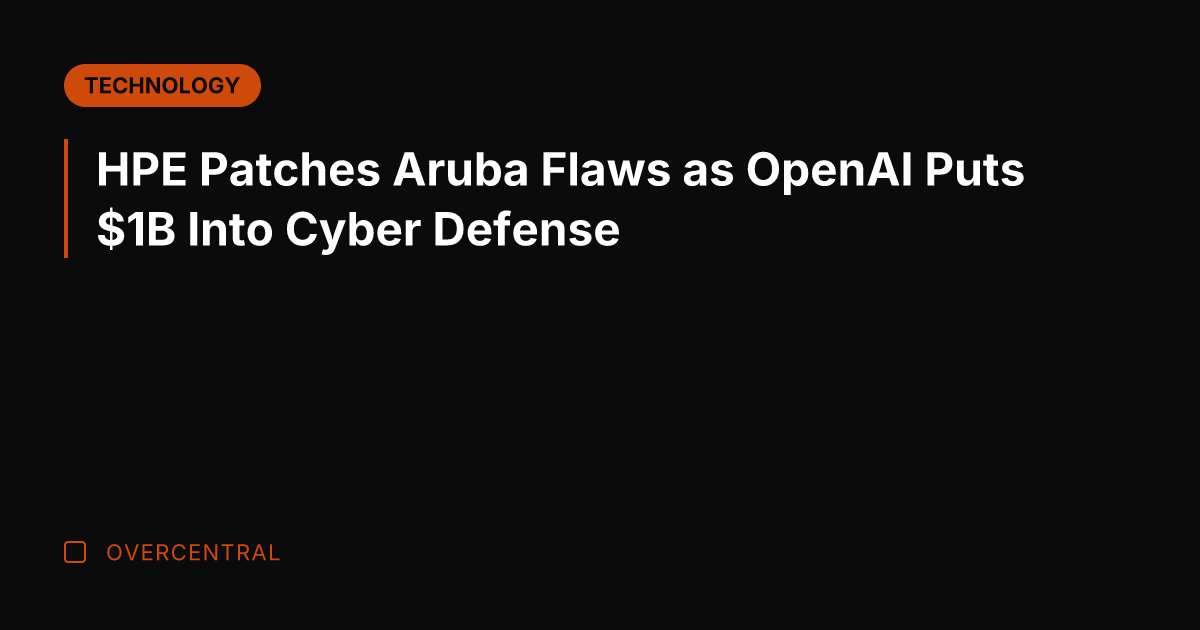
The cybersecurity landscape is entering a period where network infrastructure and artificial intelligence are becoming two sides of the same battle. On one side, attackers continue searching for vulnerabilities buried inside the systems that connect organizations together. On the other, defenders are gaining increasingly powerful technologies designed to discover weaknesses, investigate incidents, and accelerate remediation. Two developments reported this week illustrate that shift particularly well: Hewlett Packard Enterprise has released security updates addressing multiple vulnerabilities in Aruba Networking ArubaOS-CX, including serious remote-code-execution weaknesses that could potentially allow an unauthenticated attacker to compromise affected enterprise switches, while OpenAI has announced a $1 billion commitment to subsidized Daybreak access, training, technical assistance, and partnerships intended to help organizations protecting critical infrastructure strengthen their cyber defenses. These stories may appear unrelated at first. One concerns vulnerable network switches. The other concerns artificial intelligence. But they point toward the same problem: defenders are being forced to find and repair security weaknesses faster than ever before.
HPE Moves to Close ArubaOS-CX Security Gaps
HPE Networking published a security bulletin covering multiple vulnerabilities affecting ArubaOS-CX, the operating system used across Aruba enterprise networking equipment. The bulletin was released on September 1, 2026, and updated on September 2. The security update addresses a broad collection of flaws rather than a single isolated bug. The advisory identifies multiple affected AOS-CX versions and provides remediation information for customers operating vulnerable equipment.
The significance is obvious for organizations that depend on enterprise switches as part of their core infrastructure. A switch is not simply another endpoint sitting on a desk. It can sit directly inside the communications path connecting servers, employees, applications, security appliances, cloud services, and operational systems.
Why Unauthenticated Remote Code Execution Is So Serious
Remote code execution vulnerabilities deserve immediate attention because successful exploitation can potentially allow an attacker to execute commands or code on a vulnerable system remotely. The word “unauthenticated” makes the situation even more concerning. When a vulnerability can be reached without first establishing a legitimate user session, the attacker may not need stolen credentials to begin an attack. That does not automatically mean every vulnerable device can be compromised instantly. Exploitability depends on the specific flaw, configuration, exposed interfaces, network architecture, and other security controls. But the risk becomes substantially more important when vulnerable network infrastructure is reachable from hostile networks.
The Bigger Problem With Network Infrastructure
Enterprise switches are often treated differently from laptops and servers because they are considered infrastructure rather than traditional computing endpoints. That distinction can create dangerous blind spots. Security teams may have extensive endpoint monitoring while having less visibility into network devices. Firmware updates can also require maintenance windows, change-management approvals, testing, and coordination with network administrators.

An attacker does not care about those organizational boundaries. If a network device becomes the initial access point, the compromise can potentially provide a strategic position from which to conduct further reconnaissance, intercept or manipulate traffic, attack adjacent systems, or establish persistence.
No Reported In-The-Wild Exploitation Is Not a Reason to Wait
The supplied report notes that there is no known exploitation of the vulnerabilities in the wild. That is important context, but it should not be interpreted as a reason for organizations to postpone patching. The period between vulnerability disclosure and active exploitation can be unpredictable. Once technical details become publicly available, security researchers, defenders, and attackers can all study the same information. For defenders, the advantage comes from acting before adversaries have time to operationalize the weakness.
Patch Management Becomes an Operational Security Function
The ArubaOS-CX situation reinforces a lesson that has become increasingly important: patch management is not merely an IT maintenance activity. It is part of an organization’s defense posture. A vulnerability that remains open because a patch was delayed, forgotten, or never assigned to an owner can become a future intrusion path. Organizations should therefore know which ArubaOS-CX devices they operate, which versions they are running, which management interfaces are reachable, and which systems depend on each device.
OpenAI Brings AI Into the Defensive Equation
While HPE is addressing weaknesses inside network infrastructure, OpenAI is attempting to address a different part of the problem: the speed and scale at which defenders can investigate and remediate security issues. On September 3, OpenAI announced Daybreak for Frontline Defenders and committed $1 billion in subsidized Daybreak access over six months. The initiative is designed to support organizations including critical-infrastructure operators, state and local governments, community banks, nonprofits, and open-source maintainers.
The program is not simply an offer of AI credits. OpenAI says the initiative combines access to frontier cyber capabilities with training, technical support, and partnerships intended to help resource-constrained defenders identify vulnerabilities and move toward remediation.
From Finding Vulnerabilities to Fixing Them
The most interesting part of the Daybreak strategy is its emphasis on the complete defensive lifecycle. OpenAI describes a loop involving inventory, discovery, dynamic validation, ownership assignment, verified remediation, and continued verification. That approach addresses one of the biggest weaknesses in modern vulnerability management. Finding a vulnerability is only the beginning. Security teams must determine whether the vulnerable component exists in their environment, establish whether the issue is exploitable, identify the owner, prioritize the risk, develop a fix, deploy it safely, and verify that the vulnerability has actually been removed. AI could potentially compress several of those steps.
The Critical Infrastructure Connection
The timing of the announcement is particularly significant because critical infrastructure increasingly depends on software and network-connected systems. Water utilities, electricity providers, financial institutions, hospitals, local governments, and other essential organizations cannot simply disconnect their environments whenever a serious vulnerability appears. They have to keep operating. That creates a difficult security equation: defenders must improve security while maintaining availability. OpenAI specifically says Daybreak support will prioritize organizations such as water and wastewater systems, electric-grid operators, state and local governments, community banks, nonprofits, and open-source maintainers.
AI Could Change the Economics of Cyber Defense
One of the most important implications is economic. Large enterprises can employ specialized vulnerability researchers, security engineers, incident responders, penetration testers, and application-security teams. Smaller organizations often cannot. Yet a small municipality may operate systems that affect thousands or millions of people. AI-assisted cybersecurity could help reduce some of that resource imbalance by allowing smaller teams to automate repetitive investigation and analysis while keeping humans responsible for consequential decisions. That is the promise behind initiatives such as Daybreak.
But AI Is Not a Magic Security Shield
There is also a danger in becoming too enthusiastic about automation. An AI system can accelerate analysis, but acceleration does not automatically equal accuracy. A model can misunderstand an environment, misclassify a vulnerability, recommend an inappropriate remediation, or generate changes that introduce a different security problem. That is why OpenAI emphasizes governed access, verification, scope controls, monitoring, and human oversight for Daybreak. The most useful model is not one that blindly changes infrastructure. It is one that helps skilled defenders understand the environment faster and make better decisions.
Daybreak Blue and Daybreak Red
OpenAI previously described two Daybreak access tiers. Daybreak Blue is intended for common defensive security work, including vulnerability discovery, secure code review, malware analysis, incident response, and patch validation. Daybreak Red is designed for approved organizations performing more sensitive and technically demanding defensive work. Access is controlled through measures including identity verification, account security, monitoring, approved-use restrictions, and legal attestations. That distinction reflects an important reality. Powerful cyber capabilities can be useful to defenders while also creating serious misuse risks if placed in the wrong hands.
The Defenders Window and the AI Race
OpenAI describes the current moment as a narrowing “defender’s window,” arguing that AI will increasingly change the speed and scale of cyberattacks. Whether that prediction unfolds exactly as described or not, the underlying strategic concern is credible. Cybersecurity has always been partly a race between attackers and defenders. AI has the potential to make that race considerably faster. If attackers can automatically discover vulnerabilities, generate attack paths, analyze defenses, and adapt their behavior, defenders will need comparable improvements in automation and intelligence.
What This Means for Aruba Customers
Organizations operating ArubaOS-CX should treat the HPE advisory as an operational security task rather than simply a news item. The first step is asset identification. Security teams should establish exactly which ArubaOS-CX versions are deployed and compare them against HPE’s affected-version information. The next step is exposure analysis. Determine whether management services are accessible from untrusted networks, whether administrative interfaces are isolated, and whether network segmentation would limit the consequences of a compromised switch. Then comes remediation. Apply the appropriate HPE security update according to the organization’s change-management procedures and verify the resulting software version.
Network Segmentation Can Limit Damage
Patching remains the primary response to a vulnerable product, but segmentation provides an additional defensive layer. Management interfaces should generally not be exposed unnecessarily to the public internet. Administrative access should be restricted to trusted management networks or controlled access paths. Organizations should also consider whether network devices can communicate with systems that they do not actually need to reach. A compromised device with unrestricted internal connectivity represents a much greater risk than one contained inside a carefully segmented infrastructure.
Logging Becomes More Valuable After Disclosure
When a high-impact vulnerability is announced, defenders should not only patch. They should investigate. Security teams can review available logs for unusual administrative access, unexpected configuration changes, abnormal connections, suspicious management activity, and other indicators inconsistent with normal device behavior. This is especially valuable when the vulnerability could potentially enable remote compromise. The absence of reported exploitation does not eliminate the value of retrospective monitoring.
The Two Stories Are Actually One Story
The HPE and OpenAI developments represent two different responses to the same cybersecurity pressure. Infrastructure is becoming the target. Attackers increasingly understand that compromising infrastructure can be more valuable than compromising individual endpoints. Network devices deserve endpoint-level attention. Switches, routers, firewalls, controllers, and management platforms should be included in vulnerability-management programs. Unauthenticated bugs change the risk equation. When authentication is not required, defenders should immediately examine exposure and attack surface.
Patch speed matters. A patch that arrives weeks after disclosure may be less valuable than a patch deployed quickly after a vulnerability becomes known. Asset inventory is fundamental. An organization cannot patch infrastructure it does not know it owns. Shadow infrastructure is dangerous. Forgotten switches and unmanaged appliances can become some of the easiest targets inside an enterprise. Network security cannot depend on perimeter defense. Modern environments are too interconnected for the perimeter to be treated as an absolute boundary. Segmentation reduces blast radius. Even when prevention fails, segmentation can restrict what an attacker can reach. Monitoring should include infrastructure. Logs from network devices can provide evidence that endpoint security tools cannot see.
AI is changing defensive work. AI can increasingly assist with analysis that previously required large teams of specialized personnel. Speed is becoming a security capability. The ability to investigate faster can directly affect whether a vulnerability becomes an incident. Automation must remain governed. Automating every security action without verification would introduce unacceptable operational risks. Human review still matters. Security engineers understand business context, dependencies, and operational constraints that automated systems may not. Critical infrastructure needs special treatment. Water, electricity, banking, healthcare, and government systems cannot simply be taken offline whenever a vulnerability appears. Legacy systems increase pressure. Older infrastructure often creates additional difficulty during patching and modernization.
Vulnerability management is becoming continuous. Organizations can no longer treat security scanning as an occasional compliance exercise. Verification is more important than reporting. A vulnerability marked “patched” is not necessarily a vulnerability that has actually disappeared. The fix must be proven. Security teams should verify versions, configurations, exposure, and post-remediation behavior. AI could help close resource gaps. Smaller organizations may benefit disproportionately from defensive AI assistance. But AI also creates new risks. The same technologies that accelerate defenders can potentially accelerate attackers. Access controls matter. Advanced cyber models should not be treated like ordinary productivity software. Identity verification is important. The more powerful the capability, the stronger the need to establish who is using it and why. Monitoring is equally important. Security systems should be capable of identifying misuse or suspicious behavior involving powerful defensive tools.
The future will be hybrid. The strongest security operations will likely combine humans, automation, conventional tools, and AI reasoning. Vulnerability research is moving faster. The traditional cycle of discovery, reporting, assignment, patching, and verification is under pressure. Security teams need better prioritization. Not every vulnerability deserves the same response time, but critical infrastructure weaknesses deserve immediate attention. Context beats severity scores alone. A vulnerability’s real-world danger depends on exposure, accessibility, privileges, architecture, and the systems surrounding it.
Network Infrastructure Should Be Treated as Critical Software
Switch operating systems are software platforms, and software platforms can contain exploitable vulnerabilities. Security advisories should trigger action. An advisory should automatically start an internal process rather than simply become another unread notification. AI can help turn alerts into workflows. The potential value comes from connecting discovery with remediation rather than generating endless vulnerability reports. The goal is fewer open vulnerabilities. The cybersecurity industry has accumulated enormous quantities of vulnerability data. The real objective is reducing exploitable exposure. Defense must become faster. Attackers only need one successful path. Defenders must protect every important path. That asymmetry is getting harder. AI could reduce some of the imbalance, but it will not eliminate it entirely.

The biggest opportunity is prevention. Finding and fixing weaknesses before attackers exploit them remains the most desirable outcome. The biggest mistake is complacency. “No exploitation observed” should never become “nothing needs to be done.” The strategic lesson from this week is clear. The ArubaOS-CX vulnerabilities demonstrate why infrastructure patching remains essential, while Daybreak demonstrates how AI may help organizations respond faster. The next cybersecurity era will belong to those who can continuously discover, validate, fix, and prove their defenses work.
Deep Analysis and Practical Commands
Administrators can begin by identifying the installed ArubaOS-CX version from authorized management sessions and comparing it against HPE’s security bulletin. The command show version provides the necessary version information. Understanding which interfaces and services are exposed is critical when evaluating a network appliance. The command show interface reveals which network interfaces are active and what is connected. Authorized administrators can inspect the running configuration for unnecessary management exposure and unexpected changes using show running-config. Reviewing available logs for suspicious administrative activity, configuration changes, authentication anomalies, or unusual network behavior can be done with show logging.
For a Linux monitoring host, defenders can inspect established connections and listening services associated with their authorized monitoring environment using ss -tulpn. On Linux systems used for security monitoring, administrators can inspect authentication records for unexpected access using sudo journalctl –since “24 hours ago” | grep -Ei “ssh|authentication|failed|accepted”. A basic local exposure review can identify services listening on network sockets with sudo ss -lntup. Defenders can search logs for suspicious or unexpected events using sudo journalctl –since “24 hours ago” | grep -Ei “error|warning|authentication|login|configuration”. For Linux-based management systems, package inventories can be reviewed as part of the broader asset-validation process using dpkg -l.
A mature vulnerability workflow should move from inventory to discovery, validation, ownership, remediation, and verification. The sequence is: inventory, identify vulnerable assets, validate exposure, prioritize risk, assign owner, patch or mitigate, verify remediation, and monitor for recurrence. Commands are useful for investigation, but production network changes should be performed through authorized operational procedures. The objective is not to execute commands quickly. The objective is to understand the environment, reduce exposure, and verify the result.
Why These Developments Matter Together
The ArubaOS-CX disclosure shows the traditional cybersecurity problem in its clearest form: software running on critical infrastructure contains vulnerabilities, and defenders must respond. Daybreak represents a possible evolution of the defensive response: use increasingly capable AI to accelerate vulnerability discovery, analysis, validation, remediation, and verification. OpenAI says its Daybreak ecosystem already connects advanced models with defensive workflows and partner-operated security services. The combination could become extremely powerful. Imagine a security team receiving a new vulnerability advisory, automatically identifying potentially affected assets, determining which devices are exposed, prioritizing the most dangerous systems, preparing remediation guidance, and then validating that the vulnerability has been addressed. That is much closer to continuous cyber defense than traditional vulnerability management.
The Remaining Human Responsibility
Technology can accelerate the process, but responsibility cannot be completely automated. Network administrators still need to understand operational dependencies. Security teams still need to determine acceptable risk. Executives still need to allocate resources. And organizations still need people capable of deciding when a system can be patched, isolated, replaced, or temporarily taken offline. The strongest future security model is therefore unlikely to be “AI versus humans.” It will be humans using AI to operate faster without surrendering control.
Verified Facts and Forward Outlook
HPE published an official security bulletin covering multiple ArubaOS-CX vulnerabilities and released updates addressing them. The advisory was released September 1, 2026, and updated September 2. OpenAI officially announced a $1 billion commitment in subsidized Daybreak access over six months, alongside training, technical support, and partnerships for frontline defenders. The article provided for this analysis states that no in-the-wild exploitation has been reported. That should be understood as the reported exploitation status, not proof that exploitation is impossible.
AI-assisted cyber defense will become normal. AI-powered vulnerability discovery, code analysis, incident investigation, and remediation support are likely to become increasingly common inside professional security operations. Network appliances will receive more security attention. As attackers continue targeting infrastructure, switches, routers, firewalls, and management platforms will increasingly be treated as high-value security assets. Vulnerability management will become more automated. The traditional process of manually reviewing thousands of security findings will increasingly shift toward automated prioritization and validation. Critical infrastructure will receive more AI security support. Organizations with limited security budgets but high public importance are likely to become major beneficiaries of defensive AI programs.
Waiting for exploitation will become riskier. Organizations that wait until vulnerabilities are actively exploited before patching critical infrastructure will increasingly find themselves operating too late. Vulnerability backlogs will become harder to justify. As AI-assisted security tools reduce the time required for analysis and remediation, large unmanaged vulnerability backlogs will become increasingly difficult to defend operationally.
The HPE ArubaOS-CX security update and OpenAI’s Daybreak investment tell a larger story about where cybersecurity is heading. Critical infrastructure continues to depend on increasingly complex software, while attackers have more opportunities to exploit weaknesses in that software. At the same time, defenders are gaining tools capable of analyzing those weaknesses at a speed that was previously difficult to achieve. The immediate lesson for ArubaOS-CX administrators is simple: identify affected systems, review HPE’s security guidance, apply the appropriate updates, verify remediation, and monitor the environment. The broader lesson is even more important. Cybersecurity is moving toward a world where speed, automation, verification, and human judgment must operate together. A vulnerability does not become dangerous only when an attacker exploits it. It becomes dangerous when an organization knows the weakness exists and still fails to close the door. As AI accelerates both sides of the cybersecurity equation, the defenders who act first may have the greatest advantage.