The fragile calm that had settled over southern Lebanon for the past two months was shattered this week when Israeli airstrikes killed at least 11 people, marking the deadliest incident since the ceasefire with Hizbollah took effect. The military escalation, which the Israeli Defense Forces (IDF) described as a “response to an action” by the militant group, has raised immediate questions about the durability of the truce and the potential for a wider regional conflagration. This article examines the events of the strike, its stated justifications, the immediate aftermath on the ground, and the critical implications for the already strained ceasefire agreement between Israel and Hizbollah.
Israeli Military Confirms Strikes as Retaliation for Hizbollah Activity
The IDF publicly acknowledged the airstrikes, framing them as a direct and proportional response to what it termed a hostile act by Hizbollah. According to official statements released by the military’s spokesperson, the strikes targeted a series of positions in southern Lebanon that were being used by Hizbollah operatives. “We identified an action that violated the terms of the understanding, and we responded with precision,” a senior military official told reporters on condition of anonymity. The statement did not provide specific details about the exact nature of the “action” that triggered the attack, but emphasized that the response was intended to “restore deterrence” and enforce the unwritten rules of the ceasefire. Local Lebanese security sources later confirmed that the Israeli jets hit a compound near the village of Kafr Kila, a well-known flashpoint along the Blue Line boundary.
Casualty Figures and Ground Reports from South Lebanon
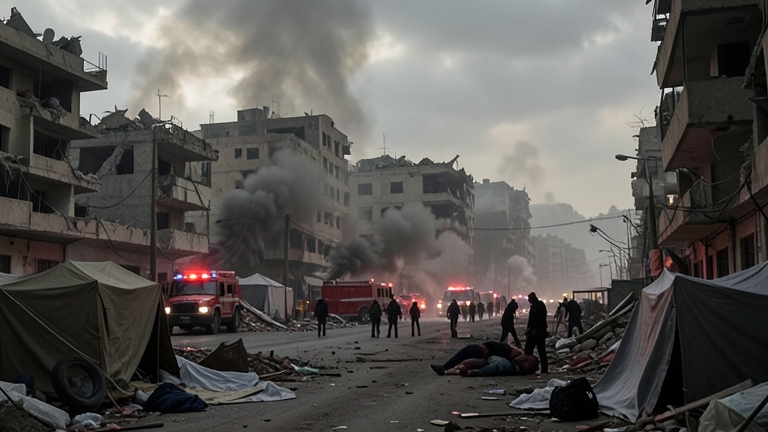
Lebanon’s Ministry of Public Health reported that the strikes resulted in the deaths of 11 individuals, with an additional 15 people wounded, several of whom were listed in critical condition. The dead included both Hizbollah members and civilians, according to preliminary reports from local hospital officials. Rescue teams worked through the night to pull bodies from the rubble of a multi-story building that was completely leveled in the attack. In the town of Bint Jbeil, residents described scenes of chaos. “The explosions were deafening. We have been living in relative quiet for two months, and now this,” a local shopkeeper told Al Jazeera. The United Nations Interim Force in Lebanon (UNIFIL) confirmed it was aware of the strikes and called for “maximum restraint” from all parties, warning that any escalation could unravel the fragile stability achieved since the truce was declared in late February.
The Context of the Two-Month Truce: A Fragile Pause
The ceasefire agreement, which came into effect two months ago, was brokered through intense diplomatic efforts involving the United States, France, and the United Nations. It effectively halted months of cross-border exchanges of fire that had threatened to spiral into an all-out war. Under the terms of the understanding, Hizbollah was expected to withdraw its heavy weapons and fighters from a zone south of the Litani River, while Israel was to cease all aerial and artillery attacks on Lebanese territory. For weeks, the situation had remained largely stable, with only minor violations reported by UNIFIL observers. However, analysts have consistently warned that the truce was a “thin line,” as neither side had fully committed to a long-term political resolution. The underlying strategic tensions—namely Hizbollah’s continued military buildup and Israel’s determination to prevent a repeat of the October 7a-style infiltration—remained fully in place. This week’s strike demonstrates exactly how easily that thin line can be crossed.
Hizbollah’s Reaction and Warning of Retaliation
In the immediate hours following the airstrikes, Hizbollah issued a terse statement confirming the deaths of several of its members. The group did not explicitly announce a retaliation plan, but the language used was ominous. “The blood of our martyrs will not be wasted,” read the statement on the group’s official Al-Manar TV channel. “The enemy will pay the price for this aggression at the time and place of our choosing.” This carefully calibrated response mirrors Hizbollah’s historical playbook: avoid an immediate, large-scale escalation that might trigger a massive Israeli counterattack, while signaling that the balance of deterrence has been damaged. Military experts point out that Hizbollah still possesses a vast arsenal of precision-guided missiles and drones, which it has largely kept in reserve during the previous conflict. The group’s leadership now faces an internal dilemma: to restore its credibility as a defender of Lebanese soil, it must respond visibly; but any significant attack risks drawing Israel into a devastating air campaign against Lebanon’s infrastructure.

International Reactions and Diplomatic Concerns
The international community reacted with alarm to the breakdown in the ceasefire. The United States Department of State issued a statement urging “all parties to adhere strictly to the cessation of hostilities” and called on Israel to exercise “maximum restraint.” However, the statement notably avoided directly condemning the Israeli operation, instead emphasizing the “right of any state to defend itself against immediate threats.” France, which has historical ties to Lebanon, took a sharper tone, with its foreign ministry summoning the Israeli ambassador for a formal protest. “Such escalatory actions serve no purpose but to fuel further violence,” read the French communiqué. At the United Nations Security Council, an emergency session was called by non-permanent members, including Algeria and Russia, to debate the situation. Meanwhile, the Lebanese government, which has limited control over Hizbollah’s military wing, made an official appeal to UNIFIL to strengthen its patrols along the Blue Line to prevent further violations. The diplomatic dance is precarious: while no one wants a full-scale war, the mechanisms to enforce the current truce are proving to be entirely inadequate.
The Broader Regional Implications of Renewed Hostilities
The strike in Lebanon carries implications far beyond the narrow confines of the Blue Line. It happens against the backdrop of the ongoing war in Gaza, where Israel continues its military operations against Hamas. The synchronization between the fronts has been a key concern for Israeli planners, who have feared a “multi-front war” involving Hizbollah, Iranian-backed militias in Syria, and the Houthis in Yemen. This week’s violence reinforces the connectivity of these theaters. Iranian officials have already signaled that this action will not go unanswered, though they have stopped short of direct military threats. In Damascus, a senior Iranian military advisor stated that “the resistance axis is united,” a clear warning that an attack on one front is an attack on all. For Israel, this means that any prolonged engagement in southern Lebanon could rapidly deplete its air defense resources, particularly if Houthi missiles from Yemen resume their trajectory toward central Israel. The region is now watching closely to see whether this is a single exchange—a “mowing the grass” operation—or the opening salvo of a new cycle of escalation.
Analysis: Can the Ceasefire Be Salvaged?
Two months into the truce, the core issue remains a fundamental lack of trust and a missing enforcement mechanism. The ceasefire was always a gentleman’s agreement, not a formal treaty. There are no inspectors on the ground to verify Hizbollah’s withdrawal from the border area, and no impartial arbiter to adjudicate claims of violations. The Israeli military’s doctrine of “preemptive retaliation” means it will almost always choose to strike first if it perceives a threat forming. On the other hand, Hizbollah views any Israeli violation of Lebanese airspace or territory as a reason to fire. This creates a descending spiral where each side’s actions are framed as “defensive” but quickly become “provocative.” De-escalation will require a demonstrable, simultaneous gesture. For instance, Israel could stop its reconnaissance overflights over Lebanon, and Hizbollah could publicly commit to keeping its forces north of the Litani River, with UNIFIL visibly monitoring the zone. Without such tangible steps, the current incident is likely not the last.
In the final analysis, the two-month truce that provided a precious respite from violence has been dealt a severe blow. The Israeli strikes, framed as a necessary response to a Hizbollah action, have instead revealed the profound fragility of an agreement built on mutual fear rather than mutual interest. For the families mourning the 11 dead, the promise of peace has once again been broken. For the leaders in Tel Aviv and Beirut, the challenge is clear: either find a way to rebuild a more robust ceasefire, or accept that the cycle of strike and counterstrike will inevitably repeat, drawing the region back into the darkness of open conflict. The coming days will be critical, as the world watches to see whether Hizbollah will retaliate, and whether Israel will then escalate further. One thing is certain: the status quo is no longer stable, and the window to prevent a larger war is closing quickly.