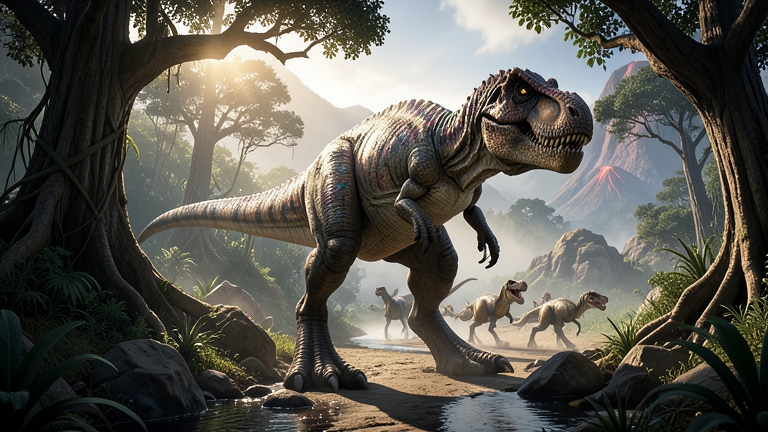
Frontier Developments has released a new downloadable content pack for Jurassic World Evolution 3, introducing a dinosaur that can genuinely challenge the T. rex for dominance. The Deinosuchus, a prehistoric crocodilian with a bite force exceeding that of the Tyrannosaurus rex, leads a roster of five new species in a DLC that also brings over 200 new items, 13 blueprints, and a strategic shift toward coastal and deep-water park management. The expansion arrives at a turbulent moment for the Jurassic World franchise, as the next film loses its director and faces a reshuffled production timeline.
Five New Species and a Focus on Coastal and Deep-Water Environments
The DLC, simply titled but substantial in scope, broadens the game’s ecosystem with five distinct prehistoric creatures. Beyond the headline-grabbing Deinosuchus, the update adds the Postosuchus, Desmotosuchus, Styxosaurus, and Shonisaurus. Each brings unique traits and habitat requirements: Postosuchus is an armored reptile, Desmotosuchus a herbivorous crocodile relative, Styxosaurus a large marine reptile, and Shonisaurus a deep-water ichthyosaur. Together, they encourage players to expand their parks into coastal and deep-water zones, moving beyond the traditional land-based enclosures that have defined the series since its 2018 debut.
The content update is not merely a roster expansion. Frontier Developments has integrated 200 new items and 13 blueprints, giving players additional tools for park customization, guest management, and dinosaur welfare. The coastal and deep-water focus suggests new gameplay mechanics, possibly including marine feeding stations, underwater viewing domes, and specialized transport systems. For long-time players, this represents a meaningful evolution of the park-building formula, one that rewards adaptation to aquatic environments.
What is the Deinosuchus and Why Is It Stronger Than the T. rex?
For players asking “What is the Deinosuchus and why is it stronger than the T. rex?”, the answer lies in paleontological fact and gameplay design. Deinosuchus was a massive crocodilian that lived during the Late Cretaceous period, reaching lengths of up to 10 meters and possessing a bite force estimated at over 20,000 newtons—significantly higher than the T. rex’s roughly 8,000 to 13,000 newtons. In the context of Jurassic World Evolution 3, this translates into a creature that can not only coexist with the T. rex in a park but potentially overpower it in direct confrontations. The DLC positions the Deinosuchus as the first “real” giant crocodile in the game, emphasizing its size and crushing bite as a key selling point. For players seeking to build the ultimate predator exhibit, the Deinosuchus offers a new apex option.
Frontier Developments Expands the Series’ Ecological Depth
Frontier Developments has a track record of supporting its simulation titles with substantial post-launch content. Jurassic World Evolution 3, released in 2025, built on the foundation of its predecessors with improved AI, deeper park management systems, and a greater variety of dinosaurs. This DLC continues that trajectory, but with a noticeable shift toward environmental diversity. The addition of deep-water species like Shonisaurus and Styxosaurus signals that the developer is not content to simply add more of the same; it is actively redefining the habitats players must manage.

The coastal expansion is particularly noteworthy. In previous games, water bodies were largely decorative or limited to small enclosures for aquatic creatures. Now, players must consider saltwater vs. freshwater requirements, tidal patterns, and the logistics of feeding large marine predators. The 200 new items include decorations, viewing platforms, and infrastructure specifically designed for coastal areas. This is a deliberate move by Frontier to keep the game fresh and to cater to a community that has been vocal about wanting more aquatic content since the early days of the franchise.
How Does the DLC Change Park Management Strategies?
Players accustomed to building land-based parks will need to rethink their approach. The Deinosuchus, for instance, requires a large lagoon with deep water and high-quality filtration. It cannot be housed in standard enclosures. Similarly, the Shonisaurus demands an open-ocean environment, which may necessitate building along the map’s edges or constructing artificial marine basins. The 13 blueprints offer new building types, including coastal barriers, underwater tunnels, and advanced feeding systems. These additions force players to invest in research and infrastructure, potentially increasing the complexity of park management. For veteran players, this is a welcome challenge; for newcomers, it may require a steeper learning curve.
The Jurassic World Movie Franchise Faces a Director Change
The DLC’s release coincides with significant uncertainty in the wider Jurassic World film franchise. The next movie, tentatively titled Jurassic World: Rebirth (or “El renacer” in Spanish), has lost its director, Gareth Edwards, due to creative differences. Edwards, known for Godzilla (2014) and Rogue One, was attached to direct the sequel to Jurassic World Dominion. His departure has left Universal Pictures scrambling for a replacement. According to industry reports, Adam Wingard, the director behind Blair Witch (2016) and Godzilla vs. Kong, has emerged as the frontrunner.
This leadership change raises questions about the franchise’s direction. Edwards’ vision for the film was expected to be more grounded and character-driven, echoing his work on Rogue One. Wingard, by contrast, has a flair for spectacle and monster mayhem, as demonstrated in his Godzilla vs. Kong. If Wingard takes the helm, the next Jurassic World film could lean heavier into action and cross-species battles, mirroring the tone of the DLC’s headline creature. The timeline remains fluid: filming is not expected to begin until 2027, with no release date set. That gives Universal time to recalibrate, but it also means the franchise will be silent for several years, leaving the video game as the primary source of new Jurassic World content for fans.
What Does the Director Change Mean for the Franchise’s Future?
The creative differences that led to Edwards’ departure suggest tension between the studio’s commercial ambitions and the director’s artistic vision. Universal has invested heavily in the Jurassic World brand, which has grossed over $6 billion globally. The studio likely wants a safe, crowd-pleasing sequel that can launch a new trilogy. Edwards, known for ambitious but thoughtful blockbusters, may have pushed for a more risky take. Wingard, if selected, would bring a proven track record of delivering high-octane, fan-friendly movies. The choice will signal whether the franchise prioritizes continuity and depth or spectacle and broad appeal. For game developers like Frontier, the movie’s direction could influence future DLC themes—perhaps a Wingard-led film would inspire more combat-focused content, while an Edwards-style film might emphasize environmental storytelling.
Strategic Implications for Frontier Developments and the Simulation Genre
Frontier Developments is no stranger to managing a live-service title. The company’s Elite Dangerous and Planet Coaster have both received long-term support. Jurassic World Evolution 3 is a key revenue driver, and the DLC strategy appears designed to maintain engagement between major expansions. The focus on aquatic and coastal content addresses a long-standing community request and differentiates this game from its predecessors. It also positions Frontier to potentially introduce more marine species in future updates, such as mosasaurs or plesiosaurs, which were featured in the films but have been underrepresented in the games.
From a market perspective, the DLC arrives at a strong time for the simulation genre. Jurassic World Evolution 3 has sold well, and the addition of high-profile creatures like the Deinosuchus generates media buzz. The controversy over the movie’s director change also indirectly benefits the game, as it keeps the franchise in the news and reminds fans that there is active Jurassic World content available. Frontier’s decision to tie the DLC to a creature that can outmatch the T. rex is a smart marketing move—it taps into the innate curiosity of dinosaur enthusiasts and creates natural shareable moments on social media and streaming platforms.
What Are the Practical Consequences for Players?
For players who already own Jurassic World Evolution 3, the DLC offers a significant new dimension. The coastal and deep-water areas require new infrastructure, which means rethinking existing park layouts. The Deinosuchus, in particular, demands careful management: it can attack other dinosaurs and even guests if its enclosure is not secure. The 200 new items provide ample customization, but they also increase the complexity of park design. Players who enjoy optimization will find plenty to sink their teeth into. Casual players may prefer to focus on the new species and ignore the deeper mechanics, but the game’s systems encourage engagement with the full suite of additions.
Looking Ahead: The DLC as a Bellwether for Future Content
This DLC is likely the first of several focused expansions for Jurassic World Evolution 3. The marine and coastal theme suggests that Frontier is testing the waters—literally—for a larger aquatic expansion. Given the popularity of marine reptiles in the films, a full-fledged “Jurassic World: Aquatic” expansion could be on the horizon. Similarly, the inclusion of the Deinosuchus, which is not a dinosaur but a crocodilian, hints that Frontier may be willing to expand beyond the strict dinosaur label to include other prehistoric reptiles, such as pterosaurs and marine reptiles, as separate categories.
The timing of the DLC, coinciding with the movie’s production challenges, also gives Frontier an opportunity to fill the content gap. While the film franchise is in flux, the game series can continue to evolve, building a loyal fanbase that will carry over when the next movie eventually arrives. The success of this DLC will likely influence Frontier’s content roadmap for the next 12 to 18 months.

Ultimately, the Deinosuchus is more than just a powerful creature—it is a symbol of the game’s ambition to keep surprising players. By introducing a dinosaur that can genuinely challenge the T. rex, Frontier has reignited the kind of playground debates that have fueled the franchise for decades. Whether you are a park builder, a dinosaur enthusiast, or a fan of the films, this DLC offers something to explore. And with the movie franchise in a state of uncertainty, the game may well become the most reliable source of Jurassic World excitement for the foreseeable future.






/i.s3.glbimg.com/v1/AUTH_08fbf48bc0524877943fe86e43087e7a/internal_photos/bs/2026/Y/y/eloBAuRYqsg3YH6XQqQQ/imagem-2026-09-10-200407901.png "WARDOGS Early Access: Why “Just Wait for Full Release”")