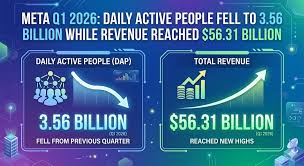
On Friday, May 8, 2026, The New York Times published a guest essay by investigative journalist Julia Angwin with a headline that demands attention: “Meta Is Dying.” She highlights that Meta lost daily active users in Q1 2026, falling from 3.58 billion in Q4 2025 to 3.56 billion. Angwin sees this as the beginning of a long, slow decline, comparing the company’s trajectory to AOL in 2003 and Yahoo in 2015: technically alive, still profitable, but entering what she bluntly calls the “zombie era.” She may be right. And if she is, Theodore Levitt told us exactly why this would happen, 66 years ago.
The Lesson Meta Never Learned
In 1960, Harvard Business School professor Theodore Levitt published “Marketing Myopiaa” in the Harvard Business Review. His central argument was that companies fail not because demand disappears, but because they define their business too narrowly. Railroads collapsed because they thought they were in the railroad business rather than the transportation business. Trolley car companies were replaced by automobiles they could have pioneered. “People don’t want a quarter-inch drill,” Levitt wrote. “They want a quarter-inch hole.” Now look at Meta’s six major pivots over 22 years and ask: What business did Mark Zuckerberg actually think he was in? In 2021, he declared the answer was “the metaverse business” — a bet whose Reality Labs division has since accumulated roughly $80 billion in operating losses. Users didn’t agree. In 2023, he pivoted to generative AI and has since committed over $100 billion to building models that, as Angwin notes, currently perform worse than the competition. Q1 2026 results show record revenue of $56.3 billion, up 33% year over year, but also $33.44 billion in total costs, a 35% increase, and an AI spending outlook that has rattled investors. The revenue looks strong. The trajectory looks like a company that keeps pivoting to new product definitions while its core users quietly disengage.
What The Traffic Data Actually Shows
This is where opinion meets evidence, and the Similarweb traffic for March 2026 is instructive. Google leads the world with 86.9 billion monthly visits. YouTube follows with 29.3 billion. Facebook comes in third at 11.9 billion, and Instagram comes in fourth at 7.1 billion. That gap between Google and Facebook is the data equivalent of what Levitt was describing. Google defined itself as being in the information access business. Facebook defined itself as being in the social network business. One of those definitions scales indefinitely. The other runs out of room. The AI category data is even more pointed. ChatGPT records 5.7 billion monthly visits globally, with year-over-year growth of 28.5%. Gemini is growing sharply at 283.8% YoY. Claude.ai jumped 423.7% to 613.7 million visits YoY. Meta.ai does not appear in the top 100 most-visited websites. Meta spent $100 billion entering the AI race. It is not winning it.
The Squeeze Play Angwin Describes
When an aging platform’s user base starts to shrink, the immediate response is almost always the same: monetize harder. Angwin documents this clearly. Meta’s Q1 ad impressions increased 19% year over year while average ad prices rose 12%. Revenue per user jumped 27%. The company is cramming more ads onto its platforms and charging advertisers more for each one. This is the move that maximizes short-term revenue while accelerating long-term decline. More ads mean a worse user experience. A worse experience means slower growth. Slower growth means the ad inventory eventually stops expanding. Levitt described this as the trap companies fall into when they focus on selling their current product harder rather than understanding what customers actually need. For digital marketers and SEO professionals, this creates a near-term concern. Meta’s Advantage+ advertising suite delivers genuinely strong performance data — a $4.52 return per dollar spent, 22% higher than comparable manual campaigns, according to Meta’s own earnings reports. But those returns depend on a healthy, engaged user base generating meaningful behavioral signals. If the user base contracts and ad load increases simultaneously, signal quality degrades, and performance follows.
The Counterargument Worth Taking Seriously
Angwin’s essay is persuasive, but she is writing opinion, not analysis, and the full Q1 picture is more complicated than “dying” suggests. Year-over-year, Meta’s daily active user base still grew 4%. The quarter-over-quarter decline has a partially verifiable explanation in internet disruptions in Iran and Russia’s WhatsApp ban. Revenue growth of 33% is not the profile of a company in terminal decline. What it is, is the profile of a company spending at a scale that requires the growth to continue, while its AI investments have not yet produced meaningful new revenue streams. As the Wall Street Journal‘s Asa Fitch observed this week, “the spending growth looks increasingly unsustainable.” Levitt’s lesson wasn’t that myopic companies always die quickly. AOL and Yahoo lingered for years. The lesson was that once a company loses the plot on what business it’s actually in, recovery becomes structurally difficult. Every dollar spent defending the wrong definition is a dollar not spent understanding the customer. The question Levitt would ask isn’t whether Meta is dying. It’s whether Meta has ever clearly understood what business it was actually in. Across six pivots in 22 years, the answer appears to be: not consistently. That uncertainty is now visible in the traffic data. And traffic data doesn’t lie.

Six Pivots in 22 Years: A Company Searching for an Identity
Meta’s history is a case study in strategic drift. From its origins as a college social network, the company has reinvented itself repeatedly: first as a universal social platform, then as a mobile advertising powerhouse, then as a video and messaging conglomerate with acquisitions like Instagram and WhatsApp. Each pivot generated short-term growth, but none addressed the fundamental question of what business Meta was building for the long term. The metaverse pivot in 2021 was the most dramatic — a full-scale redefinition of the company’s purpose that required massive capital allocation and organizational restructuring. Reality Labs was positioned as the future of computing, social interaction, and commerce. Yet nearly five years and $80 billion in operating losses later, the metaverse remains a niche proposition with limited mainstream adoption. Users did not flock to virtual reality in the numbers Zuckerberg projected. The pivot to generative AI in 2023 represented another wholesale shift, this time toward large language models and AI-powered tools. But entering a race already dominated by OpenAI, Google, and Anthropic meant Meta was always playing catch-up. The $100 billion commitment has produced models that, by Angwin’s accounting and independent benchmarks, underperform relative to competitors. Meta.ai’s absence from the top 100 most-visited websites is a damning statistic for a company that spent nine figures to become an AI leader.
The Structural Challenge Behind the Numbers
The quarterly active user drop from 3.58 billion to 3.56 billion may seem small in absolute terms — just 20 million users — but its significance lies in the direction of travel. For a company whose entire business model depends on scale, any contraction in the user base is a warning signal. The 4% year-over-year growth in daily active users shows that Meta is still adding users overall, but the quarter-over-quarter decline suggests that the growth engine is losing momentum. Internet disruptions in Iran and Russia’s WhatsApp ban provide partial explanations, but these are one-time events that mask a deeper trend: Facebook’s core markets in North America and Europe are saturated or declining, and growth in emerging markets faces increasing competition from alternative platforms. The advertising metrics tell a similar story. A 19% increase in ad impressions and a 12% rise in average ad prices generated strong revenue growth, but these levers cannot be pulled indefinitely. Users already report increasing dissatisfaction with the volume of ads on Facebook and Instagram, and regulators in the EU and elsewhere are tightening restrictions on data collection and targeting. The combination of a shrinking user base and rising ad load creates a negative feedback loop that is difficult to break without fundamental product innovation.
What Levitt’s Framework Reveals About Meta’s Strategy
Theodore Levitt’s framework is more than a historical curiosity — it is a diagnostic tool for identifying why dominant companies lose their way. When Levitt wrote about marketing myopia in 1960, he was observing a pattern that has repeated across industries for decades. The railroads believed they were in the railroad business, not the transportation business, and they ceded growth to trucking and aviation. Hollywood studios thought they were in the movie business, not the entertainment business, and they missed the rise of television. Meta appears to be repeating this error. By defining itself as a social media company, Meta has limited its horizon to the set of activities that fit within that category. Social media is a mature market with high penetration rates, increasing regulatory scrutiny, and shifting user preferences toward private messaging, ephemeral content, and algorithmic feeds. The growth potential within that definition is finite. Levitt would argue that Meta should have defined itself as being in the human connection business, the digital identity business, or the attention infrastructure business — definitions that would have opened up broader opportunities for innovation and expansion. Instead, the company has cycled through product categories without ever settling on a durable, scalable definition of its purpose.
The Advertising Dilemma for Digital Marketers
For professionals who depend on Meta’s platforms for customer acquisition and brand building, the current trajectory creates a practical challenge. Meta’s advertising ecosystem remains powerful — the $4.52 return per dollar spent on Advantage+ campaigns is a legitimate performance metric that few other platforms can match. But that performance is contingent on a healthy user base that generates rich behavioral data. As the user base contracts and ad load increases, the quality of behavioral signals degrades. Users who remain on the platform may be less engaged, less responsive to advertising, and more likely to use ad blockers or ignore sponsored content. The result is a gradual erosion of return on ad spend that may not be immediately visible in campaign-level metrics but will become apparent over time as customer acquisition costs rise and conversion rates decline. Marketers who rely heavily on Meta should consider diversifying their channel mix now, before the performance degradation becomes acute. Platforms like TikTok, YouTube, and emerging AI-driven search interfaces offer alternative paths to reach audiences, and early experimentation with these channels can provide valuable data for long-term strategy. The key insight from Levitt’s framework is that no platform is immune to the forces of market maturity and user fatigue. The question is not whether Meta will decline, but how quickly and with what consequences for the businesses that depend on it.
The Broader Implications for the Technology Industry
Meta’s situation is not unique — it reflects a broader pattern in the technology industry where companies that achieve massive scale struggle to maintain relevance as markets evolve. Google, Apple, Amazon, and Microsoft have all faced moments where their core definitions were challenged by technological shifts or changing user expectations. What distinguishes Meta is the frequency and magnitude of its pivots without a clear strategic anchor. Each pivot represents a bet that the company’s future lies in a different business than the one it currently operates. But a series of pivots without a coherent theory of value creation is not a strategy — it is a series of gambles. The $180 billion combined commitment to the metaverse and generative AI represents an extraordinary concentration of capital on unproven propositions. If either bet pays off, the returns could be enormous. But the evidence so far suggests that Meta is trailing in both arenas, and the window for achieving leadership positions is closing. The lesson for the broader technology industry is that scale alone is not a defense against strategic obsolescence. Companies must continuously question what business they are in, and they must be willing to redefine that answer as markets change. But redefinition without discipline — without a clear understanding of customer needs and competitive advantages — is just expensive guesswork.
The Parallels to AOL and Yahoo: A Cautionary Tale
Angwin’s comparison of Meta to AOL and Yahoo is instructive because those companies illustrate the long, slow decline that Levitt described. AOL was a dominant internet service provider in the late 1990s, with a massive user base and strong brand recognition. But the company defined itself as an access provider rather than a content platform, and it failed to adapt as broadband replaced dial-up and open web standards eroded the walled garden model. Yahoo was the internet’s leading portal and search engine in the early 2000s, but it defined itself as a media company rather than a technology company, and it missed the rise of algorithmic search, social networking, and mobile computing. Both companies remained profitable for years after their peak — AOL generated billions in revenue from its dial-up subscriber base long after broadband had become the standard, and Yahoo continued to earn advertising revenue even as its market share declined. But neither company ever recovered its strategic momentum. The same pattern could unfold for Meta. The company’s core advertising business remains highly profitable, and the installed base of users and advertisers creates a powerful economic moat. But if the user base continues to shrink and the advertising load reaches a ceiling, the profitability will eventually erode. The question is not whether Meta will disappear overnight — it won’t — but whether it will ever regain the growth trajectory that made it one of the most valuable companies in the world.
The Revenue Growth Paradox
The 33% year-over-year revenue growth in Q1 2026 presents a paradox: how can a company with declining users and mounting costs be growing revenue so rapidly? The answer lies in the monetization squeeze. Meta is extracting more revenue from each remaining user by increasing both the volume and the price of advertising. Revenue per user jumped 27% in Q1, which is a remarkable feat in absolute terms but also a sign that the company is approaching the limits of what its user base can sustain. The risk is that revenue growth will decelerate as the user base contracts and advertisers push back against rising prices. The $33.44 billion in total costs, up 35% year over year, indicates that Meta is spending heavily to maintain its infrastructure and fund its AI ambitions. If revenue growth slows while costs continue to rise, the margin compression could be severe. Wall Street analysts have already begun to question the sustainability of Meta’s spending trajectory, and the stock price has reflected that uncertainty. The paradox of strong revenue growth in a declining business is a classic sign of the zombie era that Angwin describes — the company is technically healthy on the surface, but the underlying dynamics are working against it.
What Meta Could Do Differently
If Levitt’s framework offers a diagnosis, it also suggests a prescription. Meta needs to redefine its business in a way that opens up new avenues for growth rather than locking it into a shrinking category. That means moving beyond the social media label and asking what fundamental human needs the company can serve. Communication, identity, commerce, information, and entertainment are all broad categories that could accommodate a redefined Meta. The company has assets that could support such a redefinition — the world’s largest messaging platforms in WhatsApp and Messenger, a powerful advertising infrastructure, substantial AI research capabilities, and unparalleled data on human social behavior. But these assets need to be harnessed in service of a coherent vision rather than deployed in a series of disconnected bets. The metaverse and AI are not wrong as potential directions, but they need to be grounded in a clearer understanding of what Meta uniquely offers to users and how that offering creates value over time. Without that grounding, the company risks continuing its pattern of expensive pivots that fail to address the underlying myopia Levitt identified six decades ago. The answer may lie in a combination of the company’s existing strengths — messaging, identity, and commerce — extended into new contexts through AI and immersive experiences. But that combination requires a strategic discipline that Meta has not consistently demonstrated.
The Traffic Data as a Leading Indicator
Traffic data from Similarweb and other analytics providers serves as a leading indicator of platform health. When users stop visiting a platform, the decline in engagement precedes the decline in revenue by several quarters. Facebook’s 11.9 billion monthly visits and Instagram’s 7.1 billion visits are still enormous numbers, but the trajectory relative to Google’s 86.9 billion visits and YouTube’s 29.3 billion visits shows the relative positioning. Facebook and Instagram are not growing at the rate of the platforms that have defined themselves more broadly. The AI traffic data is even more telling for Meta’s future prospects. ChatGPT’s 5.7 billion monthly visits with 28.5% YoY growth, Gemini’s 283.8% growth, and Claude.ai’s 423.7% growth indicate that users are flocking to AI platforms that offer tangible utility. Meta.ai’s absence from the top 100 is not just a competitive failure — it is a signal that the company’s AI investments have not yet translated into products that users find compelling. For a company that has committed over $100 billion to AI, the lack of measurable traction in user adoption is a serious concern. The traffic data does not lie, and it does not offer easy explanations. It reflects the aggregate decisions of billions of users about where to spend their time and attention. If those decisions are trending away from Meta’s platforms, the company needs to understand why and respond accordingly. Levitt would say that the answer lies in understanding what customers actually need, not in selling them more of what the company already has.
The Role of Regulation and Geopolitical Factors
The quarter-over-quarter decline in daily active users was partially attributed to internet disruptions in Iran and Russia’s ban on WhatsApp, but these factors are symptoms of a larger challenge. Meta operates in an increasingly fragmented regulatory environment where data privacy laws, content moderation requirements, and competition rules vary dramatically across jurisdictions. The EU’s Digital Services Act and Digital Markets Act impose strict requirements on large platforms, and similar regulatory frameworks are emerging in other regions. These regulations constrain Meta’s ability to collect data, target advertising, and launch new products, which in turn limits the company’s growth potential. Geopolitical tensions also affect Meta’s operations. The Russia-Ukraine conflict, the Iran situation, and broader disputes over internet governance create an unstable operating environment for a company that depends on global connectivity. While these factors are not unique to Meta, they disproportionately affect platforms that rely on cross-border data flows and uniform product experiences. The combination of regulatory constraints and geopolitical instability creates headwinds that may persist for years, regardless of the company’s strategic choices. For investors and marketers, these external factors add another layer of uncertainty to Meta’s long-term outlook. The company’s ability to navigate these challenges will depend on its willingness to adapt its business model to a more fragmented and regulated global environment.

The Investor Perspective: Value Trap or Opportunity?
Asa Fitch’s characterization of Meta as an “investor trap” captures the tension between the company’s current profitability and its uncertain future. On paper, Meta’s financial metrics look attractive: 33% revenue growth, strong operating margins, a massive user base, and a dominant position in digital advertising. But these metrics need to be evaluated in the context of the company’s spending trajectory and strategic direction. The $33.44 billion in quarterly costs, the $80 billion in accumulated Reality Labs losses, and the $100 billion AI commitment represent an extraordinary allocation of capital toward unproven ventures. If these investments do not generate meaningful returns, the financial profile of the company could deteriorate rapidly. Value investors who look at Meta’s current earnings and low price-to-earnings ratio may see a bargain. Growth investors who look at the spending trajectory and competitive positioning may see a trap. The truth likely lies somewhere in between. Meta’s core advertising business is durable and will continue to generate substantial cash flow for years, even if the user base declines modestly. But the company’s ability to return to high-growth territory depends on the success of its strategic bets, and the evidence so far is not encouraging. The prudent investor approach may be to wait for clearer signals that Meta has found a sustainable growth path before committing capital at today’s valuation.
The Human Element: User Experience and Platform Fatigue
Behind the numbers and the strategic analysis is a human reality: users are spending less time on Meta’s platforms because the experience is becoming less rewarding. The increased ad load, the algorithmic promotion of divisive content, the privacy concerns, and the general sense that social media is more stressful than enjoyable are all contributing to a gradual disengagement. Younger users, in particular, are gravitating toward platforms like TikTok, Discord, and others that offer different forms of social interaction and entertainment. The metaverse and AI investments, while strategically significant, do not address the immediate user experience issues that are driving the decline. Users do not want more ads. They do not want algorithmic feeds that prioritize engagement over well-being. They do not want platforms that feel increasingly commercialized and impersonal. Levitt’s insight — that customers want a quarter-inch hole, not a quarter-inch drill — applies here. Users want meaningful connection, useful information, and enjoyable entertainment. They do not want the product features that Meta is building. They want the outcomes that those features are supposed to deliver. If Meta loses sight of that distinction, the decline will continue regardless of how much the company spends on AI or virtual reality. The user experience is not a secondary concern — it is the foundation on which everything else depends.
The Path Forward: What a Recovered Meta Would Look Like
A recovered Meta would be a company that has internalized Levitt’s lesson and redefined its business in terms of customer needs rather than product categories. It would be a company that uses its massive data assets and AI capabilities to create genuinely useful services that improve people’s lives, not just services that capture attention and sell advertising. It would be a company that prioritizes user satisfaction over engagement metrics and that measures success in terms of long-term customer value rather than short-term revenue growth. Such a transformation would require a fundamental shift in corporate culture, leadership incentives, and strategic priorities. It would require Zuckerberg to articulate a vision that goes beyond “connecting the world” and addresses the specific, tangible needs that users have in their daily lives. It would require the company to invest in products that users love, not just products that generate data. And it would require a willingness to accept lower short-term growth in exchange for a more sustainable long-term trajectory. Whether Meta can make this transformation is an open question. The company’s history of pivots without strategic coherence suggests that the organizational capabilities for sustained transformation may be lacking. But the resources, talent, and market position are there. The question is whether the leadership has the clarity and discipline to use them wisely. Levitt’s framework suggests that the answer will determine whether Meta follows AOL and Yahoo into the zombie era or finds a path to renewed relevance.
The Verdict on the Zombie Era Thesis
Angwin’s thesis that Meta is entering a “zombie era” is not a prediction of imminent collapse. It is a characterization of a company that remains profitable but has lost the strategic momentum that drives long-term value creation. AOL and Yahoo were not dead when they entered their zombie eras — they were still generating significant revenue and profits. But they were no longer growing, no longer innovating, and no longer shaping the future of their industries. Meta appears to be on a similar trajectory. The revenue growth in Q1 2026 is real, but it is driven by monetization intensity rather than user expansion or product innovation. The AI and metaverse investments are real, but they have not produced the results that would justify the capital deployed. The user base is still enormous, but it is declining in key markets and growing slowly in others. The company is not dying in the sense of being on the verge of bankruptcy or dissolution. But it is losing the vitality that made it one of the most dynamic and influential companies of the early 21st century. For Levitt, the tragedy of myopic companies is not that they fail quickly, but that they fail slowly — lingering for years as the world changes around them, never quite understanding what they could have done differently. Meta has the resources to avoid that fate. The question is whether it has the clarity of purpose to use them.