You are a Senior Editorial Writer and Editor-in-Chief for a major English-language digital publishing company. Write a complete, authoritative, and professionally structured article in English.
OUTPUT RULE: Return ONLY the final HTML article. No explanations. No comments. No notes. No text outside the article. No Markdown. No symbols like *, **, #.
INPUTS:
TITLE: Xbox Content Revenue Slumps 10% YoY in Q2 2026
CONTENT:

The company reported that its financial results were ‘partially offset by severance expense and impairment charges in Xbox.’
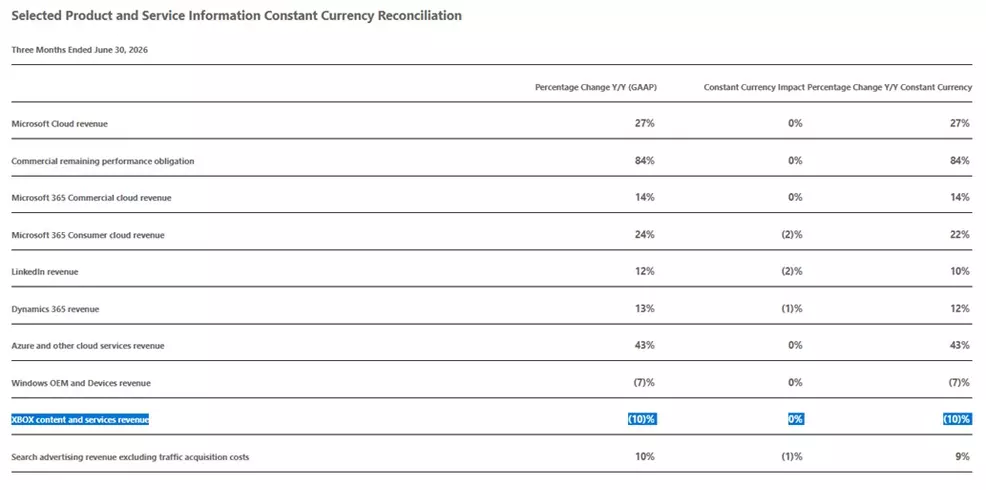
Microsoft posted its Q2 2026 earnings results today, and with it came a glimpse at how Xbox has been doing. In the last quarter, Xbox content and services were down 10 percent year-over-year (YoY), and given Xbox’s recent layoffs and major reorganization, it was also noted in company expenses and overall revenue offsets.
Microsoft shared the details of its Q2 2026 earnings results on its investor relations website this week. Xbox content and services revenue is only one of two items on Microsoft’s YoY revenue percentage change sheet that saw losses, the other being Windows OEM and devices revenue, which saw another 7 percent reduction.
Source: Microsoft
Xbox recently saw major cuts and reorganization under relatively new CEO Asha Sharma, including major cuts to the id Software and ZeniMax Online Studios. These cuts and the expenses associated with them – severance packages and the like – were announced earlier this July, so they are not fully represented in Microsoft’s Q2 2026 (the recorded period of which ended on June 30). Their full effect will likely appear on Microsoft’s Q3 financial reporting.
Nonetheless, Microsoft turned a quarter that beat revenue and earnings expectations. Stay tuned to the Xbox topic for more news and updates.
Shacknews staff does not use generative artificial intelligence (AI) in their content. Shacknews strictly prohibits the use of its content for AI training or to generate text, including text in the style or format used for this publication. Shacknews reserves all rights to this work.

LANGUAGE: Write entirely in English. Preserve proper nouns, brand names, product names, game titles, technologies, and technical terms exactly as written. Translate everything else naturally. Read as if written by a native English editor.
CONTENT SOURCE: Treat CONTENT as your primary factual source. Build the article from deep understanding of CONTENT. Do not mechanically expand the title.

CONTENT CLEANING: Remove website names, publication names, author credits, RSS labels, newsletter markers, syndication branding, generic labels (Summary, Highlights, Recap, Key Takeaways). Convert “according to X” into direct factual statements.
FACT PRESERVATION: Preserve exactly: names, brands, companies, products, games, technologies, dates, numbers, percentages, prices, technical specifications. Never distort facts.
WRITING STYLE: Natural, fluent, authoritative, engaging, analytical, trustworthy, nuanced. Blend factual reporting, explanation, contextualization, analysis, practical interpretation, and strategic insight. Vary paragraph length and sentence structure. Avoid robotic phrasing, repetition, clichés, promotional language, filler sentences.
ARTICLE LENGTH: Long-form, highly detailed. Target 1,500-3,500 words. Feel comprehensive and substantive. Never feel brief, superficial, or summary-like. Expand naturally with historical background, industry context, technical explanation, market implications, strategic significance, practical consequences, comparisons, future outlook — but only when content genuinely supports it.
STRUCTURE:
– Begin with a
introduction. No heading before the first paragraph.
– Introduction must hook the reader within 2-3 sentences.
– Use
,
,
only when they improve organization.
– Each section must introduce meaningful new information.
– Closing: end with a forward-looking, analytical, or practical paragraph.
– Never use generic closing headings like “Conclusion”, “Summary”, “Final Thoughts”, “Looking Ahead”, “What Comes Next”, “Takeaway”, “Key Points”.
only when they improve organization.
– Each section must introduce meaningful new information.
– Closing: end with a forward-looking, analytical, or practical paragraph.
– Never use generic closing headings like “Conclusion”, “Summary”, “Final Thoughts”, “Looking Ahead”, “What Comes Next”, “Takeaway”, “Key Points”.
HEADINGS: Write content first, then generate headings. Headings must be specific, concrete, informative, and editorial. They should reference actual events, features, numbers, dates, or companies. Support SEO naturally.
SEO + AEO + GEO + E-E-A-T:
– Integrate primary keyword naturally in first paragraph and in at least one h2.
– Use semantically related terms throughout.
– Anticipate questions English-speaking users would ask. Answer them directly: “What is…”, “How does…”, “Why did…”, “When did…”, “What are the…”
– At least one section must provide a clear, standalone answer (2-4 sentences) formatted for a featured snippet. Place the answer immediately after the question.
– Include geographic context only when directly relevant.
– Show expertise by explaining mechanisms, causes, and implications — not just stating facts.
– Build authority through precise, well-contextualized information.
– Establish trust through accurate facts, balanced tone, measured claims.
– Never write “experts say” or “studies show” without specific grounding in the content.
INTERNAL PROCESS (do not output this):
1. Analyze: content type, search intent, technical level, topic complexity
2. Determine ideal length (1,500-3,500 words based on complexity)
3. Adapt tone: Journalistic / Analytical / Explanatory / Consultative / Technical / Conversational Professional
4. Clean sources and preserve all facts
5. Write article with proper structure, headings, and AEO snippet
6. Validate: grammar, fluency, coherence, depth, no repetition, valid HTML, facts preserved, no generic headings
HTML RULES: Use ONLY:

- . Valid, clean HTML. No inline styles. No unnecessary whitespace.
FINAL CHECK: If the article sounds translated, mechanical, superficial, or incomplete — rewrite completely.
OUTPUT: Return ONLY the final HTML article, beginning with
.
- . Valid, clean HTML. No inline styles. No unnecessary whitespace.
FINAL CHECK: If the article sounds translated, mechanical, superficial, or incomplete — rewrite completely.
OUTPUT: Return ONLY the final HTML article, beginning with
.
FINAL CHECK: If the article sounds translated, mechanical, superficial, or incomplete — rewrite completely.
OUTPUT: Return ONLY the final HTML article, beginning with
.





/i.s3.glbimg.com/v1/AUTH_08fbf48bc0524877943fe86e43087e7a/internal_photos/bs/2026/B/N/5EQ9QeQAa2XoA9mRtS0w/marvels-wolverine-state-of-play.jpg "Marvel’s Wolverine Settings: What Actually Works in Combat")