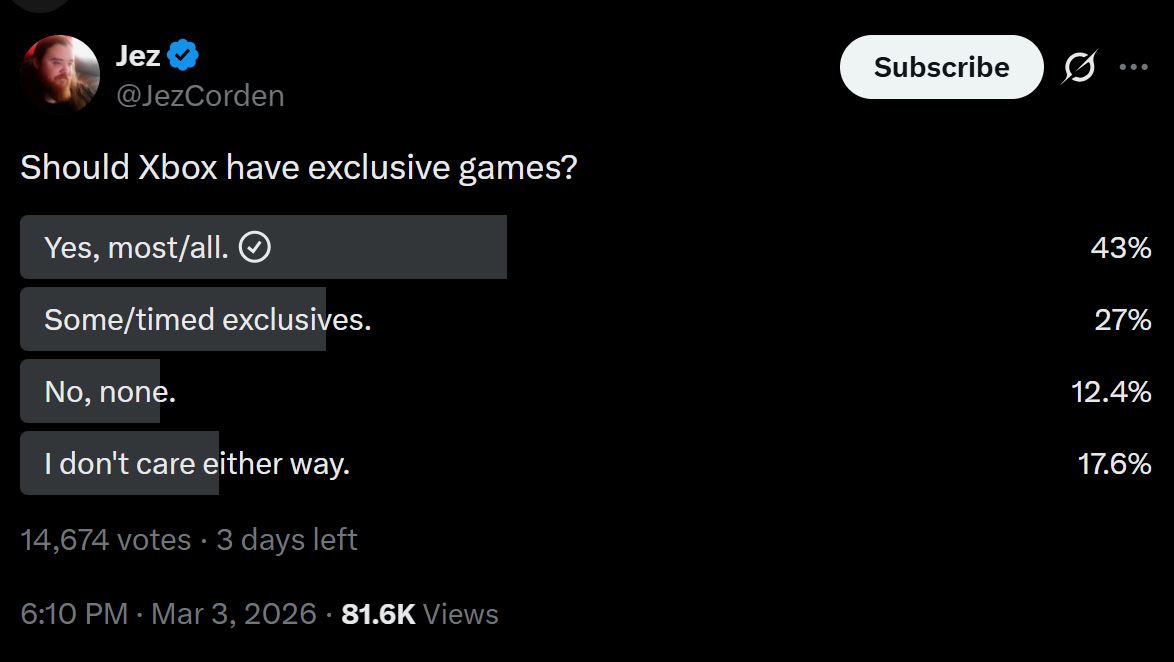
A new survey of over 14,000 Xbox community members has revealed a surprising trend in an era of multiplatform releases: a strong majority of fans want Microsoft’s gaming division to return to console-exclusive titles. The poll, conducted by prominent industry journalist Jez Corden, indicates that nearly 70% of respondents favor some form of exclusivity for Xbox first-party games, challenging the company’s current strategy of releasing titles across multiple platforms.
The Poll Results That Challenge Xbox’s Strategy
The Twitter poll presented voters with several options regarding their preferences for Xbox’s publishing approach. The results showed a clear preference for traditional console exclusivity:
Detailed Breakdown of Voter Preferences
According to the poll data, 42% of respondents voted for “heavy exclusivity,” indicating they believe most first-party Xbox titles should remain exclusive to the platform. An additional 27% supported “limited exclusivity,” suggesting they want some games to be exclusive while others could be multiplatform. Combined, these two groups represent 69% of the voting base who favor some degree of exclusivity for Xbox games.
The remaining votes were split between those who preferred no exclusivity at all and those who indicated they didn’t care about the platform strategy. The overwhelming support for exclusivity comes as a surprise to many industry observers who believed the gaming community had largely embraced the multiplatform approach that Microsoft has championed since 2024.
Historical Context: Xbox’s Shift Away From Exclusivity
Microsoft’s move away from console exclusivity began gradually but accelerated significantly in early 2024 when the company announced it would release several first-party titles on competing platforms, including PlayStation and Nintendo Switch. This strategic pivot represented a fundamental shift in how Xbox approached its gaming business, moving from a hardware-centric model to one focused on software sales and subscription services across all platforms.
The Business Rationale Behind Multiplatform Releases
Industry analysts point to several factors that drove Microsoft’s decision to abandon traditional exclusivity. The most significant was the financial reality of modern game development, where budgets for AAA titles regularly exceed $100 million. By releasing games on multiple platforms, Xbox could maximize revenue potential and offset development costs more effectively.
Additionally, Microsoft’s acquisition of Activision Blizzard in 2023 created pressure to generate returns on the massive $68.7 billion investment. Multiplatform releases of popular franchises like Call of Duty represented one way to achieve those returns more quickly. The strategy also aligned with Microsoft’s broader vision of gaming as a service accessible across devices rather than tied to specific hardware.
The Community Response and Why It Matters
The poll results suggest that despite the business logic behind multiplatform releases, a significant portion of the Xbox community feels differently. For many long-time fans, console exclusives represent more than just games—they represent the identity of the platform itself. Exclusive titles have historically driven console sales and created dedicated fan communities that define platform loyalty.
The Psychological Impact of Exclusivity
Game industry psychologists suggest several reasons why exclusivity remains important to console owners. First, exclusives create a sense of community and shared experience among players on the same platform. Second, they provide justification for hardware purchases—if games are available everywhere, the argument for owning a specific console weakens. Third, exclusives often receive more focused development resources and platform-specific optimization, potentially leading to higher quality experiences.
“When you buy into a console ecosystem, you’re not just purchasing hardware—you’re buying into an identity,” explains Dr. Elena Rodriguez, a gaming culture researcher at Stanford University. “Exclusive games become part of that identity. They’re the stories you can only experience on that platform, the adventures you can only share with fellow platform owners. That creates powerful social bonds and brand loyalty that multiplatform strategies struggle to replicate.”
The Changing Landscape of Console Competition
Xbox’s shift toward multiplatform releases occurred alongside interesting developments from competitors. Recent rumors suggest PlayStation may be reconsidering its own multiplatform strategy after several years of releasing first-party titles on PC. While Sony hasn’t confirmed any major policy changes, industry insiders note that PlayStation’s PC releases haven’t generated the expected financial returns in some cases, leading to internal discussions about refocusing on console exclusivity.
Nintendo’s Continued Success With Exclusivity
Meanwhile, Nintendo has maintained its traditional exclusivity model with remarkable success. The Japanese company continues to release nearly all first-party titles exclusively on Switch and its successor platforms, creating what many analysts call the “Nintendo ecosystem”—a closed but highly profitable environment where hardware and software sales reinforce each other. Nintendo’s approach demonstrates that exclusivity can still work financially, particularly when combined with distinctive hardware and beloved franchises.
This contrast between platform strategies creates an interesting dynamic in the console market. While Xbox moves toward openness and PlayStation appears to be reevaluating its position, Nintendo remains committed to the traditional model that Xbox fans now seem to be requesting.
The New Leadership Factor: CEO Asha Sharma’s Potential Impact
The timing of this community sentiment is particularly noteworthy given recent leadership changes at Xbox. Microsoft appointed Asha Sharma as the new CEO of Xbox in late 2025, bringing fresh perspective to the division’s strategic direction. In her initial statements, Sharma has indicated that “nothing is off the table” regarding Xbox’s future strategy, including a potential return to exclusivity.
Strategic Flexibility Under New Management
Sharma’s background in both technology and entertainment positions her uniquely to evaluate Xbox’s direction. Unlike previous leadership that was deeply committed to the multiplatform vision, Sharma enters without the same ideological attachment to specific strategies. This creates potential for policy shifts based on data, community feedback, and market conditions rather than predetermined corporate vision.
Industry analysts note that Sharma’s appointment coincides with several factors that could make a return to exclusivity more feasible. The upcoming release of a new Xbox console provides an opportunity to relaunch the platform with exclusive titles. Additionally, major franchises like Halo, Forza, and Gears of War are reportedly receiving new entries in 2026, creating natural candidates for exclusive releases that could drive hardware sales.
The Practical Challenges of Reverting to Exclusivity
Despite community sentiment and leadership openness, returning to an exclusivity model presents significant challenges for Xbox. The company has spent years building infrastructure and partnerships around multiplatform releases. Reversing this approach would require renegotiating contracts, restructuring development pipelines, and potentially disappointing players who have grown accustomed to accessing Xbox games on other platforms.
Financial Implications and Shareholder Expectations
Perhaps the biggest obstacle is financial. Microsoft’s shareholders have grown accustomed to the revenue streams from multiplatform releases. Exclusivity would likely reduce short-term software sales, though it might increase long-term hardware and ecosystem revenue. Convincing investors to accept this trade-off would require compelling data and projections that exclusivity could ultimately be more profitable.
Additionally, Xbox Game Pass—Microsoft’s subscription service—has become a cornerstone of the company’s gaming strategy. The service’s value proposition relies on a steady stream of high-quality content. If Xbox returns to exclusivity, Game Pass would lose its multiplatform appeal on PlayStation and Nintendo systems, potentially reducing subscriber growth outside the Xbox ecosystem.
The Broader Industry Implications
The debate over exclusivity extends beyond Xbox to touch on fundamental questions about the future of gaming. As cloud gaming and subscription services grow, the traditional console model faces increasing pressure. Some industry visionaries predict that within a decade, dedicated gaming hardware may become less important than streaming platforms and services.
The Role of Exclusives in a Streaming Future
In this emerging landscape, exclusivity takes on new meaning. Rather than being tied to specific hardware, exclusives could become tied to specific services. Xbox Game Pass could feature games unavailable on competing services like PlayStation Plus, creating service-based exclusivity rather than hardware-based exclusivity. This approach would maintain some competitive differentiation while acknowledging the declining importance of physical hardware.
The poll results suggest that even as technology evolves, gamers still value exclusive content. The form that exclusivity takes may change—from console exclusives to service exclusives—but the fundamental desire for unique, platform-defining experiences appears to remain constant.
Community Voices and Platform Identity
Beyond the business considerations, the poll reveals something important about gaming culture. For many players, their chosen platform represents more than just a piece of hardware—it represents community, identity, and shared experience. Exclusive games serve as cultural touchstones within these communities, creating memories and conversations that bind players together.
The Emotional Connection to Platform Exclusives
This emotional dimension explains why exclusivity remains important even in an increasingly connected gaming world. When Xbox fans request exclusives, they’re not just asking for business strategy—they’re asking for shared experiences that define what it means to be part of the Xbox community. They want games they can point to and say, “This is why I chose Xbox. This experience is uniquely ours.”
This sentiment presents both challenge and opportunity for Xbox leadership. The challenge lies in balancing business realities with community desires. The opportunity lies in leveraging this community passion to build stronger platform loyalty and identity. If handled correctly, a carefully calibrated exclusivity strategy could satisfy both financial objectives and community aspirations.

The gaming landscape continues to evolve at a rapid pace, with business models, technology, and player expectations all in flux. What remains constant is the fundamental human desire for community and shared experience. The recent poll of Xbox fans suggests that despite the industry’s move toward openness and accessibility, there’s still strong appetite for the unique identity that exclusives provide. As new leadership considers Xbox’s direction and next-generation hardware approaches, the tension between business pragmatism and community identity will likely define the platform’s future. The decisions made in the coming months will not only shape Xbox’s trajectory but potentially influence the entire console industry’s approach to one of gaming’s oldest debates.