The latest refresh of MSI’s B850 chipset motherboards brings incremental upgrades to the lineup, with the MAG B850 Gaming Plus Max WiFi representing both aesthetic refinement and a challenging value proposition. Positioned at a $260 MSRP, this ATX motherboard offers a distinctive white PCB design with black accents, upgraded BIOS storage, and a dedicated BCLK generator, yet struggles to justify its price against competitive alternatives in the market.
Specifications and Core Features
The MSI MAG B850 Gaming Plus Max WiFi maintains the same fundamental specifications as its predecessor while introducing key changes. The motherboard supports AMD Ryzen 7000, 8000, and 9000 series processors through the AM5 socket, with DDR5 memory support up to 8200+ MT/s (overclocked). Storage options include three M.2 slots (one PCIe 5.0 x4, one PCIe 4.0 x4, and one PCIe 4.0 x2) alongside four SATA 6Gbps ports.
Network and Connectivity Assessment
One of the board’s standout features is its networking capability, featuring a Realtek RTL8126 5G LAN controller alongside WiFi 7 and Bluetooth 5.4 support. The inclusion of 5G LAN at this price point is unusual and potentially valuable for users with compatible internet services, though it comes at the expense of other premium features that might offer broader utility.
Power Delivery and Component Quality
The power delivery system utilizes a 12+2+1 phase design with 50A discrete MOSFETs rather than the more modern DrMOS or SPS designs found in competing motherboards at similar price points. This design choice contributes to higher VRM temperatures observed during testing, reaching 64 degrees Celsius under full load with a Ryzen 9 9950X processor. While sufficient for most processors, the thermal performance and component selection raise questions about the board’s value positioning.
Design and Build Quality
Visually, the motherboard represents a significant improvement over its predecessor, featuring a white PCB with black diagonal lines across the heatsinks that create a cohesive aesthetic suitable for white-themed builds. The absence of onboard RGB lighting keeps the design clean, though addressable RGB headers are available for user customization.

PCB Construction and Durability Features
MSI employs a 6-layer PCB with 2oz copper and implements their “PCB Fabric Technology” to minimize signal loss and enhance transfer speeds. The board includes built-in overvoltage and overcurrent protection, along with electromagnetic interference suppression through copper rings. These features contribute to stable operation but are increasingly standard across mid-range motherboards.
Performance Analysis
Testing with a Ryzen 9 9950X processor revealed performance in line with expectations for the B850 chipset. Synthetic benchmarks including Blender (52-second render time), Cinebench 2024, and V-Ray (48,808 points) showed no significant performance deviations from comparable motherboards. Gaming performance in titles like Cyberpunk 2077 (143 FPS average), Far Cry 6 (183 FPS average), and Starfield (108 FPS average) demonstrated the board’s capability to handle modern gaming workloads without bottlenecking high-end components.
Boot Times and System Responsiveness
The motherboard recorded a 22-second boot time with Windows 11 23H2, a respectable figure that benefits from the upgraded 64MB BIOS chip. This expanded storage capacity allows for more comprehensive BIOS interfaces and better firmware feature support compared to the original 32MB configuration.
Connectivity and Expansion Options
The board offers 17 USB ports total, including one 10Gbps Type-A port on the rear I/O and two 10Gbps Type-C ports. Notably absent are USB4 and 20Gbps USB connections, which have become increasingly common at this price segment. The audio solution utilizes the Realtek ALC897 codec, a dated component that contrasts with the ALC4080 or ALC4082 solutions found on competing motherboards.
Storage and PCIe Configuration
The primary PCIe 5.0 x16 slot supports modern graphics cards without steel reinforcement but includes MSI’s EZ PCIe release mechanism for easier installation and removal. The three M.2 slots provide reasonable expansion, though only the primary Gen5 slot includes a heatsink, requiring users to provide their own cooling solutions for secondary high-speed drives.
Quality of Life Features
MSI incorporates several user-friendly features that enhance the building and maintenance experience. The EZ M.2 Clip II system simplifies SSD installation, while the front panel connector cable reduces the frustration of connecting case headers. The external BCLK generator allows separate adjustment of CPU and memory clocks, potentially offering additional overclocking headroom for enthusiasts.
Debugging and Monitoring Capabilities
Four debug LEDs assist in troubleshooting CPU, GPU, memory, and boot issues, though the board lacks a more comprehensive debug code display found on higher-end models. The Nuvoton NCT-6687D-R controller manages fan speeds and system monitoring, providing adequate control over cooling configurations.
Competitive Landscape and Value Proposition
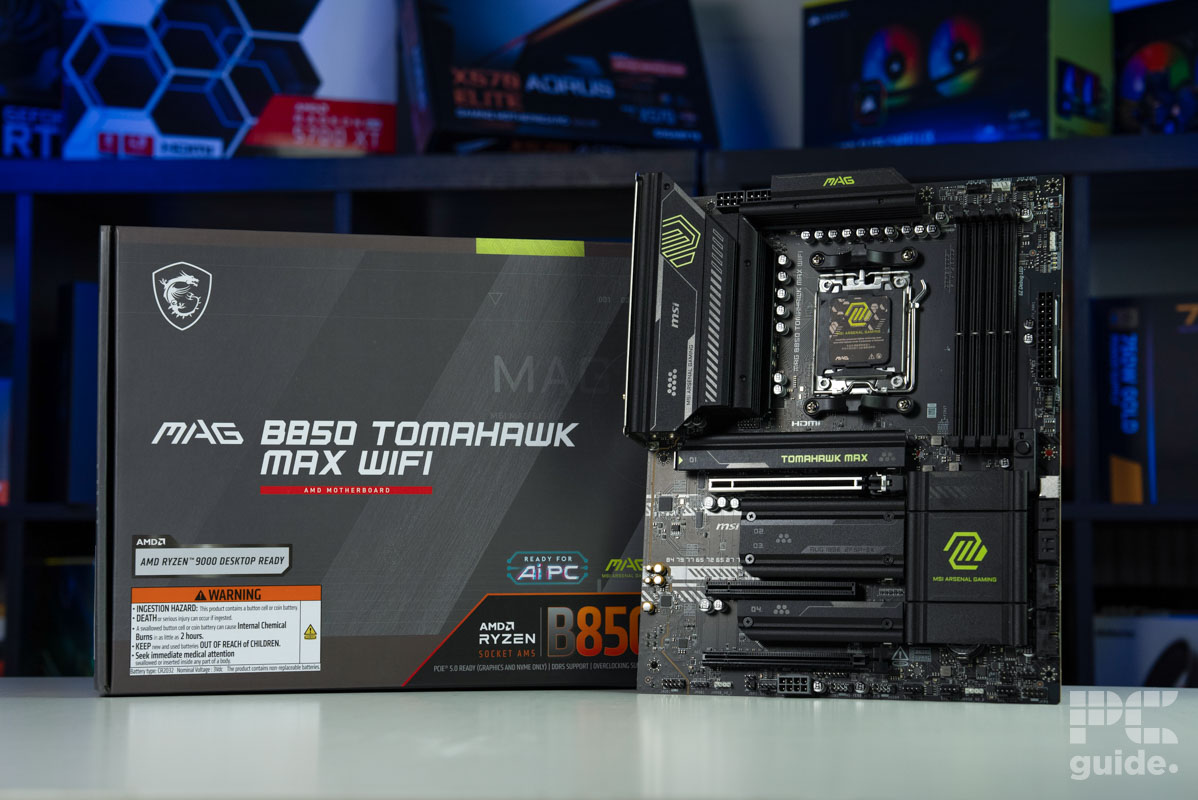
At $260, the MSI MAG B850 Gaming Plus Max WiFi faces stiff competition from both within MSI’s lineup and from other manufacturers. The MSI B850 Tomahawk Max WiFi and various ASRock offerings provide similar or better feature sets at comparable or lower price points. The board’s value proposition rests primarily on its distinctive aesthetics and 5G LAN connectivity rather than comprehensive feature superiority.
Target Audience Considerations
This motherboard appeals most directly to builders creating white-themed systems who prioritize the visual integration of components. The 5G LAN support serves a niche market of users with compatible internet infrastructure, while the BCLK generator offers modest overclocking potential for those willing to navigate its complexities.
Thermal Performance and Limitations
During sustained load testing, the VRM temperatures reached 64 degrees Celsius, higher than competing boards in the same category. While not dangerous for component longevity, this thermal performance suggests limitations for heavy overclocking scenarios or sustained high-power workloads. The discrete MOSFET design, while functional, represents a cost-saving measure that impacts thermal efficiency.

Cooling Implementation Assessment
The VRM heatsinks utilize a stacked fin design with 7W/mK thermal pads but lack heatpipe connections between them. This design, combined with the discrete MOSFETs, creates thermal performance that adequately serves stock operation but shows limitations under extreme conditions. Users planning to push high-core-count processors should consider additional case airflow directed at the VRM area.
The MSI MAG B850 Gaming Plus Max WiFi occupies a challenging position in the motherboard market, offering distinctive aesthetics and specific features like 5G LAN that will appeal to targeted audiences while falling short of providing comprehensive value at its price point. For builders prioritizing visual cohesion in white-themed systems or requiring 5G LAN connectivity, the board presents a viable option with adequate performance. However, those seeking maximum feature density, superior thermal performance, or outright value should explore competing offerings that deliver more comprehensive packages at similar price points. The motherboard ultimately succeeds as a specialized component rather than a general-purpose solution, reflecting the increasing segmentation of the PC component market where specific features command premium pricing regardless of overall package balance.