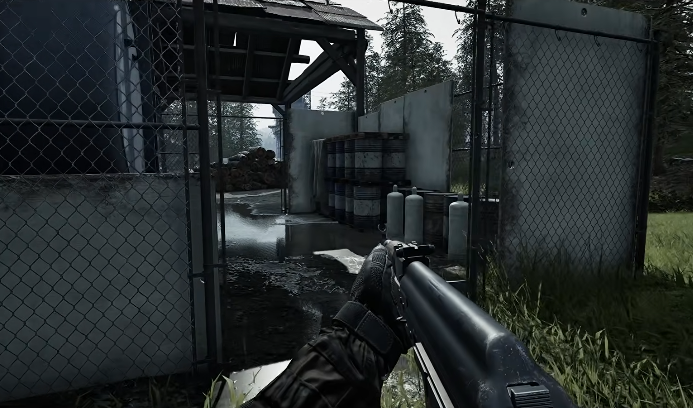
Players exploring the cliffs southeast of the Howling Hill Base in the open-world RPG Crimson Desert are encountering a frustrating and common roadblock: a mysterious, vine-covered door built into a tree or rock formation that stubbornly refuses to open. The discovery typically leads to minutes of futile interaction, with players attempting to punch, pull, or pry the entrance open using every conceivable method. The solution, however, defies this assumed complexity, relying on a straightforward two-step process that has eluded a significant portion of the player base.
The Precise Location of the Howling Hill Secret Entrance
This hidden environmental puzzle is not marked on the map, demanding thorough exploration of the terrain. To find it, travel to the Howling Hill Base, a central point in the early game region. From there, head southeast into the surrounding cliff faces. Scrutinize the bottom levels of these rocky outcrops; the door is tucked away, easily overlooked by those following main paths or engaged in combat. Its distinctive appearance—an ancient, man-made structure seamlessly integrated into natural wood and stone, choked with thick, green vines—immediately signals its importance as an interactable object, setting the stage for the ensuing confusion.
Initial Player Error and the Root of the Problem
The universal point of failure occurs the moment a player stands before the cleared door. After removing the vines, instinct and gaming convention take over. Players assume a hidden mechanic, a special key, a sequence, or a contextual button prompt must be the key. They spend excessive time attempting to interact with the door through the game’s command system, not realizing the solution exists outside the typical ‘action’ button logic. This overcomplication is a deliberate, if mischievous, design choice by the developers, testing a player’s willingness to abandon ingrained puzzle-solving habits for a simpler, more physical approach.
Step One: Clearing the Vegetal Obstruction with Fire
Before any attempt to open the door can succeed, the physical barrier must be eliminated. The thick vines covering the entrance are not merely decorative; they are a combustible puzzle element. The game provides multiple avenues to achieve this, catering to different playstyles and prepared toolkits.
Using Fire Arrows for Ranged Ignition
The most efficient method involves the use of a bow. Players must equip their bow and locate a source of flame. This could be a lit brazier in a nearby camp, the embers of a defeated enemy’s fire attack, or a torch carried by the player character. By holding the arrow near the flame, it will ignite. A single shot into the mass of vines is sufficient. The fire will spread realistically across the digital foliage, burning it away after a few seconds to reveal the unadorned wooden or stone door beneath.

Alternative Method: Sword-Based Abilities
For warriors who favor melee combat or find themselves without a bow, an alternative exists. Certain sword skills or abilities channel elemental power, with fire being a common attribute. A skill like ‘Sunlight Edge’ or a similar flame-imbued attack, when executed near the vines, will have the same effect. Swinging the empowered blade at the vegetation triggers the burn effect, clearing the path. This method emphasizes the game’s integration of combat utility into environmental puzzle-solving.
The Critical, Oversimplified Second Step
With the vines reduced to ash, the door stands unobstructed. This is the moment that extends the puzzle’s duration from seconds to minutes for most. The solution requires no inventory items, no special skills, and no hidden lore clues. The player character must simply walk directly up to the door’s surface. Upon contact, a subtle, contextually triggered animation will play—the character will place a hand on the door and push, swinging it inward with a creak. The action is tied to the basic movement collision, not a separate interaction command. It is a lesson in literal, rather than abstract, problem-solving.
Common Player Reactions and Community Response
Online forums and guides for Crimson Desert are replete with accounts of this specific puzzle. The shared experience of wasted time has become a minor community bonding moment, with veteran players often advising newcomers with the succinct phrase, “Just push it.” The puzzle’s fame stems not from its difficulty, but from the psychological trick it plays, exploiting a player’s expectation that video game doors, especially hidden ones, require more than mundane physical force to open.
Navigating the Symbol Rotation Puzzle Inside
Gaining entry is only half the challenge. The interior chamber presents a second, more conventional puzzle involving rotating stone mechanisms or panels inscribed with celestial symbols. This puzzle is logically consistent but visually cryptic, requiring observation and adjustment.
Initial Chamber Layout and Symbol Identification
Upon entering, players face a small room with three primary interactive pillars or wheels, each adorned with carved icons. The symbols typically represent a sun (or full moon), a crescent or ‘U’ shape, and a triangle or arrow. These are not randomly generated; they have a fixed correct orientation based on their positions.
Step-by-Step Solution for the Inner Mechanism
Begin with the leftmost mechanism. Rotate it until the sun or full moon symbol is positioned at the very top, pointing upward toward the ceiling. Next, address the central mechanism. Its default symbol resembles an oblong crescent or a wide ‘U’. Adjust this so the curve of the symbol tilts upward and the open end points generally toward the left pillar. Then, move to the mechanism on the right. This one usually features a solitary triangle. Rotate it until the pointed tip of the triangle faces directly downward, toward the floor. The final adjustment returns to the central mechanism. Give it one more rotation so the ‘U’ shape completes a near-circle, forming a shape akin to a backwards ‘C’ or a closing crescent, with its ends now pointing to the left.
Triggering the Reward Sequence
When all three symbols are aligned correctly, a deep mechanical clunk or a soft chime will sound. A previously hidden compartment in the chamber wall may slide open, or a treasure chest may materialize. The reward often consists of valuable early-game resources: rare crafting materials, a piece of armor with unique stats, a substantial amount of currency, or a skill-enhancing manuscript. The contents justify the initial frustration and reinforce the game’s design philosophy of rewarding thorough exploration and persistence.
This sequence of events—from baffling obstruction to simple action to a more intricate internal puzzle—encapsulates a core Crimson Desert experience. It teaches players to observe their environment literally, to consider all tools at their disposal, both martial and mundane, and to understand that not every barrier is magical. Sometimes, a door is just a door, and the only thing preventing passage is a layer of dead plants and the assumption that it must be more complicated than it appears. For players seeking to optimize their approach to such challenges, focusing early skill points on utility abilities like enhanced stamina for exploration and core combat mechanics can transform these obstacles from frustrating halts into engaging, quick diversions.