For more than a decade, the creative direction of the Pokémon franchise has been synonymous with one name: Shigeru Ohmori. Since taking the reins on Pokémon Omega Ruby and Alpha Sapphire in 2014, Ohmori has served as director or key creative lead on nearly every mainline entry, through Sun and Moon, Sword and Shield, Scarlet and Violet, and the recently released Pokémon Pokopia. His tenure has defined the modern era of the series — for better and for worse, depending on whom you ask. But according to a significant new leak, that era may be drawing to a close. The tenth generation of Pokémon games, tentatively titled Pokémon Winds and Waves, is reportedly being directed by a different pair of Game Freak veterans entirely.
Who Are the New Directors Behind Pokémon Winds and Waves?
According to information shared by the prominent leaker BallGuy, the directing duties for Pokémon Winds and Waves will fall to Hiroyuki Tani and Katsuhiko Ichiraku. Both have been part of the Pokémon development team for years, but this marks their first time leading a mainline base game. The move represents a significant shift in creative leadership at Game Freak — one that could signal a new philosophical direction for the franchise.
Tani and Ichiraku are not unknown quantities. Their most notable prior work includes the downloadable content for Pokémon Sword and Shield — The Isle of Armor and The Crown Tundra — as well as the DLC for Pokémon Scarlet and Violet, comprising The Teal Mask and The Indigo Disk. These expansions were widely praised by the player community, with many considering them superior experiences compared to the base games they accompanied. For a fanbase that has grown increasingly vocal about the series’ technical shortcomings and creative stagnation, that track record is a meaningful reason for cautious optimism.
What Did the DLC Directors Accomplish?
The Crown Tundra DLC was especially notable for its emphasis on exploration. It introduced a sprawling, semi-open area where players could roam freely, hunt for legendary Pokémon, and engage in content that felt less linear than the main campaign. That focus on discovery and environmental storytelling will be critical for a generation of games that, according to leaks, is centered on adventures in the wild. Meanwhile, The Teal Mask, released in 2023, was praised for its slice-of-life storytelling and more intimate narrative scale — a grounding contrast to the technical ambitions of Scarlet and Violet‘s open world. Together, these expansions showed that Tani and Ichiraku understand how to deliver content that feels both fresh and polished, even within the constraints of the Pokémon formula.
From Ohmori to Tani and Ichiraku: What a Leadership Change Means
Shigeru Ohmori has been the face of mainline Pokémon game direction for over ten years. His influence spans the transition from 3DS to Switch, from linear routes to open worlds, and from pixel art to fully 3D environments. Under his direction, the series introduced mechanics like Mega Evolution, Z-Moves, Dynamax, and Terastallization. But his tenure was also marked by persistent criticism: buggy launches, technical underperformance, and a perceived unwillingness to evolve the core formula in meaningful ways.
Leaked internal documents from 2025 suggest that Ohmori was still involved in the early proposal stage for Winds and Waves — a presentation that reportedly cited games like No Man’s Sky and Spore as influences. But those same documents indicate that as of 2024, Ohmori was no longer serving as director on the project. That distinction matters: it suggests his creative fingerprints may still be on the game’s foundational concepts, but the final execution — and the day-to-day directorial decisions — will belong to Tani and Ichiraku.
For longtime observers of Game Freak, this is both a natural succession and a potential turning point. Younger developers have often been cited within the industry as eager to push the series in directions that Ohmori’s generation was reluctant to explore. If the leaks hold true, the company is betting that fresh leadership can address the two most persistent complaints about modern Pokémon: technical instability and creative risk aversion.
The Seed Pokémon System: A Fundamental Shift in Monster Design
One of the most intriguing concepts tied to the Winds and Waves leaks is the introduction of “Seed” Pokémon. According to the leaked documents, these creatures would not follow the traditional fixed evolutionary tree that has defined the franchise since 1996. Instead, Seed Pokémon would develop based on environmental factors, weather conditions, and how a trainer raises them. This represents a fundamental departure from the series’ core design philosophy.
In the standard Pokémon model, every species has a predetermined evolutionary path: a specific level, a trade condition, a stone, or another defined trigger. The Seed Pokémon system, by contrast, appears to be dynamic and contextual. A single Seed species might evolve into multiple different forms depending on whether it is raised in a forest, a desert, or near water, or depending on the climate of the region, or how often it battles versus how often it is cared for. The leaked documents specifically name Spore as an influence, referencing that game’s creature creator and evolutionary mechanics. The ambition is to make each trainer’s experience genuinely unique — not just in terms of which monsters they catch, but in how those monsters grow.
This system may also explain another jaw-dropping claim from the leaks: that Winds and Waves will introduce 300 new Pokémon, the largest single-generation roster in the franchise’s 30-year history. If Seed Pokémon are mechanically variable, with multiple branching forms per base creature, that number becomes more plausible. A single Seed species with, say, five distinct evolutionary outcomes would count as five new entries in the Pokédex, even if they share a common root.
Addressing the Performance Problem: Could a New Engine Be on the Horizon?
Pokémon Scarlet and Violet launched in late 2022 to what can charitably be described as a mixed reception. While critics praised the games’ ambition and narrative scope, the technical execution was widely panned. Frame rate drops, texture pop-in, collision glitches, and outright crashes plagued the experience. It was not until 2025, with the release of the Switch 2 and a free performance upgrade patch, that players could experience the games in something close to their intended form. For many fans, that two-year gap between ambition and execution was unacceptable.
If Tani and Ichiraku are indeed taking the helm, their first major test will not be creative — it will be technical. The DLC they directed was built on the same engine as the base games, but it generally performed better, likely because the scope was more contained and the teams had time to optimize. For a full base game, and one that reportedly introduces radical new systems like Seed Pokémon and a potentially overhauled battle engine, the technical demands will be far greater.
The influence of No Man’s Sky — a game that itself underwent a notorious technical redemption arc — is telling. The leaked proposal documents suggest Game Freak is thinking about procedural systems, dynamic environments, and large-scale exploration. All of those ideas place heavy demands on hardware and software engineering. Whether Tani and Ichiraku can deliver a polished product at launch, rather than a promise that gets fulfilled years later, will define their legacy before a single new Pokémon is judged.
What Is the New Battle System in Pokémon Winds and Waves?
Leaks have also hinted at changes to the battle system. While Pokémon Winds and Waves will reportedly retain turn-based combat, the way battles unfold may look very different. The same leaker, BallGuy, has suggested that the new system will maintain the strategic depth of turn-based play while introducing elements that make encounters feel more dynamic and reactive. This is, in many ways, a middle path — one that preserves the core identity of Pokémon combat while addressing the criticism that battles have grown stale over eight generations.
The exact mechanics remain unconfirmed, but the direction is consistent with Game Freak’s recent experiments. Pokémon Legends: Arceus introduced action-oriented elements, allowing players to dodge attacks in real time and throw Poké Balls without entering a separate battle screen. Pokémon Legends: Z-A, still in development, is expected to push further in that direction. The Winds and Waves battle system may represent a synthesis: the tactical depth of traditional turn-based combat with the immediacy and flow of real-time interactions. For a franchise that has often been accused of refusing to evolve, even incremental changes to how battles feel could be transformative.
The Strategic Significance of Passing the Torch
From an industry perspective, the reported leadership change at Game Freak is significant for reasons that go beyond any single game. Pokémon is the highest-grossing media franchise in history. Its core video game releases are cultural events. But the company behind those games has long been criticized for insularity, for resisting external talent, and for adhering to a cadence of releases that prioritizes schedule over quality. By elevating directors from the DLC teams — which are often staffed by younger or less tenured developers — Game Freak is signaling that it recognizes the need for generational renewal.
That renewal is not without risk. DLC is, by its nature, smaller in scope and safer in execution than a full game. Tani and Ichiraku have never had to carry an entire generation on their shoulders. The transition from supporting act to main event is one of the hardest in game development. But the alternative — continuing with the same leadership that delivered the technically troubled Scarlet and Violet — carried its own risks. Audiences have made their discontent clear, both in reviews and in the more muted cultural conversation around recent releases.
What Fans Can Expect from the Tenth Generation
If the leaks are accurate, the tenth generation of Pokémon will be defined by three major pillars: dynamic creature evolution through the Seed system, a reimagined battle framework, and a world designed for exploration rather than linear progression. Each of these represents a response to long-standing player feedback. Seed Pokémon address the desire for deeper personalization and consequence in raising monsters. The battle system addresses the desire for more engaging combat. The exploration focus addresses the desire for worlds that feel alive rather than scripted.
The 300 new monsters figure, if real, would also address a common complaint about recent generations: that the regional Pokédexes have felt thin. Scarlet and Violet introduced just over 100 new species, a number that felt modest compared to the scale of the open world. Doubling or tripling that count would signal an ambition to recapture the density of discovery that defined earlier generations like Black and White or Ruby and Sapphire.
But ambition must be matched by execution. The single most important factor in the success of Pokémon Winds and Waves will not be the number of new monsters or the cleverness of the Seed system — it will be whether the game works properly at launch. The DLC team has a reputation for polish relative to the base game team. Now they have the chance to prove that reputation is deserved at scale.
How Does the Switch 2 Factor Into These Plans?
Platform matters, and the timing of the tenth generation aligns with the release of Nintendo’s next hardware. The Switch 2 has already demonstrated backward compatibility with performance upgrades for Scarlet and Violet, suggesting that the new system offers meaningful headroom over the original Switch. For a franchise that has been visibly constrained by aging hardware, a more capable platform could be transformative.
The influence of No Man’s Sky in the leaked proposal documents further suggests that Game Freak is thinking about procedural generation and large, persistent worlds — ideas that require significant processing power and memory bandwidth. The Switch 2 may provide the technical foundation that allows the Seed Pokémon system to function as intended, with real-time environmental calculations and branching evolution paths that respond to player choices in ways the original Switch could not handle gracefully.
That said, hardware alone does not fix software quality. The Scarlet and Violet performance issues were not solely a result of Switch limitations; they were also a result of suboptimal engineering and compressed development timelines. If Game Freak has learned from those mistakes, the tenth generation could be the first Pokémon game that feels both ambitious and finished. If it has not, even the Switch 2’s additional power will not mask the cracks.
A Franchise at a Crossroads
Pokémon has spent the better part of a decade caught between two competing pressures: the commercial imperative to release new games on a predictable schedule, and the artistic imperative to innovate and refine. Under Ohmori, the balance tilted heavily toward schedule. The result was a string of games that were commercially successful but increasingly ragged around the edges. The fanbase grew larger and more vocal, and the divide between what players wanted and what Game Freak delivered grew wider with each generation.
The reported appointment of Tani and Ichiraku is the strongest signal yet that the company is aware of that divide and intends to close it. Their work on the DLC expansions demonstrated that they understand what players value: exploration, storytelling, and technical reliability. Now they will have the opportunity to build an entire game around those values.
What remains to be seen is whether the broader corporate structure of The Pokémon Company will allow them the time and creative freedom they need. The franchise’s release schedule is not set by Game Freak alone; it is dictated by a complex ecosystem of trading cards, animation, merchandise, and licensed products that all depend on new generations of games to drive interest. That pressure will not disappear because the director credit changed.
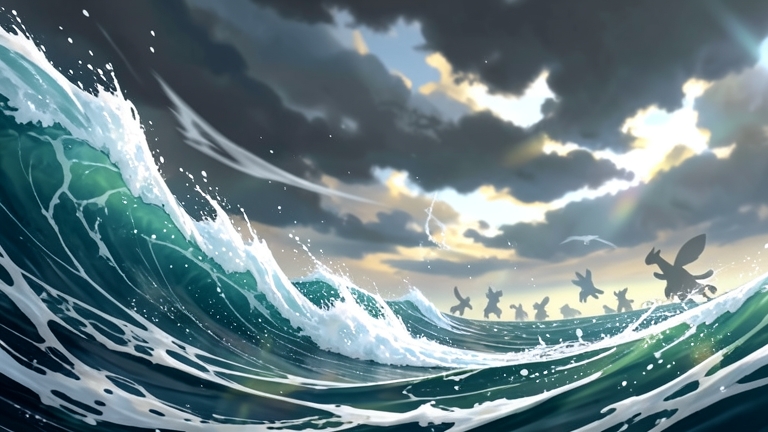
But if the leaks are true, then the winds of change are finally blowing through Game Freak. The waves of a new generation are building. And for the first time in a long time, the direction of the Pokémon franchise is genuinely uncertain — which, for a series that has often felt locked into a comfortable rut, is itself a reason to pay attention.