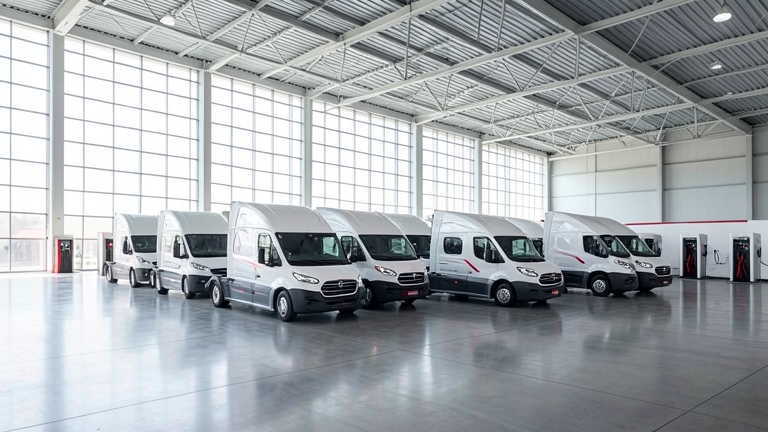
Swedish electric and autonomous trucking company Einride has placed a landmark order for 500 Tesla Semis, a deal that will more than triple the size of its fleet and deepen its integration with major customers including Amazon. The Tesla Semis will be added in phases over the next 24 months beginning in September 2026, marking one of the largest single commitments to Tesla’s electric big rig from a fleet operator. The move signals a critical inflection point for both companies: Einride accelerates its push to scale electric freight operations across North America, while Tesla finally begins to translate its long-delayed Semi program into meaningful volume production.
500 Tesla Semis: The Scale and Structure of the Deal
The agreement between Einride and Tesla is not a speculative reservation but a firm purchase plan for 500 units of the Class 8 electric truck, to be deployed across Einride’s customer network in North America. Einride is using a third party to finance the acquisition, a structure that allows the company to avoid the heavy capital outlay of outright ownership while still expanding its fleet at scale. The Tesla Semis will be available to customers operating on key freight corridors in California, Georgia, New Jersey, and Texas, among other regions.
To understand the magnitude of this order, consider Einride’s current fleet. The company operates approximately 200 of its own heavy-duty electric trucks for clients including Heineken and PepsiCo. Adding 500 Tesla Semis will roughly triple that number, transforming Einride overnight into one of the largest operators of battery-electric heavy trucks in North America. The phased delivery schedule starting in September 2026 gives Einride time to integrate the vehicles into its operational framework, train drivers, and deploy charging infrastructure along the planned routes.
The deal also carries significant implications for Tesla. The Semi program has been plagued by delays since the concept was first unveiled in 2017. Initial customer deliveries began in December 2022 to PepsiCo, but volume production remained elusive. It was not until April 2026 that the first Semi rolled off the high-volume production line at Tesla’s factory in Nevada. Even then, the company has tempered expectations, acknowledging in its second-quarter 2026 shareholder letter that it is working to increase battery production, specifically around the 4680 cell, to support both the Semi and the Cybercab at scale. Einride’s order represents a concrete vote of confidence in Tesla’s ability to finally deliver on its production promises.
What Is Saga AI and How Does It Manage the Tesla Semi Fleet?
Einride will not simply hand the keys of the Tesla Semis to its customers. Instead, the trucks will be managed through the company’s proprietary Saga AI software, a fleet management platform that sits at the core of Einride’s value proposition. Saga AI is designed to give shippers all the benefits of electric trucking—lower fuel costs, reduced emissions, regulatory compliance—without the financial and logistical burden of owning and operating the vehicles themselves.
The platform determines how the trucks are used, routed, and charged. It optimizes for factors such as battery state of charge, available charging infrastructure, route elevation, weather conditions, and customer delivery windows. For a fleet of 500 Tesla Semis operating across multiple states and serving diverse customers, the software’s ability to coordinate charging schedules and avoid downtime becomes critical. Saga AI also integrates with Einride’s autonomous pod-like trucks, which are notable for their cab-less design, creating a unified operational layer across different vehicle types.
For customers, the appeal is straightforward. They gain access to electric freight capacity without needing to invest in trucks, charging equipment, or the software expertise to manage a complex electric fleet. Einride handles the operational complexity, and Saga AI provides the intelligence that makes the system work efficiently. The Tesla Semi deal strengthens this pitch by adding a highly recognizable and capable truck to the platform, potentially making Einride’s service more attractive to shippers who have been hesitant to commit to electric freight.
Einride’s Fleet Strategy: From 200 Trucks to Critical Mass
Einride was founded a decade ago with a vision that combined electric trucks, autonomous driving technology, and software-driven fleet management. For years, the company focused on developing each component of its business: the electric trucks themselves, the self-driving system for its cabless vehicles, and the Saga AI platform that ties everything together. The company’s own heavy-duty electric trucks have been deployed with customers like Heineken and PepsiCo, proving the concept in real-world freight operations.
The decision to add Tesla Semis to the fleet represents a pragmatic shift. Rather than relying solely on its own vehicles, Einride is now embracing a multi-vendor strategy that leverages Tesla’s manufacturing scale and brand recognition. The Tesla Semi is a known quantity in the industry, with a range of up to 500 miles on a single charge and a design that has been refined over nearly a decade of development. By adding the Semi to its roster, Einride can offer customers a proven, high-profile electric truck while still wrapping it in the Saga AI software and charging infrastructure that differentiate the company.
The fleet expansion also positions Einride to convert what it describes as approximately $800 million in potential long-term annual recurring revenue under joint business plans with shippers into actual revenue. This figure represents the value of agreements and partnership frameworks that Einride has established with customers but has not yet fully realized due to fleet capacity constraints. With 500 additional Tesla Semis entering service over the next two years, the company now has the hardware to match its software ambitions.
Why Did Einride Go Public, and How Does This Deal Fit the Timeline?
Einride went public in June 2026, a move that provided the company with access to capital markets and increased its visibility with potential customers and partners. The IPO came at a time when the company was already accelerating its push to scale electric freight operations. The Tesla Semi deal, announced just a few months after going public, suggests that Einride is using its public market position to secure the kind of large-scale commitments that were previously out of reach.
The timing is also notable because of the broader context of the electric trucking industry. Regulations in California and other states are pushing fleets toward zero-emission vehicles, and major shippers like Amazon are under pressure to decarbonize their supply chains. Einride’s public offering and subsequent fleet expansion signal that the company believes the market is ready for electric freight at scale, and that it intends to be the operator that delivers that scale to customers.
The IPO also gave Einride the credibility and financial flexibility to pursue acquisitions. In July 2026, the company acquired EV charging company Flipturn, a deal that allows it to offer customers the full package of services, including electric trucks and the charging software needed to run them more efficiently and reliably. Flipturn’s technology complements Saga AI by adding a layer of charging management that can optimize power usage, reduce costs, and ensure that trucks are charged and ready when needed.
How Does the Amazon Partnership Fit into the Broader Picture?
Einride’s relationship with Amazon is a critical piece of its growth strategy. The company struck a deal to add 75 of its electric heavy-duty trucks to Amazon’s Relay freight network, providing charging infrastructure across five locations in the United States. This partnership gives Einride a foothold in one of the largest and most demanding freight operations in the world, and it serves as a reference account that can be used to win additional business from other large shippers.
The Tesla Semi deal will amplify this relationship. With 500 additional trucks at its disposal, Einride can offer Amazon more capacity on more routes, potentially deepening the partnership over time. The Tesla Semis are well-suited to Amazon’s long-haul operations, where range and reliability are paramount. By integrating the Semis into the Saga AI platform, Einride can provide Amazon with the same level of operational visibility and optimization that it offers with its own trucks.
The Amazon deal also demonstrates the value of Einride’s full-service model. Amazon does not need to purchase the trucks, install charging infrastructure, or develop software to manage the fleet. Einride provides all of that as a service, allowing Amazon to focus on its core logistics business while benefiting from electric freight. The Tesla Semi order extends this model to a larger scale, making it available to more customers across more regions.
The Tesla Semi’s Production Journey and the 4680 Battery Challenge
For all the promise of the Einride deal, it ultimately depends on Tesla’s ability to deliver the Semis on schedule. The Semi program has a long and well-documented history of delays. The concept was unveiled in 2017, and initial deliveries to PepsiCo finally began in December 2022, five years later. Volume production was repeatedly pushed back due to the Covid pandemic, global supply chain shortages, and, most critically, challenges with battery production.
The Tesla Semi uses the company’s 4680 battery cell format, which is also used in the Cybertruck and the Cybercab. Tesla has struggled to ramp up production of the 4680 cell, and the company acknowledged in its second-quarter 2026 shareholder letter that increasing battery production is a priority for starting to build the Semi and the Cybercab at scale. The first Semi rolled off the high-volume production line in Nevada in April 2026, a milestone that was years in the making, but Tesla has since pulled back on promises to reach volume production levels in 2026.
This creates a tension at the heart of the Einride deal. The 500 Semi order is a vote of confidence in Tesla’s production capabilities, but it also carries risk. If Tesla continues to face battery production challenges, the phased delivery schedule could slip, leaving Einride with fewer trucks than planned and potentially straining its commitments to customers. Einride’s use of third-party financing mitigates some of the financial risk, but the operational risk remains. The company will need to manage customer expectations carefully and have contingency plans in place if deliveries are delayed.
What Are the Key Freight Corridors and Why Do They Matter?
Einride has said that the Tesla Semis will be deployed across North America, with a focus on key corridors in California, Georgia, New Jersey, and Texas. These states represent some of the most important freight hubs in the United States, and they also have regulatory environments that are conducive to electric trucking.
California is the most aggressive state in the country when it comes to zero-emission vehicle mandates, with requirements that increasingly affect heavy-duty trucks. Georgia has emerged as a hub for electric vehicle manufacturing and logistics, with significant investments from automakers and battery producers. New Jersey serves as a gateway to the New York metropolitan area, one of the largest consumer markets in the world. Texas is a major freight corridor in its own right, with connections to ports, distribution centers, and the broader southern United States.
By focusing on these corridors, Einride can maximize the utilization of its Tesla Semi fleet while also building out charging infrastructure in locations that will serve multiple customers and routes. The corridors also allow Einride to demonstrate the viability of electric freight on some of the most demanding routes in the country, providing a template for future expansion into other regions.
How Saga AI Unifies Einride’s Mixed Fleet of Electric Trucks
One of the most interesting aspects of the Einride story is the diversity of its fleet. The company operates its own heavy-duty electric trucks, which are designed and built by Einride itself. It also operates autonomous pod-like trucks that have no cab, designed for specific use cases like warehouse-to-warehouse freight movement. And now it will add 500 Tesla Semis, which are a completely different vehicle with their own specifications, charging requirements, and operational characteristics.
Saga AI is the software layer that makes this mixed fleet work. The platform is designed to be vehicle-agnostic, meaning it can manage trucks from different manufacturers, with different battery sizes, different charging protocols, and different performance characteristics. For Einride, this is a strategic advantage. It allows the company to add the best available trucks to its fleet without being locked into a single vendor, and it gives customers access to a diverse range of vehicles optimized for different routes and loads.
The Saga AI platform also handles the complex task of charging management. With a fleet that includes both Einride’s own trucks and Tesla Semis, the software must coordinate charging schedules across multiple locations, optimize for energy costs, and ensure that each truck is charged and ready when it is needed. The acquisition of Flipturn adds another layer of capability here, providing Einride with charging software that can be integrated with Saga AI to create a seamless end-to-end system.

Market Implications: What the Deal Means for the Electric Trucking Industry
The Einride-Tesla deal is significant not just for the two companies involved, but for the broader electric trucking industry. It demonstrates that there is real demand for electric heavy-duty trucks at scale, and that fleet operators are willing to commit to large orders when the economics and operational support are right. It also shows that the software and services layer around electric trucks—fleet management, charging optimization, route planning—is becoming just as important as the trucks themselves.
For other electric truck manufacturers, the deal is a competitive signal. Einride has chosen to add Tesla Semis to its fleet rather than trucks from other manufacturers, suggesting that Tesla’s combination of range, brand recognition, and production scale is compelling. But the multi-vendor nature of Einride’s strategy also means that the door is open for other manufacturers to compete for future orders, provided they can offer trucks that integrate well with Saga AI and meet the operational requirements of Einride’s customers.
For shippers like Amazon, Heineken, and PepsiCo, the deal represents an expansion of available electric freight capacity. As Einride grows its fleet, these customers can move more of their freight to electric trucks without having to invest in their own vehicles or charging infrastructure. This is a significant advantage in a regulatory environment that is increasingly pushing toward zero-emission logistics.
Why Einride’s Acquisition of Flipturn Matters for the Tesla Semi Deployment
The acquisition of Flipturn, announced in July 2026, is a strategic move that directly supports the Tesla Semi deployment. Flipturn provides EV charging software that helps fleet operators manage their charging infrastructure, optimize energy consumption, and reduce costs. By integrating Flipturn’s technology into the Saga AI platform, Einride can offer customers a complete solution that covers both the trucks and the charging infrastructure needed to run them.
This is particularly important for the Tesla Semi, which has a large battery pack and requires high-power charging to achieve fast turnaround times. Tesla has its own charging network, the Tesla Semi Charging network, but Einride’s customers may also need charging at their own facilities or at third-party locations. Flipturn’s software can manage all of these charging sources, ensuring that the Tesla Semis are charged efficiently and reliably regardless of where they are operating.
The acquisition also positions Einride to offer charging-as-a-service to its customers, further reducing the barriers to adopting electric freight. Instead of having to invest in charging infrastructure, customers can rely on Einride to provide the trucks and the charging, with the software managing the entire system. This is consistent with Einride’s overall approach of offering a turnkey solution for electric freight, and it makes the Tesla Semi deal more attractive to potential customers.
Einride’s strategy is unfolding on multiple fronts simultaneously: fleet expansion, software development, charging infrastructure, and customer partnerships. The 500 Tesla Semi deal is the most visible element of this strategy, but it is supported by the Saga AI platform, the Flipturn acquisition, the Amazon partnership, and the company’s public offering. Together, these moves position Einride as a leading operator of electric freight at scale, with the ability to offer shippers a complete solution that covers trucks, software, and charging. The challenge now is execution: delivering the Tesla Semis on schedule, integrating them into the Saga AI platform, and converting the $800 million in potential revenue into actual, recurring business. If Einride can pull that off, the 500 Semi deal will be remembered as the moment when electric trucking moved from pilot projects to mainstream operations.