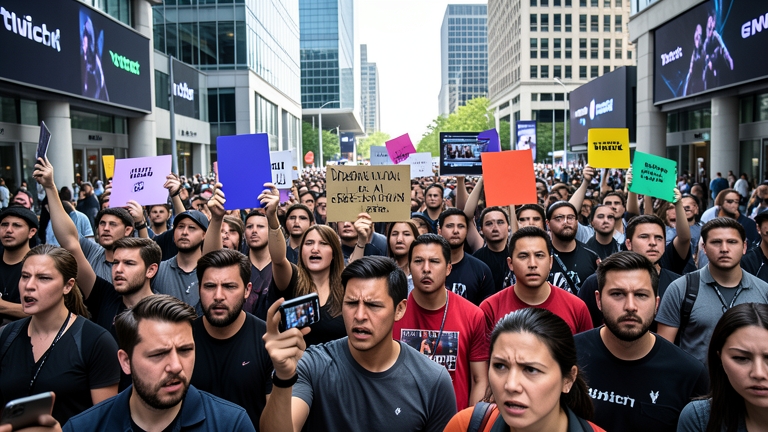
Twitch has ignited a firestorm of criticism across the gaming and streaming communities after quietly rolling out a new policy that automatically opts every streamer into generative AI training, allowing the platform and its parent company Amazon to use channel content including live streams, video-on-demand archives, clips, highlights, and even real-time viewer chat interactions to train artificial intelligence models. The feature is enabled by default, meaning that unless a streamer manually navigates into their settings and toggles the option off, every piece of content they have ever created on the platform is now considered fair game for AI development. The backlash has been swift, intense, and remarkably unified, with creators, viewers, and industry commentators all raising alarms about consent, transparency, and the increasingly brazen approach that major tech platforms are taking toward user-generated content.
At the heart of the controversy lies a policy that many streamers feel was implemented with deliberate opacity. Twitch’s official documentation now states plainly that “your stream and the stream’s chat, your VODs, your Clips, Highlights, and any text or images on your Channel may be used” for generative AI training. The phrasing leaves little room for interpretation: everything a streamer produces on the platform is potentially being fed into Amazon’s AI pipelines. The policy covers not only future content but also existing archives, meaning years of creative work, personal moments, and community interactions are now part of the training data pool unless a streamer takes active steps to prevent it.
The decision to make this an opt-out rather than opt-in feature has drawn the sharpest criticism. In a candid moment during a recent stream, Twitch chief product officer Mike Minton offered a remarkably blunt explanation for the choice. “There’s an honest answer, one I think most of you could probably appreciate: if it was opt-in, nobody would opt in. That’s honestly the answer,” Minton said. He acknowledged the community’s distress, adding, “I know that this is not a fan favorite, I know that this is upsetting to the community, but this is where we are.” He further elaborated, “There’s an honest answer, one I think most of you could probably appreciate: if it was opt-in, nobody would opt in. That’s honestly the answer. It’s going to be on by default and almost every content service is on by default, I think the thing we’re doing here that is unique and different is respecting your wishes to opt out of model training.”
Minton’s admission, while refreshing in its honesty, has only deepened the sense of betrayal among streamers. By essentially confirming that the company chose an opt-out model specifically because an opt-in approach would result in mass refusal, Twitch has laid bare the fundamental tension between its business interests in AI training and the preferences of its user base. The statement has been widely circulated and condemned across social media platforms, with many pointing out that the logic itself acknowledges the policy is unpopular and would not survive a truly consensual implementation.
What Exactly Is Twitch Allowing Amazon to Train On?
Generative AI training requires vast amounts of data, and Twitch is positioned on a goldmine of exactly the kind of material that AI developers covet. The platform’s live streams contain natural, unscripted human conversation, real-time emotional reactions, gameplay commentary, creative processes, and social interactions that are extremely difficult to replicate in controlled training environments. By tapping into this stream of data, Amazon gains access to a rich and continuously updated corpus of human behavior, language use, and social dynamics that can be used to train everything from conversational AI agents to content generation tools that mimic human creativity.

The scope of what Twitch considers usable is exceptionally broad. It includes not only the video and audio content of streams themselves but also the text-based chat that accompanies them. This means that even viewers who never go live or create content are affected. Every message sent in a Twitch chat, every emote used, every conversation had in a streamer’s channel is potentially being ingested into training models. The policy does not distinguish between public figures with large followings and casual viewers who simply enjoy participating in community discussions. For the average Twitch user, the realization that their everyday conversations are being used to train commercial AI systems without their explicit consent has been deeply unsettling.
Twitch’s help section provides additional clarification that has only added to the confusion and frustration. The company notes that the opt-out setting is not universal at the user level. In practical terms, this means that even if you personally opt out of AI training for your own channel, your chat messages are still subject to the settings of whatever channel you are participating in. Twitch’s help documentation states plainly: “If you chat on someone else’s stream, their opt-out preferences govern if that chat can be used for training.” This creates a situation where a viewer who has conscientiously opted out can still have their words used for AI training simply by joining a stream whose creator has not taken the same step. The lack of individual agency over one’s own data has been a particular flashpoint in the backlash.
The Opt-Out Process: How Streamers Can Protect Their Content
For streamers who wish to prevent their content from being used in AI training, the process requires navigating into Twitch’s settings and locating the specific toggle related to generative AI data usage. The setting is buried within the platform’s privacy or data-sharing menus, and its existence has not been prominently communicated to users. Many streamers have reported being unaware of the policy change entirely until they saw posts about the backlash on social media or received messages from concerned community members. The lack of a direct notification from Twitch about such a significant change to how user content is utilized has been cited as further evidence of the company’s desire to minimize pushback by keeping the policy low-profile.
It is important to understand that opting out is not retroactive in any meaningful sense. While toggling the setting off should prevent future content from being used for training, there is no clear mechanism for removing data that has already been ingested into Amazon’s models. Once content has been used to train a generative AI system, it becomes part of the model’s underlying weights and parameters, and extracting it is technically infeasible. This means that even streamers who act quickly to opt out may have already contributed data that will remain embedded in AI systems indefinitely. The irreversible nature of AI training makes the timing of the announcement particularly consequential, as many streamers discovered the policy only after it had already been active for some period.
For viewers and community members who are not streamers themselves, the situation is even more precarious. There is no standalone viewer-level opt-out mechanism for chat data. The only way a viewer can ensure that their chat messages are not used for AI training is to only participate in channels where the streamer has opted out. This places the burden of data protection not on the individual user but on the content creators they choose to support, a dynamic that many find unreasonable and exploitative. The practical reality is that the vast majority of streamers are either unaware of the policy or have not yet taken steps to opt out, meaning that most Twitch chat activity is likely being used for training by default.
Why This Policy Represents a Major Breach of Trust
The backlash against Twitch’s generative AI training policy must be understood within the broader context of the platform’s relationship with its creator community. Twitch has a long and well-documented history of implementing controversial policies that appear to prioritize corporate interests over the well-being of streamers. From the contentious handling of exclusivity contracts and the problematic rollout of the Partner Plus program to the ongoing disputes over ad revenue sharing and the platform’s inconsistent moderation policies, many streamers have grown increasingly wary of Twitch’s decision-making. The AI training policy is seen by many as the latest and most egregious example of a pattern in which the platform makes unilateral changes that benefit Amazon while disregarding the wishes of the people who create the content that makes Twitch valuable in the first place.
The timing of the policy’s implementation has also been criticized as opportunistic. The generative AI boom is at its peak, with companies across the technology sector racing to secure training data for increasingly powerful models. By quietly enabling data collection by default, Twitch positions itself to provide Amazon with a steady stream of high-quality, naturalistic training material without having to negotiate consent or offer compensation. The optics of this arrangement are poor: a massive corporation extracting value from the creative and social labor of millions of users without asking permission and without sharing any of the proceeds from the AI systems that their data helps to build.
Minton’s framing of the policy as being “unique and different” because Twitch “respects your wishes to opt out of model training” has been met with widespread skepticism. Critics argue that offering an opt-out mechanism does not constitute respect for user autonomy, particularly when the default setting is participation and when the existence of the opt-out option is not proactively communicated. True respect for user preferences would mean implementing an opt-in model that requires affirmative consent before data can be used for AI training, or at the very least providing clear, prominent notification to all users about the policy change and giving them a reasonable window to adjust their settings before data collection begins.
The Broader Industry Pattern: Default Data Collection for AI Training
Twitch is far from alone in pursuing this approach to AI training data. As Minton himself noted, “almost every content service is on by default” when it comes to using user data for various purposes. Social media platforms, video sharing sites, and online communities have long relied on default opt-in models for data collection, arguing that this approach maximizes the utility of their services and enables features that benefit users. However, the application of this logic to generative AI training represents a qualitative shift. Unlike targeted advertising or content recommendation algorithms, which use data to improve the user’s own experience on the platform, generative AI training uses user data to create products that may compete with the creators who provided the data in the first place.
The creative industries are already grappling with the implications of generative AI models that can produce text, images, music, and video that rival human-created content. Streamers who build their livelihoods on Twitch are understandably concerned that their streams, voices, and creative styles could be used to train AI systems that eventually displace human creators or devalue the originality of live content. The existential threat that generative AI poses to creative professions makes the question of data consent not merely a matter of privacy but one of economic survival. When Twitch feeds streamer content into Amazon’s AI training pipelines, it is potentially arming a technology that could one day reduce the platform’s dependence on human creators altogether.

Several other major platforms have faced similar backlash over their AI training policies. Reddit entered into a substantial licensing agreement with Google to allow its content to be used for AI training, a deal that angered many moderators and users who felt their contributions were being sold without their consent. Stack Overflow implemented a policy banning AI-generated answers while simultaneously exploring ways to use its vast repository of human-written coding solutions to train AI models. DeviantArt launched its own AI art generator that was trained on artwork uploaded by its users, sparking a massive revolt among the artist community. The pattern is consistent: platforms that host user-generated content see AI training as a lucrative new revenue stream, while the users who create that content see their work being appropriated without fair compensation or meaningful consent.
What sets Twitch’s situation apart is the real-time, interactive nature of the content being collected. Live streaming is inherently personal and ephemeral. Streamers often share intimate thoughts, personal struggles, and unfiltered reactions with their communities, operating under the implicit understanding that while their streams are public, there is a certain level of context and trust governing how that content is consumed. The use of such content for AI training feels like a violation of that trust, a transformation of genuine human connection into raw material for corporate AI development. The fact that live chat is included only compounds this sense of betrayal, as viewers who believed they were participating in community conversations discover that their words are being harvested for purposes they never agreed to.
The Practical Consequences for Streamers and Viewers
For streamers, the immediate practical consequence of this policy is the loss of control over their own creative output. Digital content that was created with the expectation of being seen by human audiences is now being fed into machine learning systems that can analyze, replicate, and repurpose it in ways that the original creator cannot predict or prevent. A streamer’s unique style of commentary, their in-jokes with their community, their distinctive approach to gameplay or creative work — all of these become training material for AI systems that may eventually be able to mimic them with uncanny accuracy. The devaluation of human creativity that this entails is difficult to overstate, and it strikes at the very heart of what makes live streaming a compelling and authentic medium.
The policy also creates a practical dilemma for streamers who want to respect their viewers’ privacy. A streamer who opts out of AI training can reasonably assure their audience that the content created on their channel is not being used for model training. However, as the policy currently stands, even an opted-out streamer cannot guarantee that their viewers’ chat messages are protected when those viewers venture into other channels. This creates a fragmented and confusing privacy landscape in which individual users have no reliable way to control how their data is used across the platform. For streamers who take their responsibility to their community seriously, this lack of viewer-level protection is deeply troubling.
For viewers, the policy introduces a new dimension of risk to what was previously a low-stakes recreational activity. Participating in a Twitch chat has traditionally been seen as a casual, ephemeral form of social interaction. Messages scroll by and are quickly forgotten, preserved only in the chat logs that streamers themselves may choose to review. The revelation that every message sent in a popular streamer’s channel could be used to train AI systems changes the calculus entirely. Viewers who value their privacy must now consider whether they are comfortable having their casual conversations, opinions, and interactions preserved in the training data of commercial AI models. The chilling effect on community participation could be significant, as users become more guarded in their interactions or simply choose to stop chatting altogether.
What Streamers Can Do Right Now
Streamers who wish to remove their content from Twitch’s AI training pipeline should take immediate action. The opt-out setting is located within the platform’s privacy or data and privacy settings, generally under a section related to data sharing or AI training. The exact location of the toggle may vary depending on the Twitch interface version and region, but it is typically found in the same area where other data-use preferences are managed. Streamers should verify that the setting has been successfully saved and should periodically check that it remains in place, as platform updates or account changes could potentially reset such preferences.
Beyond individual action, there is growing momentum within the streaming community for collective responses to the policy. Several prominent streamers have publicly announced that they are opting out and have encouraged their followers to do the same. Community-driven campaigns to raise awareness about the policy and to pressure Twitch to change its approach are gaining traction on social media platforms. Some streamers are considering more drastic measures, such as withholding certain types of content from their streams or moving to competing platforms that offer stronger privacy protections. The effectiveness of these collective actions remains to be seen, but the intensity of the backlash suggests that Twitch cannot simply wait for the controversy to blow over.
It is also worth noting that the regulatory landscape around AI training data is evolving rapidly. Governments in several jurisdictions are considering legislation that would require explicit consent before user data can be used for AI training, and some existing privacy frameworks may already apply to Twitch’s practices in certain regions. Streamers and viewers in the European Union, for example, may have additional protections under the General Data Protection Regulation (GDPR), which requires a lawful basis for data processing and grants users certain rights over how their data is used. The extent to which Twitch’s opt-out model complies with various international privacy laws is likely to be tested in the coming months, and legal challenges could force the company to reconsider its approach.
The Strategic Calculus Behind Twitch’s Decision
From a purely business perspective, Twitch’s decision to enable AI training by default makes a certain kind of sense. Amazon is investing heavily in artificial intelligence across its entire ecosystem, from cloud computing services through AWS to consumer products like Alexa and the AI-powered features being integrated into its e-commerce and entertainment platforms. Twitch’s vast repository of natural, conversational, and creative content is an enormously valuable resource for training AI systems that can understand human behavior, generate text and media, and interact with users in natural ways. By tapping into this data stream without having to negotiate individual consent or offer compensation, Amazon gains a competitive advantage in the AI arms race at minimal cost.
The decision also reflects a broader strategic shift in how technology companies view user-generated content. In the early days of social media and user-content platforms, the value of user contributions was primarily realized through advertising and engagement metrics. Today, the value of user data extends far beyond advertising into the realm of AI training, where it becomes the raw material for building systems that could reshape entire industries. Platforms that host large amounts of user-generated content are sitting on assets that have become exponentially more valuable with the rise of generative AI, and they are increasingly eager to monetize those assets. Twitch’s policy change is part of a larger trend in which platforms are quietly updating their terms of service and data-use policies to allow for AI training, often with minimal communication to users.
However, the strategic calculus may be miscalculated if the backlash proves severe enough to drive creators and viewers away from the platform. Twitch’s value is entirely dependent on the active participation of its streamer community. If creators feel that their trust has been betrayed and that their content is being exploited without their consent, they may reduce their streaming activity, move to competing platforms, or encourage their audiences to follow them elsewhere. The rise of platforms like Kick, YouTube Gaming, and even newcomer services that specifically market themselves as creator-friendly alternatives means that streamers have more options than ever before. A significant exodus of top talent could inflict far more long-term damage on Twitch than any short-term gain from AI training data is worth.
The challenge for Twitch and Amazon is navigating the tension between their AI ambitions and the need to maintain the trust and goodwill of the community that makes the platform viable. Minton’s candid admission that the opt-out model was chosen specifically because an opt-in approach would fail suggests that Twitch’s leadership understands the depth of user resistance to AI training. The question is whether the company believes it can weather the backlash and maintain its dominant position in the live streaming market, or whether it will be forced to backtrack and adopt a more consent-based approach. The coming weeks and months will be critical in determining which path Twitch ultimately takes.
What the Future Holds for Twitch, Streamers, and AI Training
The controversy over Twitch’s generative AI training policy is unlikely to be resolved quickly or cleanly. The underlying tensions between platform owners, content creators, and AI developers are structural and systemic, and they will only intensify as generative AI technology continues to advance. Twitch’s policy serves as a cautionary tale for other platforms considering similar moves, illustrating how quickly user trust can be eroded when data-use policies are changed without meaningful consultation or transparent communication. The backlash also demonstrates that the streaming community is increasingly sophisticated about the implications of AI training and is willing to organize and advocate for its interests when those interests are threatened.
For streamers, the episode underscores the importance of understanding the terms of service and privacy settings of the platforms they use. The days when a streamer could simply focus on creating content and trust that the platform would act in their best interests are over. As platforms seek to extract increasing value from the content they host, creators must become more vigilant about protecting their work and their communities. The decision to opt out of AI training is a small but meaningful step, but it is ultimately a defensive measure. The broader fight over the use of creative content for AI training will be waged in courtrooms, legislatures, and the court of public opinion, and its outcome will shape the creative economy for years to come.
What remains to be seen is whether Twitch will respond to the backlash with meaningful policy changes or whether it will hold its ground and hope that the controversy subsides. The company has shown a willingness to backtrack on unpopular policies in the past, but the financial and strategic incentives behind AI training are powerful. Amazon’s commitment to becoming a leader in generative AI is clear, and Twitch’s data is a valuable input to that goal. The outcome of this conflict may ultimately depend on the staying power of the backlash and the ability of the streaming community to translate its anger into sustained pressure on the platform. For now, every streamer and every viewer must make their own decision about whether they are comfortable contributing to Amazon’s AI ambitions — and whether Twitch has earned the right to make that decision for them.





/i.s3.glbimg.com/v1/AUTH_08fbf48bc0524877943fe86e43087e7a/internal_photos/bs/2026/Y/y/eloBAuRYqsg3YH6XQqQQ/imagem-2026-09-10-200407901.png "WARDOGS Early Access: Why “Just Wait for Full Release”")